General Election 2026: Little Chance to Return to the “Neo-1955” Status Quo
Politics- English
- 日本語
- 简体字
- 繁體字
- Français
- Español
- العربية
- Русский
A Return to Calm Before Another Storm?
The relative stability of Japanese politics over a period of about a dozen years from the launch of Prime Minister Abe Shinzō’s second administration in 2012—which I have termed the “neo-1955 setup,” defined by a dominance of the Liberal Democratic Party similar to that seen for decades following that year—has been unraveling since the 2024 general election. The country entered a period of political recalibration that has continued through 2025. The arrival of the highly popular Takaichi Sanae administration appeared to restore some calm, but this has been upended by a series of political surprises that have carried into 2026.
The recent turbulence has exposed just how unreliable short-term political forecasts and “insider” commentary can be. Few, if any, major media outlets predicted the LDP’s crushing defeats in the October 2024 House of Representatives and July 2025 House of Councillors elections, the meteoric rise of newcomers like the Democratic Party for the People (DPFP) and Sanseitō, Takaichi’s victory in the LDP leadership race, Kōmeitō’s withdrawal from the ruling coalition, Takaichi’s sudden call of a snap election earlier this year, or the unexpected decision by the Constitutional Democratic Party and Kōmeitō to merge into a new party. Adding to the confusion were misleading media reports concerning then Prime Minister Ishiba Shigeru’s resignation following the LDP’s setback in the 2025 upper house vote.
As a political scientist, part of my work involves commenting on these developments in daily newspapers and providing analysis for monthly opinion magazines. Yet because I rely on the same reporting that often proves unreliable, I frequently find myself scrambling to reconcile my arguments with rapidly shifting realities. I have only myself to blame, of course, since from the perspective of the general public, I am part of the problem—unintentionally spreading flawed commentary and projections based on a misreading of the prevailing political mood.
Ultimately, I—or anyone else trying to analyze politics in real time—must humbly acknowledge an obvious truth: It is extremely difficult to grasp people’s inner motives or predict their short‑term behavior. The unpredictability of political developments is a natural, even healthy, phenomenon in a society where voters are free to express their will.
That said, my work requires me to continue commenting on politics as it unfolds in columns like this. As a political scientist, though, my focus is on taking a longer-term view, examining the structural features of Japanese politics and analyzing ongoing developments against that backdrop, rather than following every twist and turn like a journalist.
Little Chance of a Return to the Stability of Old
One important point to keep in mind is the need to have a firm understanding of the “rules of the game”—the institutional features that give shape to Japanese politics.
For example, Japan’s House of Councillors wields unusually strong powers compared with counterparts in other countries, being able, in principle, to block government-backed legislation. Because the ruling coalition currently lacks a majority there, it must cooperate with at least some opposition parties to pass any bill. And since the upper house cannot be dissolved by the prime minister, and only half its seats are contested every three years, the earliest the LDP could recover its 2025 losses and regain a majority is 2031—six years away.
As such, the kind of centralized authority enjoyed by Prime Minister Abe Shinzō during his second term is clearly not possible in the foreseeable future, regardless of the outcome of the February 8 general election. Even if Takaichi’s LDP were to secure a single-party majority with a decisive victory, the government would still need to reach out to other parties like Nippon Ishin no Kai and the DPFP to get legislation enacted.
Obviously, if the LDP were to suffer a loss in the upcoming election, the difficulties would only mount. Prime Minister Takaichi may hope to restore the neo-1955 setup solidified by Abe, whom she admires as an ideal leader, but such aspirations are unlikely to be realized any time soon.
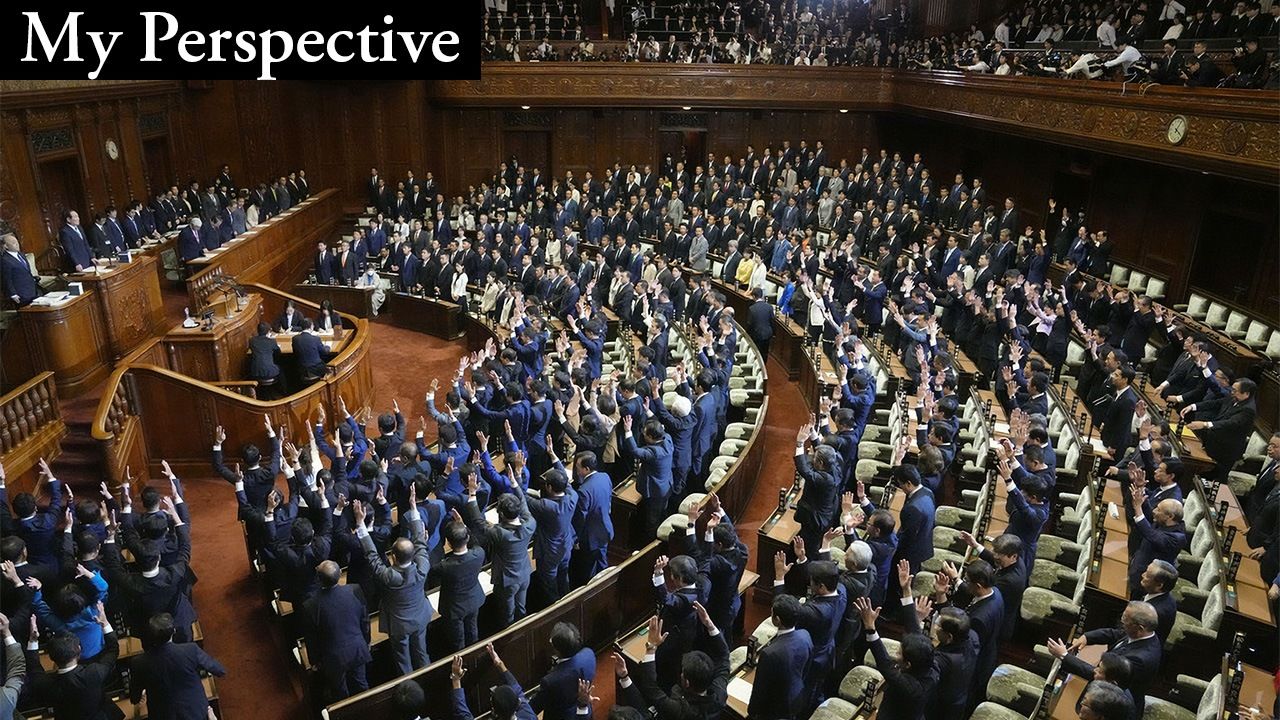
(Originally published in Japanese on January 20, 2026. Banner photo: Lawmakers shout “Banzai!” after the dissolution of the House of Representatives, October 2024. © Kyōdō.)