Did Takaichi’s Landslide Finally Bring Japan’s Postwar Era to an End?
Politics- English
- 日本語
- 简体字
- 繁體字
- Français
- Español
- العربية
- Русский
The general election held on February 8 ended in a historic landslide for the Liberal Democratic Party led by Prime Minister Takaichi Sanae. Among the opposition, Team Mirai—formed just last year—made surprising gains, but most others were swept aside by the Takaichi wave. Even parties that had surged in the 2024 lower house and 2025 upper house elections—notably the Democratic Party for the People and Sanseitō—fell far short of their own expectations.
Still, these parties at least weathered the storm. The real casualties were those in the liberal or progressive camp. The Japanese Communist Party saw its 8 lower house seats halved to 4, Reiwa Shinsengumi collapsed from 8 seats to just 1, and the Social Democratic Party once again ended with zero. The Centrist Reform Alliance—hastily assembled by the Constitutional Democratic Party and Kōmeitō on the eve of the election—also suffered a crushing blow. Of the 144 CDP incumbents, only 21 survived—and 6 of those won only because the LDP ran short of proportional‑representation candidates, allowing opposition candidates with fewer votes to take the seats.
In short, progressive groups rooted in constitutional pacifism—long a formidable postwar force—have shrunk to unprecedented lows.
The Familiar Refrain of the “End of the Postwar Era”
Not surprisingly, commentators have rushed to declare that the postwar era has now finally ended. Nippon Ishin no Kai upper house member Inose Naoki wrote on the content publishing platform Note.com in February that Japan had at long last freed itself from the “spell” of the postwar mindset, while the political scientist Yamaguchi Jirō argued in a February Mainichi Shimbun interview that the foundations of postwar politics had truly collapsed.
For decades, the key ideological divide between conservative and progressive forces in Japanese politics revolved around constitutional and defense issues. Now that one side of that divide has been effectively wiped out, these commentators argue, the political playing field has fundamentally changed.
But this is hardly the first time that the “end of the postwar era” has been proclaimed in Japan. In fact, such announcements have surfaced at nearly every major historical turning point since the 1950s.
One early example was the line appearing in the 1956 economic white paper, which famously declared mohaya sengo de wa nai (Japan is no longer in the postwar period)—an iconic catchphrase signaling the end of the recovery and reconstruction phase. This may have been true in economic terms, but politically, the postwar framework had just been consolidated the previous year with the formation of the Liberal Democratic Party and the reunification of the Japan Socialist Party. This gave birth to the so‑called 1955 system, under which the LDP committed to revising the US-drafted Constitution and rearming Japan, while the JSP sought to maintain the war-renouncing Constitution and a policy of non-armament. This setup remained the political default during the ensuing decades of robust economic growth.
In the 1980s, Prime Minister Nakasone Yasuhiro sought to bring this prolonged era to a close through a “total settlement of postwar politics.” He advanced administrative reforms, notably by pushing through the breakup and privatization of the Japanese National Railways. This dealt a major blow to the labor unions that had long supported the Socialists. Nakasone later recalled in a Mainichi Shimbun interview published on November 20, 2005, that this move greatly changed the political landscape, helping unravel one of the two pillars of the 1955 system.
The 1990s brought the end of the Cold War and the demise of the Socialists as a national force, culminating in their heading a coalition government with the LDP under Prime Minister Murayama Tomiichi in 1994–96. With the seeming dissolution of the ideological divide between conservatives and progressives, parties competed not over the fate of the pacifist Constitution or defense policy but rather over how best to reform Japan’s outdated political-economic system. The main opposition Democratic Party of Japan chose not to foreground constitutional pacifism but rather to highlight its governing competence, and succeeded in taking the reins of government in 2009. This, in the wake of the March 2011 Tōhoku earthquake, prompted noted political scientist Mikuriya Takashi to herald the “end of the postwar era and the start of the postdisaster era.”
“Postwar politics” refused to go away, however. Abe Shinzō (previously prime minister in 2006–7) returned to power in 2012, following the demise of the DPJ government, and made constitutional revision and the right to collective self‑defense the central issues of his administration under the banner of “breaking away from the postwar regime,” thereby reviving the old ideological divide. This prompted the DPJ (and its various subsequent iterations, including the Democratic Party and the Constitutional Democratic Party of Japan)—alongside the Japanese Communist Party—to drift toward a style of constitutional pacifism reminiscent of the former Socialists. Japanese politics thus slid back into what I have termed the “neo‑1955 setup.”
Is It Different This Time?
So does the near‑eradication of progressive forces in the recent House of Representatives election mean that the postwar era has finally and irreversibly come to an end? I am skeptical. As long as Article 9 continues to anchor the legitimacy of constitutional pacifism—and as long as this stance is supported by a meaningful portion of the public—progressive parties are likely to reemerge sooner or later. Japan’s political history offers ample precedent for such revivals.
Put differently, the “irreversible end to the postwar era” will likely only come when the question of revising Article 9 is settled in some definitive way. Prime Minister Takaichi, emboldened by the ruling coalition’s sweeping victory, is already taking concrete steps toward initiating a constitutional amendment—her long‑held ambition. She has also declared her readiness to pursue policies that may “divide national opinion.”
In short, while the recent election does not by itself mark the end of the postwar era, it may well prove to be the beginning of the end. Whether we welcome it or not, we need to recognize that Japan now stands at such a crossroads.
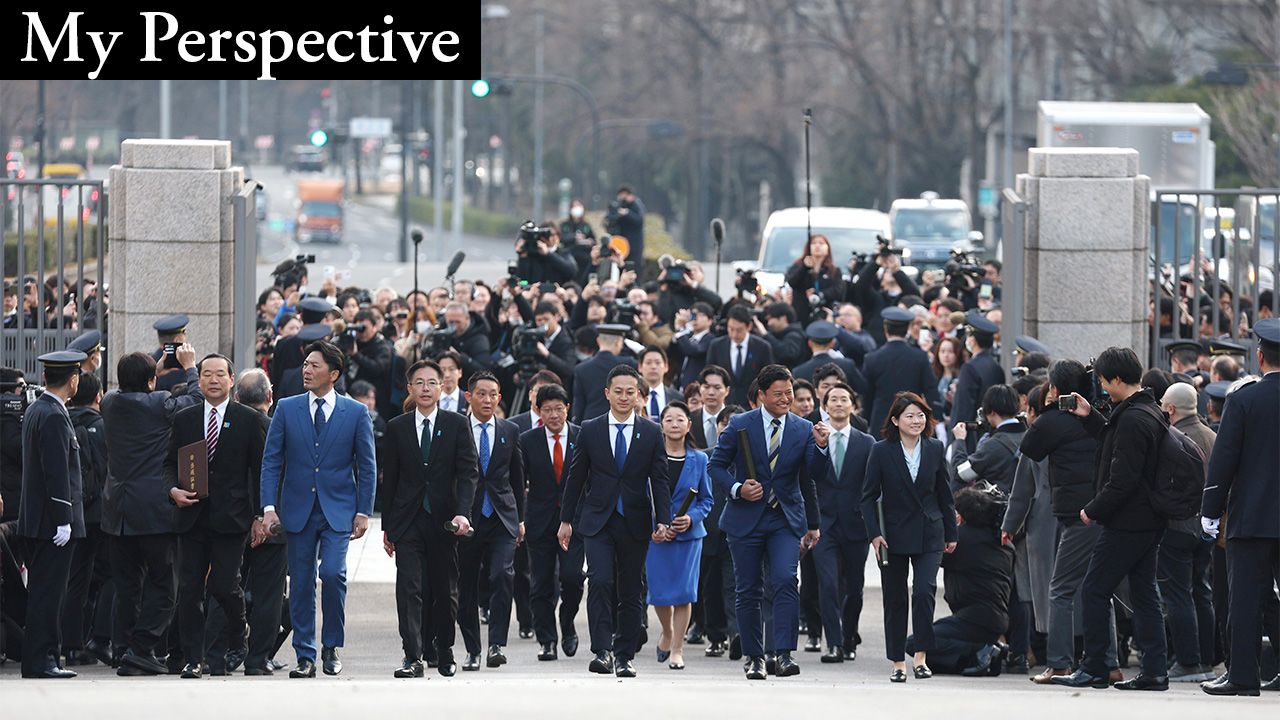
(Originally published in Japanese on March 3, 2026. Banner photo: First-term lawmakers enter the National Diet on February 18, 2026, for the first time after their February 8 election. © Jiji.)