
Japan’s Shifting Junior High School Entrance Exam Scene
Society Education Family- English
- 日本語
- 简体字
- 繁體字
- Français
- Español
- العربية
- Русский
Applicant Numbers Level Off at Last
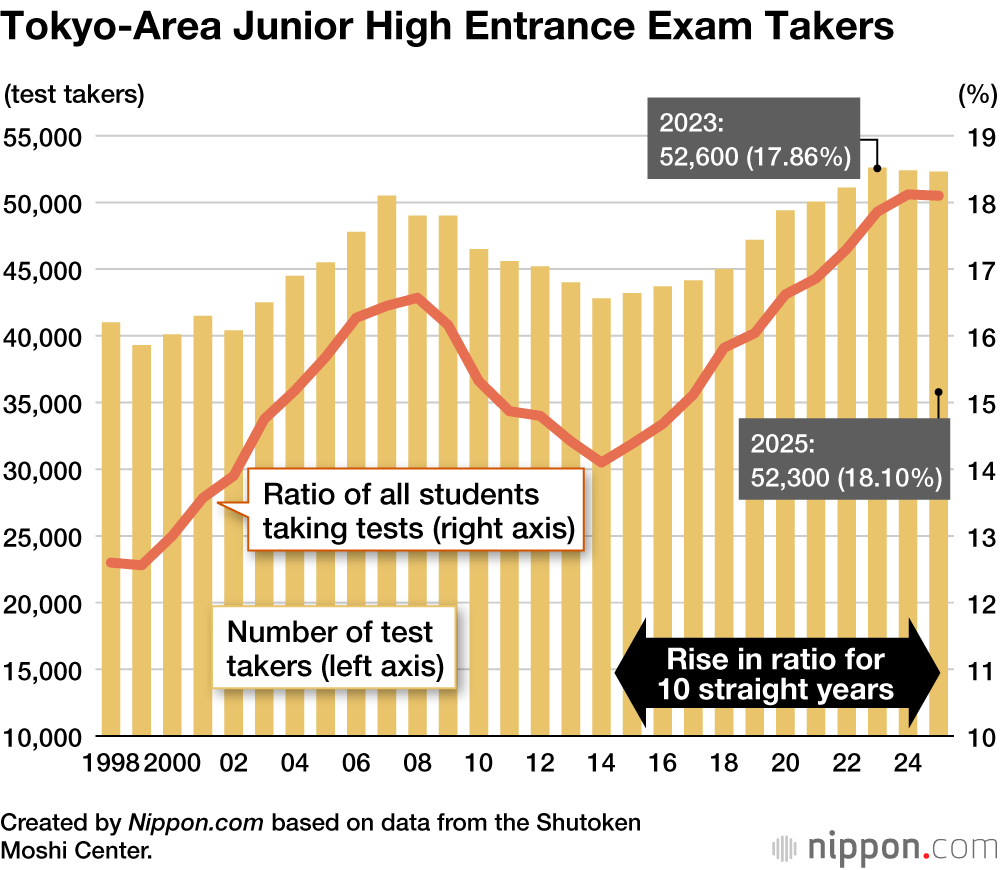
The Shutoken Moshi Center, an organization providing mock junior high school entrance examinations in Tokyo and surrounding areas, released data showing that some 52,300 sixth graders took tests to enter private or national junior high schools in the Tokyo area in 2025. This figure was down by 100 students from 2024, keeping the percentage of elementary school graduates aiming to test into more exclusive programs rather than attending local public schools at 18.1% of all students, down just 0.02 percentage points year on year.
This figure had climbed for a decade straight, driven in part by parents’ concerns about preparing their children for changes in the university-level entrance exam system and by improving economic conditions allowing more families to consider pricier private schooling. Beginning last year, though, the percentage appears to be leveling off. Potential reasons include falling childbirth rates and rising education costs. The junior high school entrance examination field is seeing its prospects for further growth drain away.
A Subscription Plan Sparks Interest
Even as capital-region interest in the entrance examination grind appeared to level off in 2024 and 2025, one entity attracting considerable attention from prospective students and their families was the Kaichi Gakuen Group. Headquartered in the city of Saitama, this group operates popular unified schools combining junior and senior high programs and covering grades 7–12, with three in Saitama Prefecture, one in Tokyo, and one in Ibaraki Prefecture. With the launch of its newest school in spring 2024 in Tokorozawa, Saitama, Kaichi also expanded its “entrance exam subscription” program, which allows prospective students to take admission tests as many times as they want, for all schools in the Kaichi system.
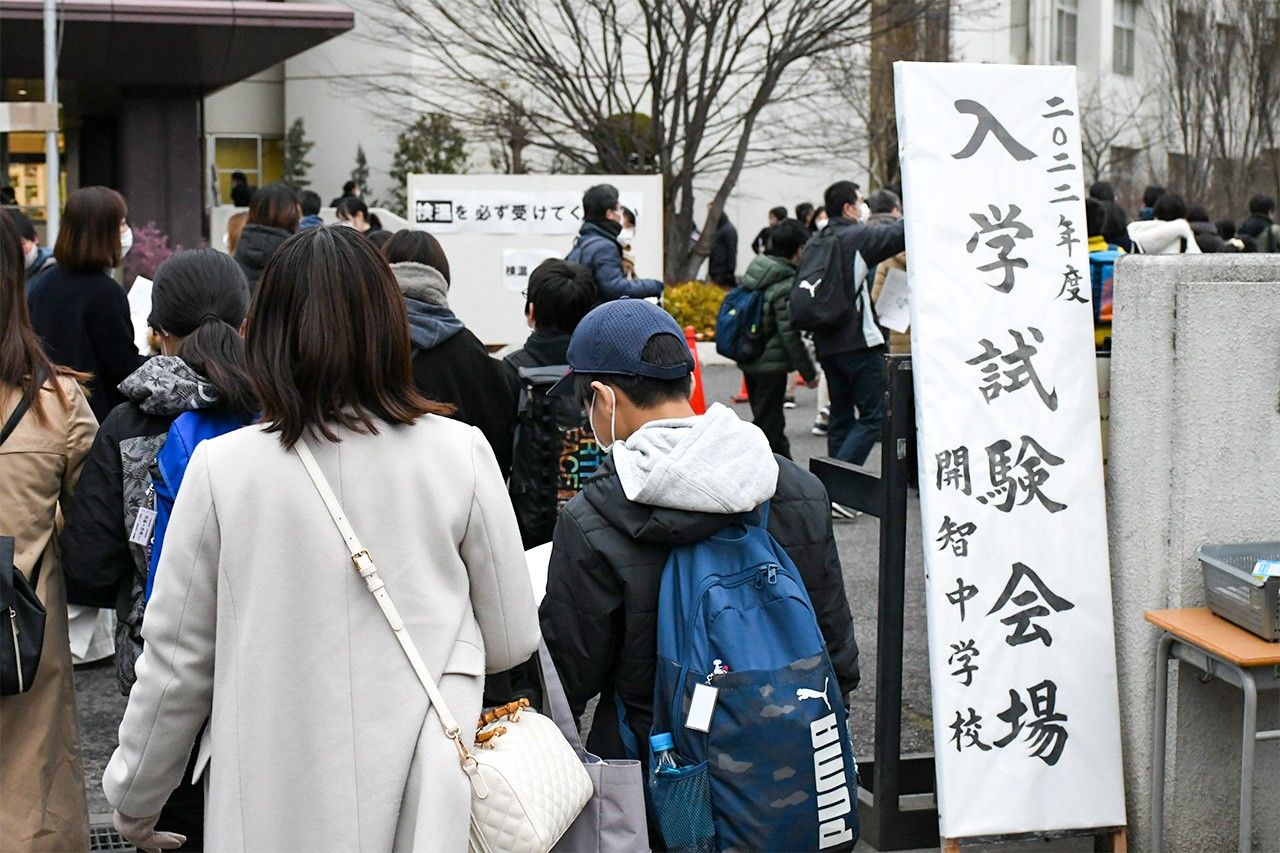
Students taking the junior high entrance examination on January 10, 2022, enter the Kaichi campus in the city of Saitama with their parents. (© Saitama Shimbun)
The majority of private junior high schools offer their entrance examinations on multiple days, and sometimes several times per day. Traditionally, students taking the test more than once (a common practice among applicants hoping for a better score the second time around) would have to pay the exam fee each time. Under the new Kaichi system, though, test-takers are able to sit the test up to 11 times for the three Saitama campuses and the Tokyo school, all for a single application payment of ¥20,000.
The organization takes it a step further by using the same exam for the schools in the cities of Tokorozawa and Saitama, thus allowing students who achieve a successful mark in a single test at either campus to secure admission to the school of their choice.
Saitama Prefecture is known for launching the test process around three weeks earlier than other locations in the Tokyo area, beginning on January 10 rather than the start of February. This has created significant demand among test-taking sixth graders throughout the region, who take advantage of this timing to try to line up admission to at least one school, or to gain some valuable test-taking experience, before going on to aim for their main targets. The Kaichi Gakuen Group saw slots for its tests in January 2025 fill up rapidly, reaching capacity and forcing the school to cease accepting applications in some test venues.
With the exception of some perennially popular schools, many institutions in the Tokyo area are seeking ways to attract more and more applicants, such as by offering bonus points on examinations taken the second time onward, doing away with requirements for photos or elementary school transcripts, and even accepting last-minute applications in person on the morning of the entrance exams.
There are also some schools implementing unique approaches to the test process. Generally speaking, junior high school entrance exams come in two parts, testing Japanese language and mathematics, or in four parts, adding science and social studies to those. But today some schools are adding new components to their tests, like English-language presentations, or reworking the examinations to enhance their focus on science, allowing applicants to sit a single test in mathematics alone, or adopting inquiry-based or aptitude testing instead.
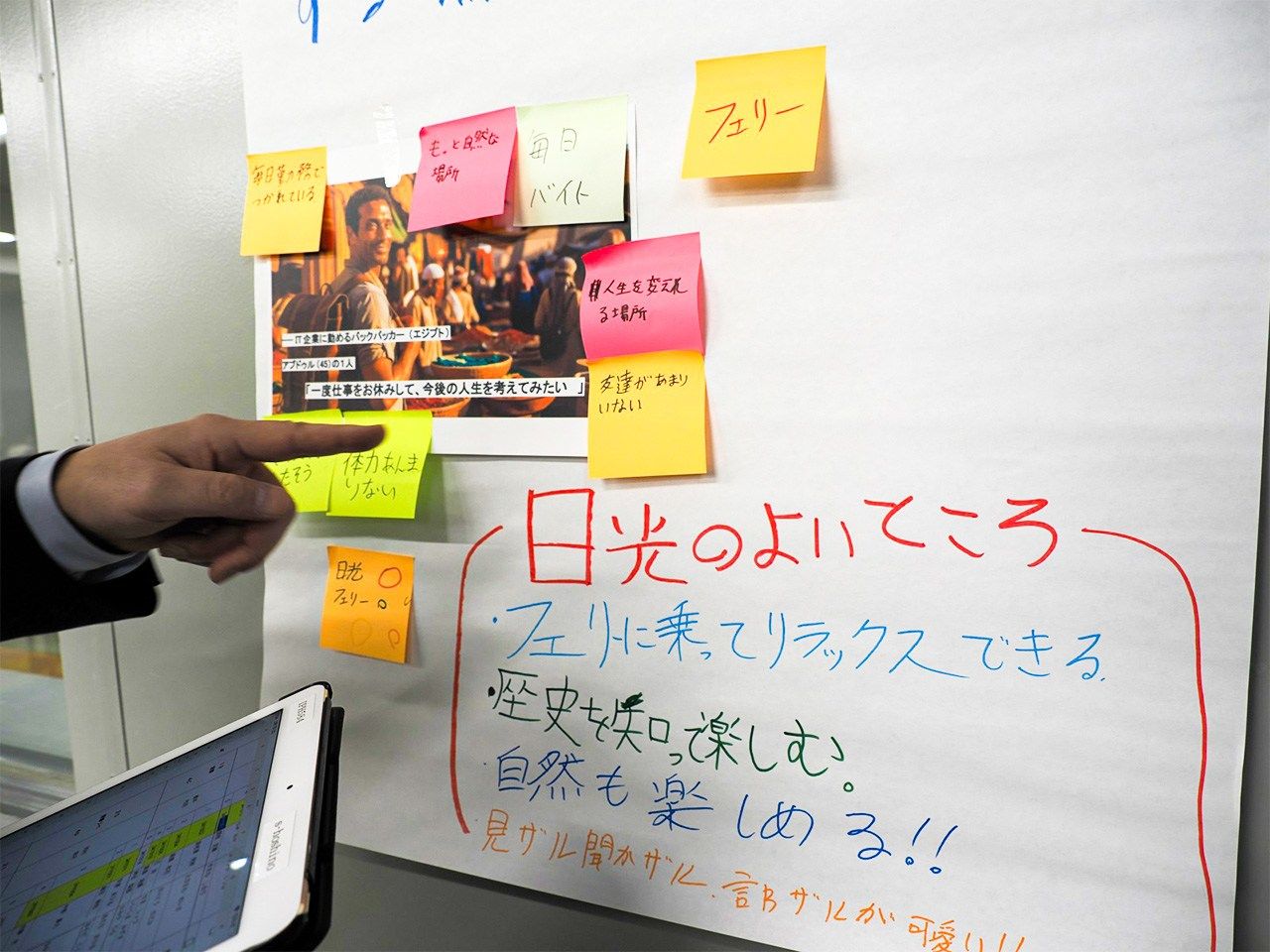
Hōsen Gakuen in Nakano, Tokyo, has diversified its testing approach, including group work among applicants placed together to investigate a topic and make a report on it. (Courtesy of the Shutoken Moshi Center)
University Tie-Ups on the Rise
Schools directly affiliated with universities have long been popular choices in the Tokyo area, due to the easier path they offer for continued studies after graduation from high school. Students and their families continue to select junior high targets with an eye on prospects for university admission six years later, a factor driving a growing number of these schools to bolster their relationships with universities, or even fully affiliating themselves with certain institutions of higher learning.
One school attracting particular attention during the 2025 entrance exam season was Nihon Gakuen, a combined junior/senior high school in Setagaya, Tokyo. Last year it announced it would make the shift from a boys’ school to a coeducational institution and become an affiliate to Meiji University. Starting with the high school graduating class of 2029, the renamed Meiji University Setagaya Junior and Senior High School will secure guaranteed admission slots at the university for 70% of its seniors. The number of applicants to the school shot up sharply at this news, climbing 36% from the previous year.
The trend among six-year schools in Tokyo to forge stronger partnerships with universities is picking up momentum. St. Hilda’s School, a Christian girls’ institution in Shinagawa, has guaranteed admission at Rikkyō University for 100% of its graduating seniors from 2025 on, while Chiyoda’s Miwada Gakuen has secured 30 admission slots each year at Hōsei University. And Nakano’s Hōsen Gakuen has reached an agreement with the Faculty of Medicine at Juntendō University, one of Japan’s more prestigious programs for medical students, to reserve a number of slots for its graduates hoping to become physicians.
These enhanced ties between junior/senior high programs and universities are driven in part by their desire to continue to thrive in an age of fewer students. Kita Kazunari, head of the Shutoken Moshi Center, notes: “Securing guaranteed admission to well-known universities for their graduates is a vital tool for schools looking to boost their popularity. And for universities, too, it’s a way to line up a pool of talented students at an early stage, something important for them in this era of lower birthrates. It’s a win-win relationship benefiting both sides, and we expect to see the trend continue to expand.”
The benefits are also clear to many parents, who see a clearer path for their children heading toward graduation from elementary school all the way through university, as well as the opportunity for the young students to spend less time focusing on the next steps in the entrance exam race.
There are also many cases where combined schools and universities reach agreements not going quite so far as affiliation. For instance, some universities may offer sample college-level lectures allowing the younger students to experience the learning that goes on at higher levels. This also allows the junior/senior highs to keep their students focused on the university entrance process they will eventually face, in addition to potentially securing admission slots for their graduates.
Looking to the Sciences, Looking Abroad
Some schools are seeking to tailor their educational experiences in other ways, such as by focusing on a more global approach to learning or on STEM subjects in their curricula. These moves, too, are being crafted with a view to preparing “exit strategies” for their students when they move on to the next stage.
Many private six-year programs have long emphasized English as a key subject in their learning plans. Now, though, more of them are positioning matriculation at overseas universities as an outcome to shoot for. For students who did not manage to get into an elite junior high school, the chance to spend six years at a combined school gaining skills that can be put to use abroad gives them a way to aim for universities outside Japan—a factor that these schools are counting on to attract more applicants.

A growing number of schools are selling themselves as places where international education, including English-language learning, can open up new paths to further learning abroad. (© Pixta)
Kōsei Gakuen, a six-year boys’ school in Suginami, Tokyo, saw its applicant number shoot up around 40% in 2024 and registered continuing growth in entrance exam takers in 2025. The Kōsei program is built around the “global course,” with small-size classes taught in English and learning opportunities in multiple locations outside Japan during the junior high years. The school also offers courses in entrepreneurship. In the spring of 2025, Kōsei saw 26 of its graduating seniors secure admission to overseas universities. According to Vice Principal Yanase Makoto, “At one point we were seeing our applicant numbers decline, and our sense of crisis then fueled our efforts to develop a more distinctive educational approach. We’re now seeing the seeds we planted bear fruit, and we take that as a valuable form of positive feedback.”
A growing number of schools are also introducing international baccalaureate programs to give graduates a leg up when it comes time to apply to universities outside Japan. The Shutoken Moshi Center’s Kita adds, “In addition to IB schools, we’re also seeing more schools offer double-diploma programs allowing their students to earn the equivalent of a foreign degree while attending high school here in Japan. These programs are also starting to attract more attention from prospective students and their families.”
Among girls’ schools, meanwhile, more institutions are promoting themselves as places to focus on science, math, technology, and related subjects. Parents concerned about their children’s future employability are more interested than ever in STEM learning, and some universities are also moving to establish admission slots for female students going into these programs. A rising number of schools are bringing their scientific equipment and laboratory facilities front and center in their PR materials and stressing the number of their graduates going on to study science, medicine, and similar subjects at the university level.
Test Fever Goes Nationwide
Until quite recently, this energy poured into the junior high entrance exam race tended to be something associated with Japan’s main urban centers, Tokyo and Osaka. Today, though, regions across Japan are seeing competition heat up among schools and the applicants hoping to attend them. One such school is Ritsumeikan Keishō Junior and Senior High School in Ebetsu, a city neighboring Sapporo in Hokkaidō.
Hokkaidō has traditionally been a market where public high schools enjoy top status, and applicant numbers for private schools had remained somewhat stagnant. But Ritsumeikan Keishō boasts a strong selling point in its connections to Ritsumeikan University, which offers preferential admission to graduates, and has reinforced this with its STEM-focused and international learning programs, its opportunities for overseas study, and its track record of placing graduates in top universities. As a result, the school has successfully tapped into new wellsprings of demand among entrance exam takers in the northern prefecture.
Ritsumeikan Keishō is also bringing fresh ideas to this area with a focus on individuality in its application process. Applicants are evaluated not just with a single exam score, but also in terms of their artistic and athletic achievements, their performance on mock exams offered by the school, and more. Prospective students also undergo interviews in which they can score bonus points. All of this allows the school to select truly talented students from the pool of applicants.
Another feature of the intensifying nationwide competition for top students is the outlying schools vying for the cream of the elementary school crop in the Tokyo area. Waseda Saga Junior and Senior High School in Karatsu, Saga Prefecture, near the birthplace of Waseda University founder Ōkuma Shigenobu, is fully equipped with dormitories and features a residential program and a number of guaranteed slots for graduates to go on to the elite Tokyo university. This has boosted its popularity among applicants from the capital; there are now 136 junior high students attending Waseda Saga who hail from Tokyo, the largest number from any prefecture, even outstripping nearby Fukuoka, with 124. Indeed, Tokyo today hosts entrance examinations for private junior high schools from as far afield as Hokkaidō, Ehime, Nagano, and Gifu Prefectures.
All Eyes on the Tuition Situation
Now that a broader swath of junior high schools are fleshing out their academic programs and emphasizing the options opening up to their graduates moving on to the next stage, applicants and their families are considering their target schools from a more holistic perspective. That said, there are a range of factors pulling the junior high entrance exam field in different directions. On the one hand, lower numbers of children and consumer inflation are dragging down the industry. However, government pledges to offer financial support to help cover high school tuition for all students at both public and private institutions, starting with the 2026 academic year, is promising to boost interest in applying to private schools. It remains to be seen how things will all shake out in years to come.
Kita of the Shutoken Moshi Center states: “Today there are more diverse options than ever before when it comes to sitting for junior high entrance exams. Once people looked only at the hensachi, the numerical value indicating the academic rigor and prestige of a given school, but now they are choosing their targets based on what abilities the student will get out of six years spent at an institution.
“Once high school tuition becomes free for all families, even those with household incomes above the previous threshold, the financial burden of education at that level will grow far lighter across the board. This doesn’t mean we can expect to see a massive jump in the number of applicants, especially in an era of low birthrates, but it does signal a potential expansion of the population making private schools a part of their considerations.”
(Originally published in Japanese. Banner photo: Students take the entrance exam for Ichikawa Junior High School in Ichikawa, Chiba, at a test center set up at the Makuhari Messe international convention center in January 2025. Courtesy Shutoken Moshi Center.)