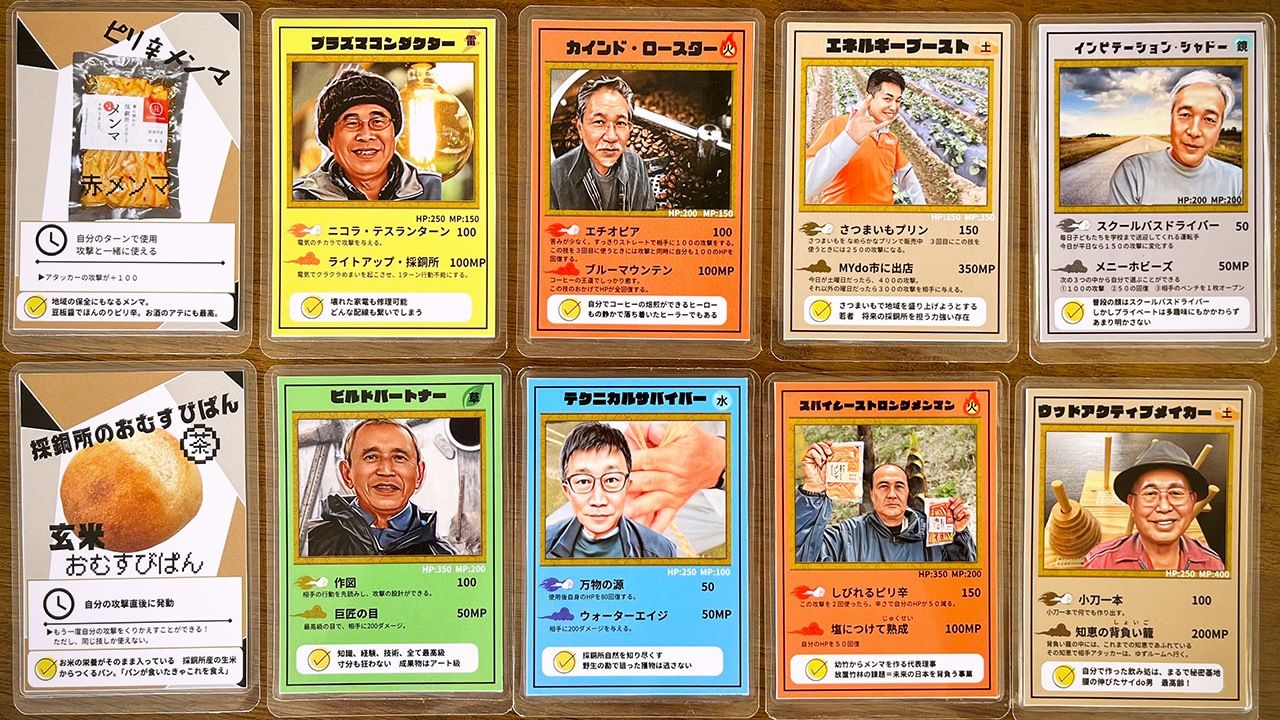
Too Hot to Handle? The Unexpected Popularity of a Fukuoka Community’s “Old Guy Cards” Project
Society- English
- 日本語
- 简体字
- 繁體字
- Français
- Español
- العربية
- Русский
Regular Old Guys or Trading Card Heroes?
Saidōsho is a neighborhood in the town of Kawara in northeastern Fukuoka Prefecture. The place name is a reference to copper mining, which brought prosperity to the area in ancient times. Some of the copper from Saidōsho is even said to have been used in the Great Buddha of Nara.
In late 2024, this district was in the media spotlight after a locally produced series of quirky trading cards proved a hit with children. These ojisan toreka (“old guy trading cards”) featured regular local men as collectible characters.
The official name for the cards was “Saido Men.” Imaginative superhero names were given to each of the characters according to their profession or unique talent, and the cards featured their portrait photos and listed their traits, skills, and “strengths,” with points assigned to indicate their power and the potency of their attacks. The operator of a local café, for instance, appears as “Kind Roaster,” wielding the skills “Ethiopia” and “Blue Mountain,” while “Invitation Shadow” can access the “School Bus Driver” and “Many Hobbies” skills.
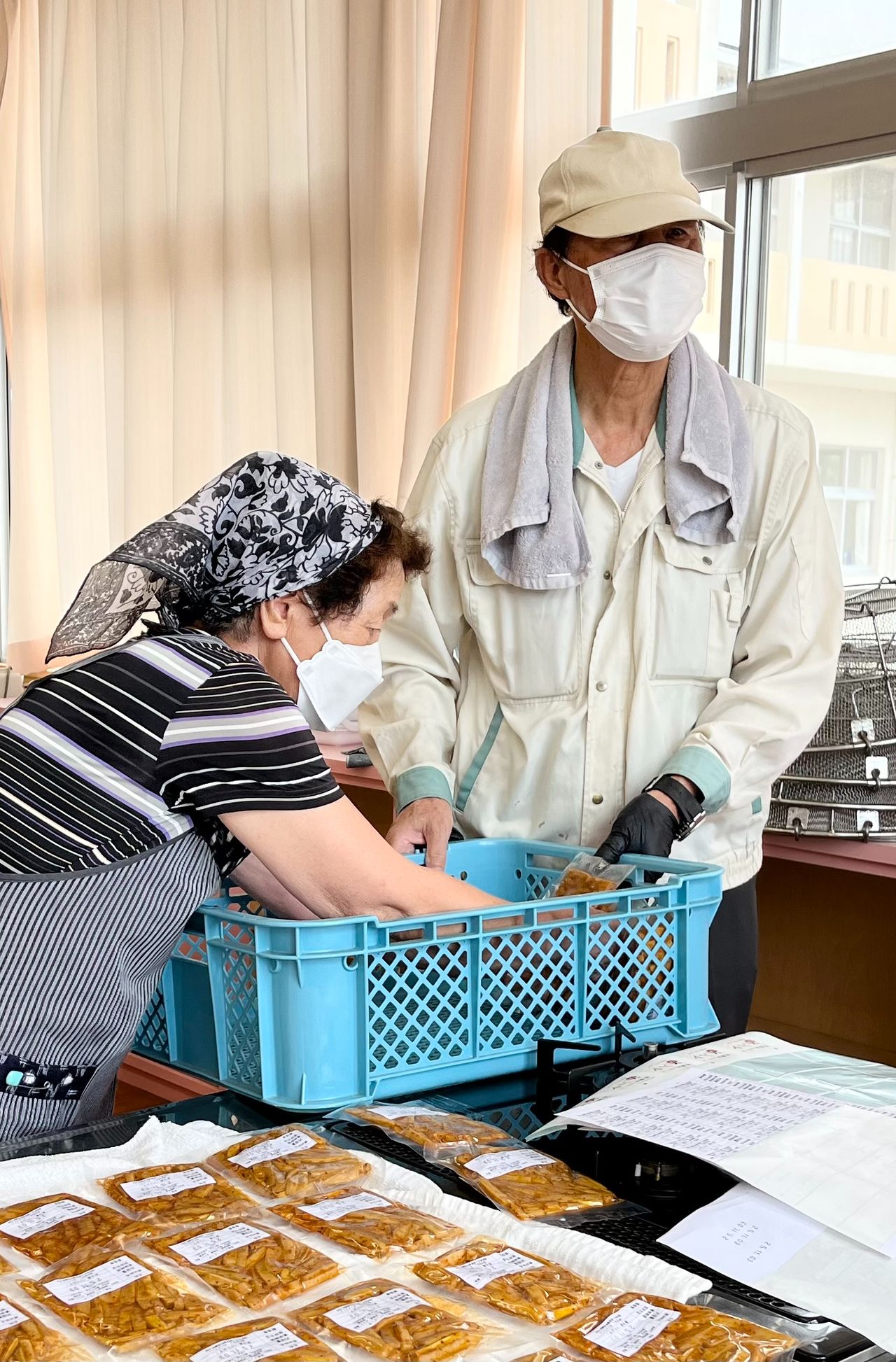
The fellow at right makes menma (preserved bamboo shoots that are a popular ramen ingredient). He features as the Saido Men character “Spicy Strong Men Man” (a play on the term menma). (© Hibino Kyōzō)
The idea was first proposed by Miyahara Eri, head of a local Saidōsho community council. Miyahara plays an active role in the community while raising her children. One day, she began thinking about the various men helping out around the community.
One was the man who installed security cameras for the council’s office, who previously worked in the electrical equipment industry. Other men who came to mind included a man who made menma, cured bamboo shoots for use in ramen and other dishes, and another involved in transforming disused agricultural land for community farming. In addition to their varied professional backgrounds, all of them were working as volunteers in the community, and Miyahara wished to raise awareness of their efforts. “I wanted to promote our volunteers as heroes.”
An Instant Hit
One concern sparking Miyahara’s project was the tendency of families with children to leave the area. Saidōsho’s local elementary school closed in March 2021 when the town consolidated its schools. Since then, children from the district have to catch the bus to a more distant school in the center of town. Miyahara explains that previously, local adults commonly greeted the kids along their walking routes to school, but since its closure, “there are no longer opportunities for interaction. Elderly local men have become strangers to the children, who no longer say hello when they see them.”
By making the trading cards, Miyahara hoped to reintroduce the children to these great older members of the community.
She was searching for someone to help get the ball rolling when Nishiu Hiroe, who had recently joined the community council, came to the rescue. Miyahara had produced a mock-up set of trading cards she had been playing around with, explaining that she wanted to produce them for sale at local festivals.
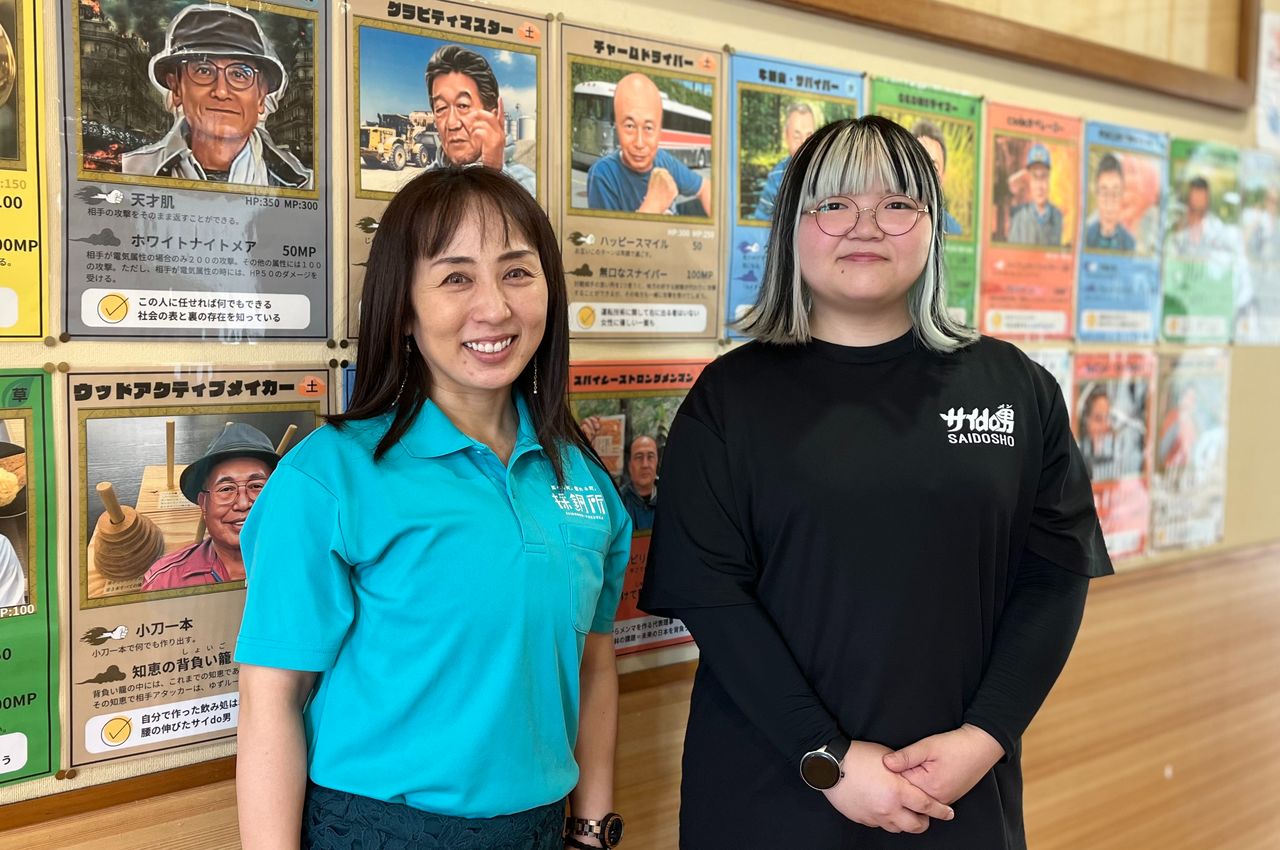
Miyahara (left), who came up with the idea of the old guy trading cards, and Nishiu, who helped them become a reality. (© Hibino Kyōzō)
With the next community festival just a week away, Nishiu worked with some friends, reworking the designs at lightning speed. After printing, the team laminated them by hand, just in time for the festival in November 2023.
On the day of the event, the cards went on sale at 100 yen for a pack of three. They were snapped up by eager children, with the initial 100 sets selling out in an hour.
Each character had been assigned “hit points” (HP) and “magic points” (MP), to “gameify” the cards. There were also game rules and game boards (“fields”) for players to pit their collections against one another in “battles.” An increasing range of characters went on sale at the community center, while card battles between the children grew in popularity.
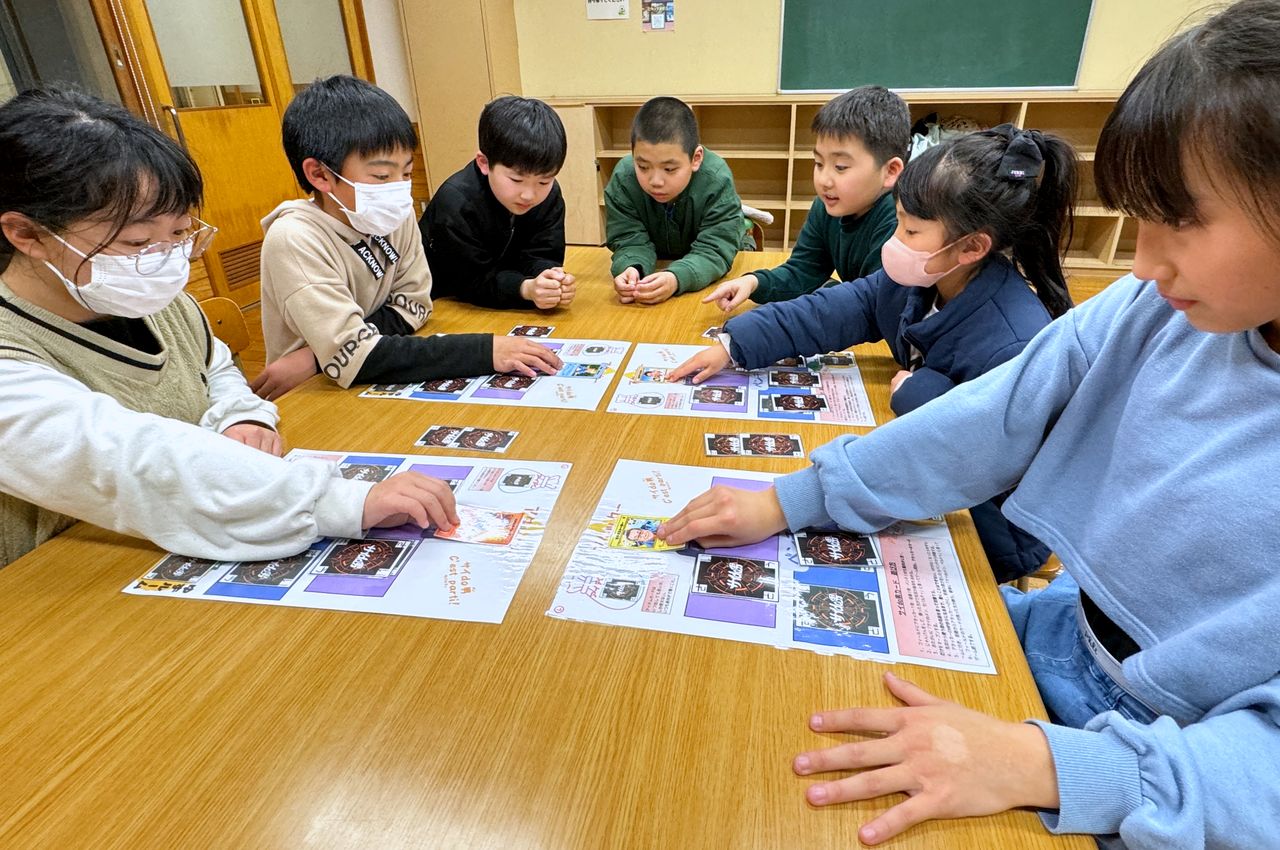
Children playing a game of Saido Men. (Courtesy the Saidōsho community council)
The cards also succeeded in achieving Miyahara’s aim of helping to restore intergenerational connections in the community. As the children started to recognize the real-life men behind the characters, they became familiar with these dependable figures in the neighborhood.
Miyahara also noticed a change in the men themselves. Mr. Honda, an amateur carpenter who previously worked for a major agricultural equipment manufacturer, is the model for the oldest character in Saido Men, “Wood Active Maker.” As he says, “I’ve had more chances to interact with children, and they love it when I gave them my woodcraft.”
As the game became more popular, other people offered to volunteer in the community, saying, “We want to be Saido Men characters too.”
The initiative attracted media attention and raised local awareness of the council’s activities.
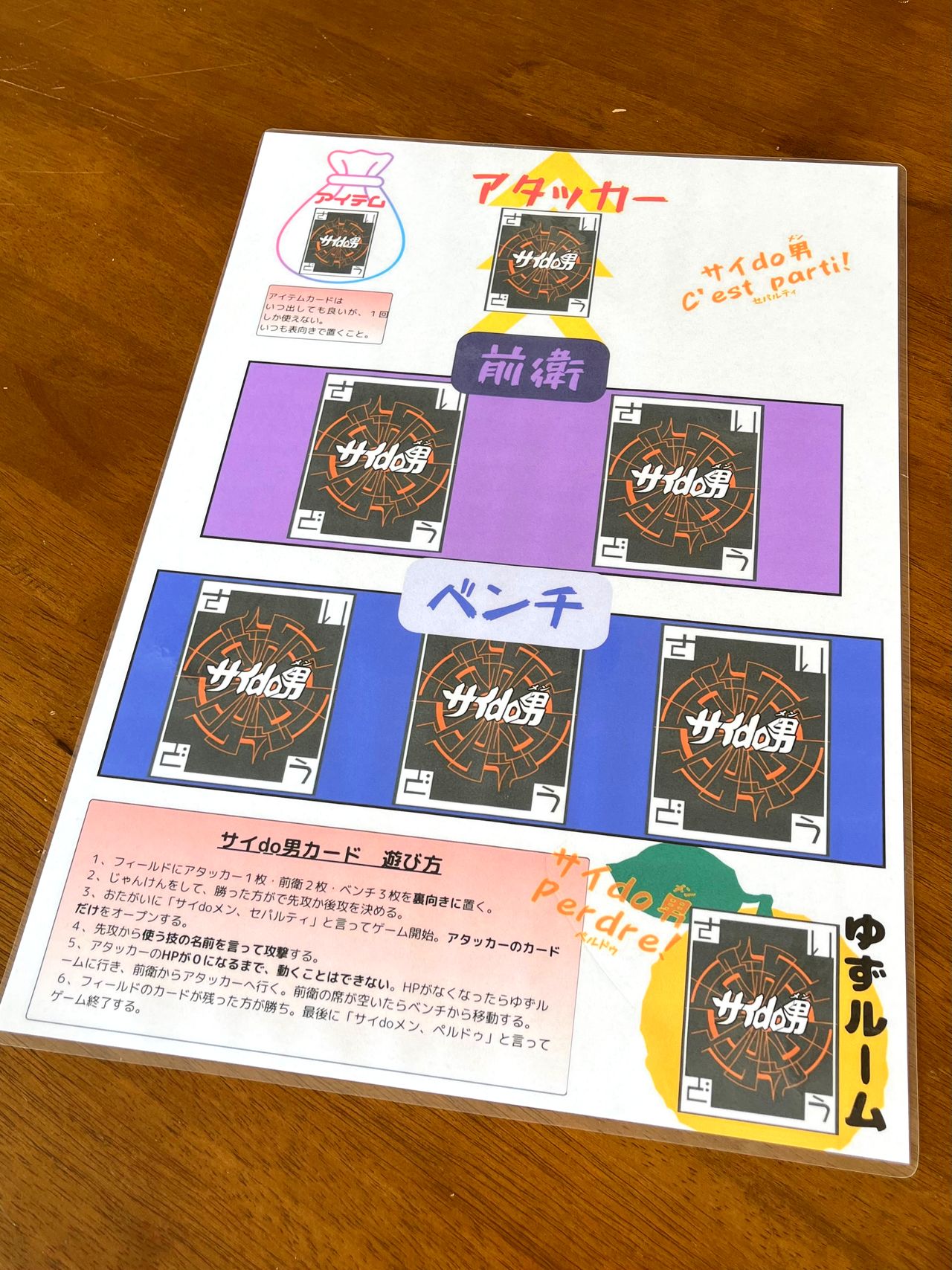
A “field” for battling with the cards. The rules are similar to those of other well-known trading card games. (© Hibino Kyōzō)
Over-Exposure Forces Withdrawal from Sale
The cards became a source of joy for Saidōsho, and helped strengthen connections among residents, but the situation took an unexpected turn.
In December 2024, a local TV channel featured Saido Men as “a curious card game that is a hit with local children,” sparking a flood of inquiries from other regional and national media outlets.
Initially, the council welcomed the media interest, but the situation quickly turned sour. According to Nishiu, “Even though only a small number of children played Saido Men, it was presented as a major phenomenon, and later media reports followed this pattern.
“They exclusively focused on the novelty of the playing cards, painting a superficial picture without explaining the significance of our initiative.”
The story also spread on social media, where it found its way onto international media channels. Saidōsho’s community council received inquiries and even visits from prospective overseas purchasers. Over-exposure led to the cards, which were only produced in small numbers, being traded on online websites for up to 4,000 yen each.
The council could no longer ignore the problem. Miyahara explains that “Because the cards were only available in limited numbers and only from the council, they began to fetch a premium. People even sold photos of the cards clipped from newspaper articles. After much deliberation, the council decided to stop selling the cards this June. We won’t relaunch them unless we can find an effective way to prevent reselling.”
In the end, their efforts to rebuild ties in the local community fell by the wayside in the media furor and the online cash-grabs carried out by those who chose to resell the cards. Attention-grabbing misrepresentations and the media’s failure to present the true value of the council’s initiative resulted in a setback.
Nevertheless, the Saidōsho community organizers hope their experience can act as a useful reference to other areas struggling with sustainability issues.
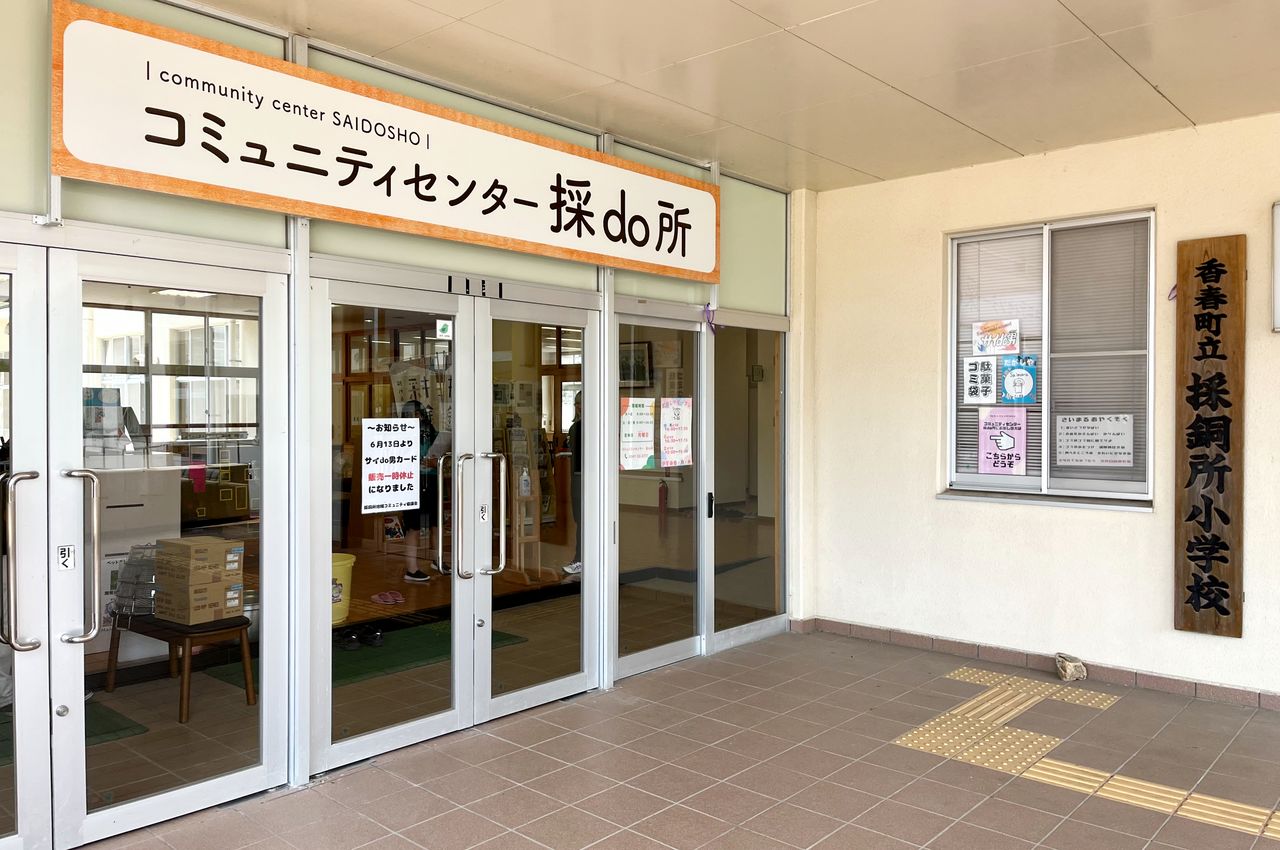
Community Center Saidōsho, the hub for the activities of Miyahara and her colleagues, is based in the neighborhood’s former elementary school building. (© Hibino Kyōzō)
Saidōsho has a population of around 1,700, of whom more than half are aged over 65. Miyahara expresses her concern that “in time, our population will halve.”
It was the weakening of intergenerational connections, partly caused by population decline, that sparked the innovative idea for “old guy trading cards” and turned local volunteers into heroes. The impact of this project on the community is thanks to the efforts of Miyahara and people like her.
In her words, “My generation, which sits between the children and the elderly, has a key role to play in community-building.”
To create truly sustainable communities, it will be important for more people to transcend generational boundaries to join in the discussion. The contributions of people of all ages produce ideas that can create a brighter future.
Although the Saido Men cards have lost their steam, Miyahara and her council will keep trying to find new ways to invigorate Saidōsho.
(Originally published in Japanese. Banner photo: A selection of Saido Men cards featuring local people helping out the community. © Hibino Kyōzō.)