High School Noodles: Ramen Chain Ippudo Supports Student Start-Up Program
Education Society Work- English
- 日本語
- 简体字
- 繁體字
- Français
- Español
- العربية
- Русский
Schoolwide Contest for Ideas
Founded in 1941, Yanagawa High School in Fukuoka is known across Japan for sporting prowess, especially in tennis and baseball. Recently, it has also made news for a program launched in June to teach students about start-ups in collaboration with major ramen chain Ippudo, a local company that has restaurants in 16 countries and regions. The winning team will travel to the United States.
Yanagawa High School’s Start-Up Program Curriculum
- Students form teams with three to five members.
- All students are taught the basics of marketing and new products.
- Qualifying round: assessment of each team’s new product proposals.
- Main round: assessment of ideas for store operations.
- Three teams chosen for the final.
- Special lectures for finalist teams.
- Finalist teams operate their business from kitchen vans.
- The winning team travels to the United States for training at Ippudo New York.
Students who elect to join the program form teams, and Ippudo staff teach them about marketing and case studies of new product development using video material.
Next, in the qualifying round, the teams put together a proposal for a new product which they submit for assessment. In the main round, their ideas for store management are assessed. The three top teams receive special lessons from staff from Ippudo and related companies on topics such as management and money, product development, and shop operation.
In the current contest, the teams submitted ideas such as “ramen that makes you think of outer space” and “a shop where you can customize your own ramen.”
Yamashita Manjirō, a first year student of international studies, qualified with his team, who developed a ramen dish using spicy yuzukoshō paste and tsukudani made with local nori to promote the local flavors of Yanagawa and Fukuoka. “We hope that it puts a smile on the face of people who eat it,” Yamashita commented.
The three finalist teams will operate kitchen vans at the festival of a nearby university. The winning team is then chosen based on an overall assessment including sales of the kitchen van and their final presentation. This team gets to travel to the United States for training at Ippudo New York.
A Program Providing Real Experience
A highlight of the program is the opportunities it provides to experience the realities of day-to-day business operation. Teams can choose members from their own class, different classes, or even different year levels. This is like working at a company, gathering members from various departments to contribute their different talents.
All of the participants felt there was great value in this kind of opportunity. Koyama Takayuki, a teacher who formerly worked at Taishō Pharmaceutical, explains that, “We limited the team size to a maximum of five members because, in my experience, bigger teams always have inactive members. Companies don’t have textbooks. You need to know how to deal with questions that don’t have set answers. It’s wonderful that these students have the chance to experience this at this early stage.”
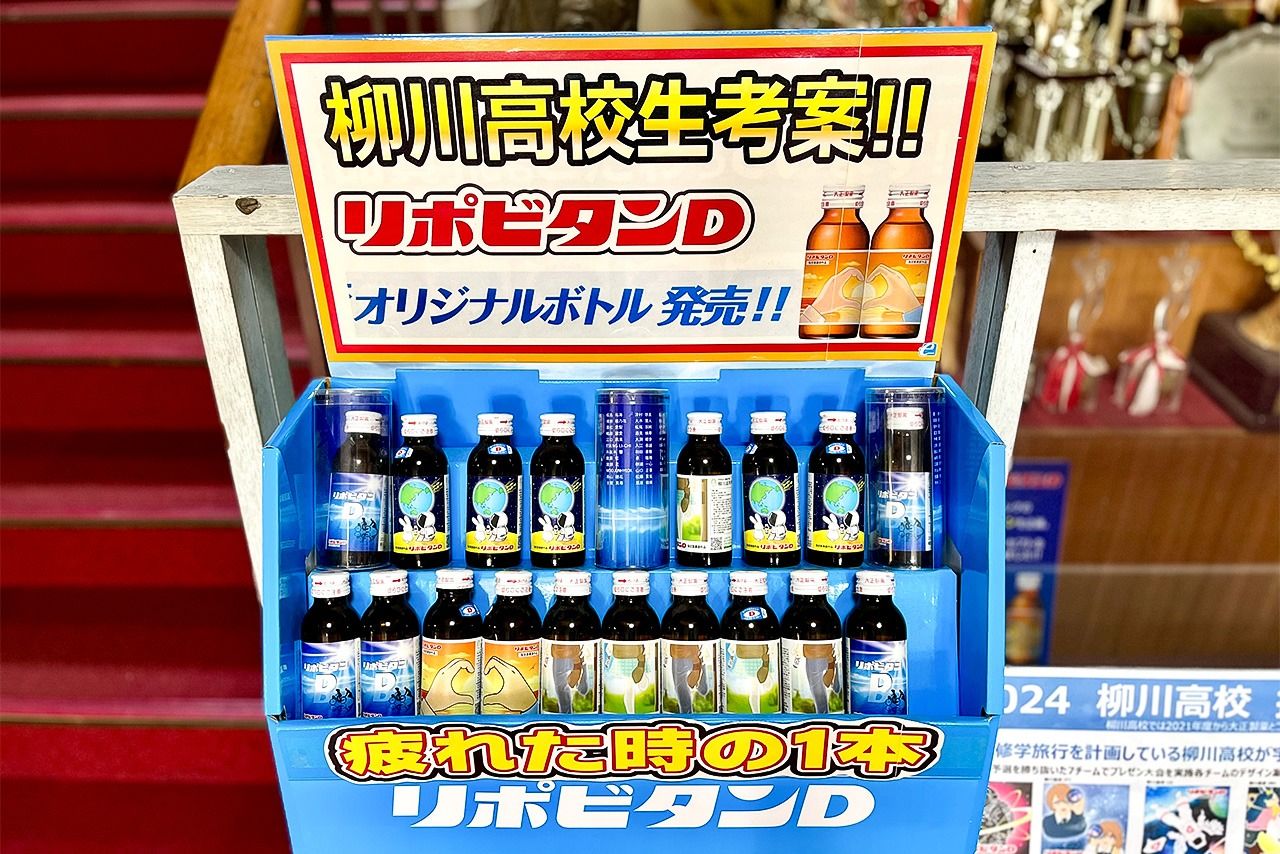
Yanagawa High School is actively collaborating with businesses. For the past four years, students from the school have worked with Taishō Pharmaceutical to design special labels for the energy drink Lipovitan D. (© Hibino Kyōzō)
Ippudo prepared special lessons for the students on the basics of product development and store management. The company is also contributing staff to assist with assessment, providing the kitchen vans, and helping with their operation.
Ippudo’s parent company Chikaranomoto Holdings is actively engaged in food education activities, including giving lessons at elementary schools and running cooking workshops for children. Yanagimoto Keisuke, director and head of product development, said, “Dealing with ramen as serious business provides a rich experience for the students. There’s great value simply in tackling such an endeavor. I look forward to seeing the ideas put forward by the students based on their unique perspectives.”
Part of the School Makeover
The start-up program strongly reflects the beliefs of the school’s principal, Koga Ken. Grandson of the school’s founder, he became its third president in 2002 at the age of 33. From 2009, he also became the school principal, and has since led a push to reform the school’s approach to education.
Policies were drastically revised to address difficulties related to Japan’s economic stagnation and declining birth rate. Koga overturned the emphasis on school club activities and academic achievement, proposing a succession of unique policies focused on the autonomy and creativity of students, and for cultivating a global outlook. The school’s policies rest on three conceptual pillars: a global academy, a smart school, and space education. The start-up education program is another new initiative.
According to Koga, “A lack of ideas is one major reason for Japan’s economic stagnation. What we need now are game changers who can alter the very rules of the business world. To nurture such talented individuals, we must show them the world from a range of angles. The start-up program is one way of doing this.”
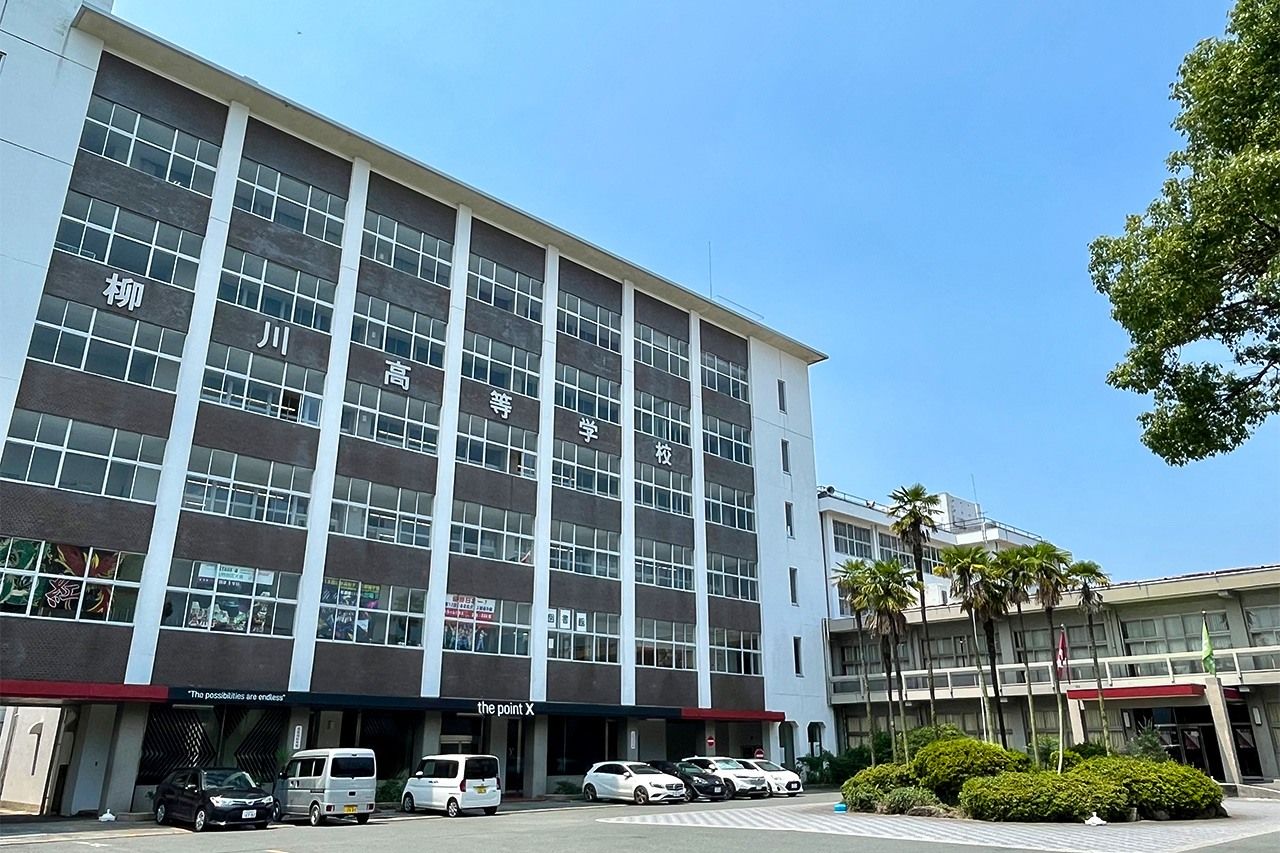
Yanagawa High School, which is promoting bold reforms. (© Hibino Kyōzō)
In Koga’s opinion, “We should have a range of assessment modes for evaluating individuals, rather than relying only on test scores. But initially, my ideas didn’t catch on in the hearts of students and their guardians. It’s true that students need high scores to pass university entrance exams, and when I announced that our school would run the world’s first “space field trip” in 2030, people said ‘Now he’s lost his mind.’”
Now, universities are gradually incorporating more comprehensive selection methods for admission, taking into account various factors including students’ eagerness to learn and their human qualities. This has brought wider acceptance of Yanagawa High School’s approach. “We don’t nurture clever students, we nurture broad-minded students.” Koga’s ideas have begun to attract greater understanding and more applications from hopeful students.
Ramen Beginnings
But why did the school base its start-up program on ramen? It dates back to fall of 2023, when a television crew visited the school to film. The reporter interviewed an exchange student from Germany, asking, “What food do you like?” The student answered, “Ramen, but they don’t serve it at the school cafeteria!”
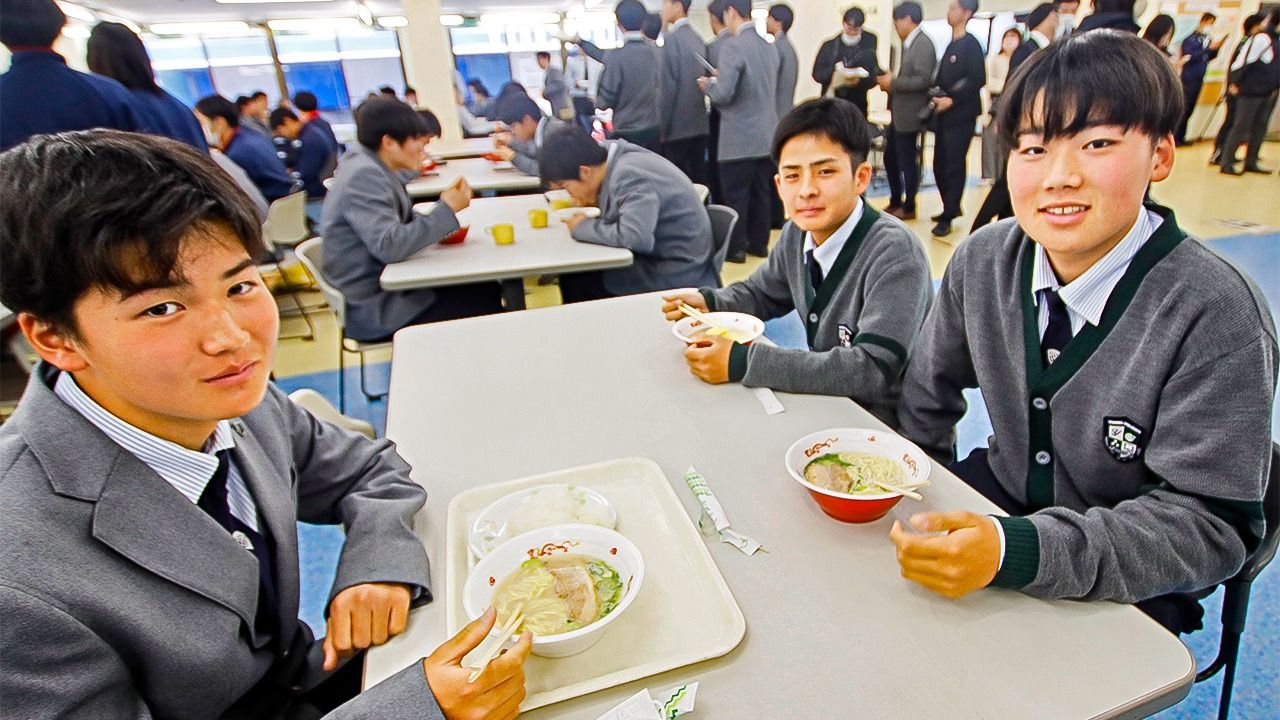
The program caught the attention of Kawahara Shigemi, Ippudo’s founder and the chairman of its operating company Chikaranomoto Holdings. He was already friendly with the school’s principal, and by the following spring, Ippudo ramen was on the cafeteria’s menu.
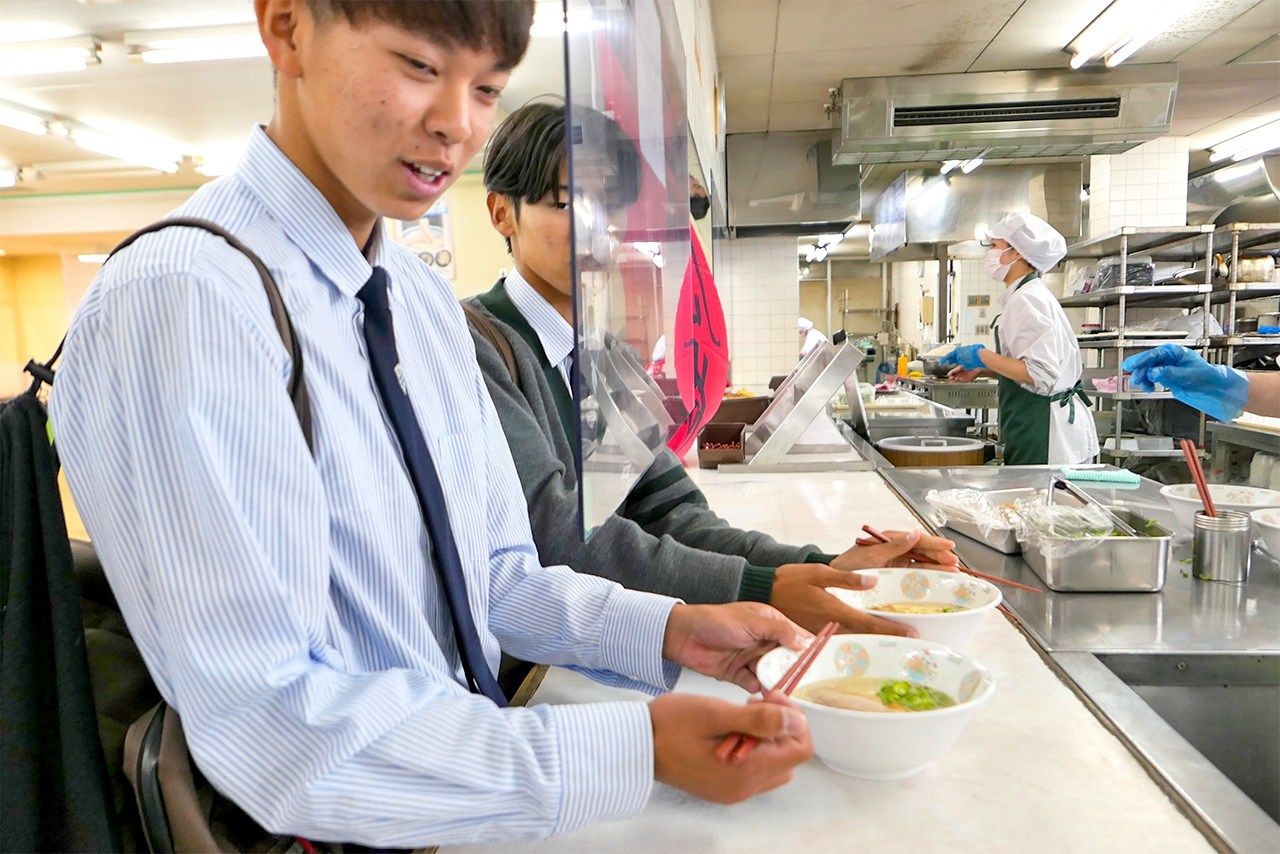
The students love the Ippudo ramen served at their school cafeteria. (Courtesy Yanagawa High School)
A few months later, Kawahara visited the school. In the principal’s office, he set eyes upon an introduction to the start-up program among the school promotional materials, and asked if his company could help in some way.
Koga recounts, “Kawahara is deeply interested in human resource development, and was kind enough to make this offer. From the outset, we were on the same page. We immediately worked out the direction for a start-up program using Ippudo’s ramen, which was followed up by discussions about the specifics.”
Valuable to Experience Failure
Koga exudes cheerfulness and positivity.
He has adopted the title Zekkōchō, which roughly translates as “Super Principal,” but also sounds like the Japanese for “peak form.” Koga wears “Super Principal” T-shirts featuring his caricature. He has an engaging ability to find laughter in failures and use them as a basis for positive discussion.
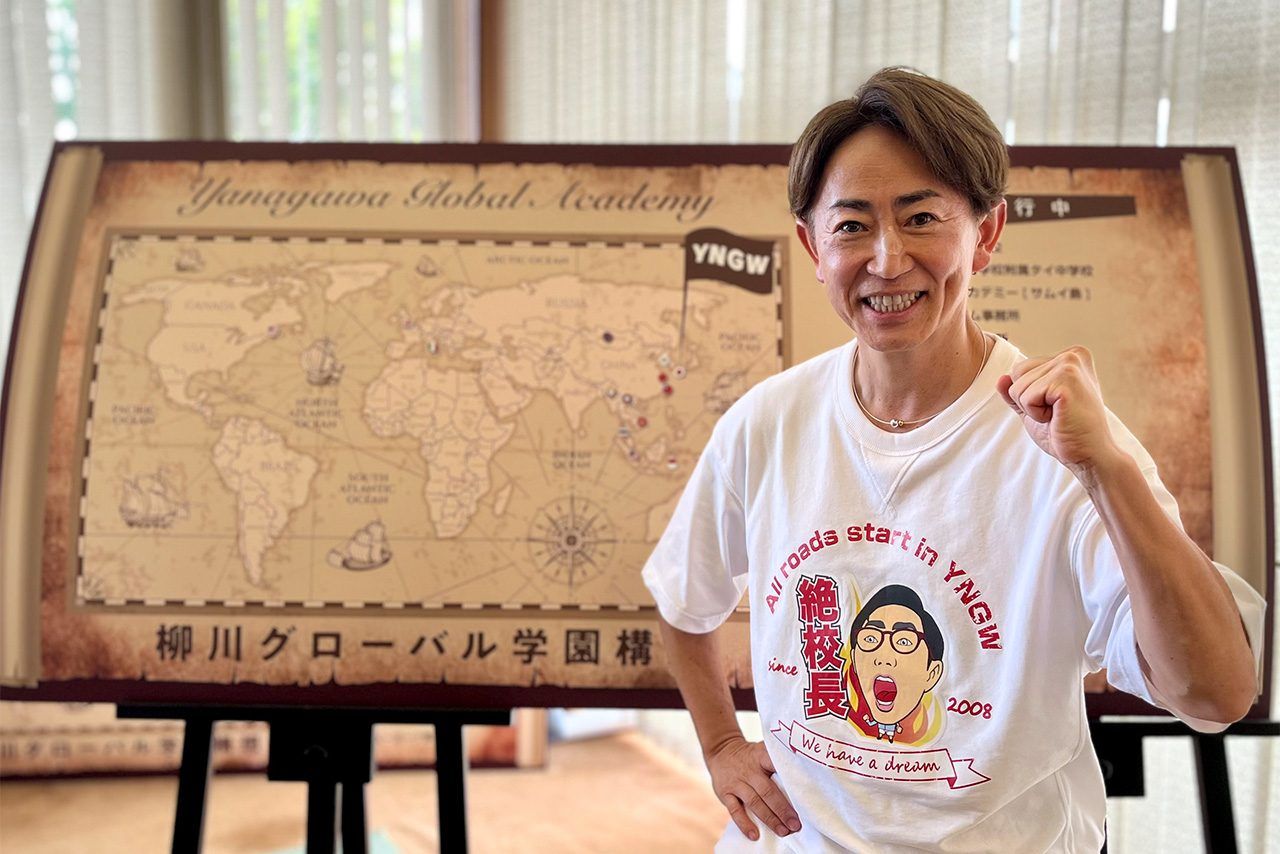
Koga wearing his trademark “Super Principal” T-shirt. (© Hibino Kyōzō)
In the words of Koga, “If someone opened a ramen restaurant out of the blue, it’d be no surprise if it failed. But it’s valuable to experience failure while still at high school.”
The three finalist teams plan to operate their kitchen vans this coming winter. Until then, the students will deliberate with their teammates to overcome issues such as the procurement and profitability of ingredients, and speed of service.
They still have no idea what they will learn through their kitchen van operation. But the process of facing unfamiliar issues with their colleagues is sure to prepare them for the future. Their efforts will be a first step in opening new doors both for themselves and for fresh directions in education.
(Originally published in Japanese on October 17, 2025. Banner photo: Yanagawa High School students enjoying Ippudo ramen during lunch break. Courtesy Yanagawa High School.)