
“I Can’t Do This Anymore!”: Why Japanese Workers are Turning to Resignation Agency Services
Society Work- English
- 日本語
- 简体字
- 繁體字
- Français
- Español
- العربية
- Русский
“Not an Environment Where I Can Say I Want to Quit”
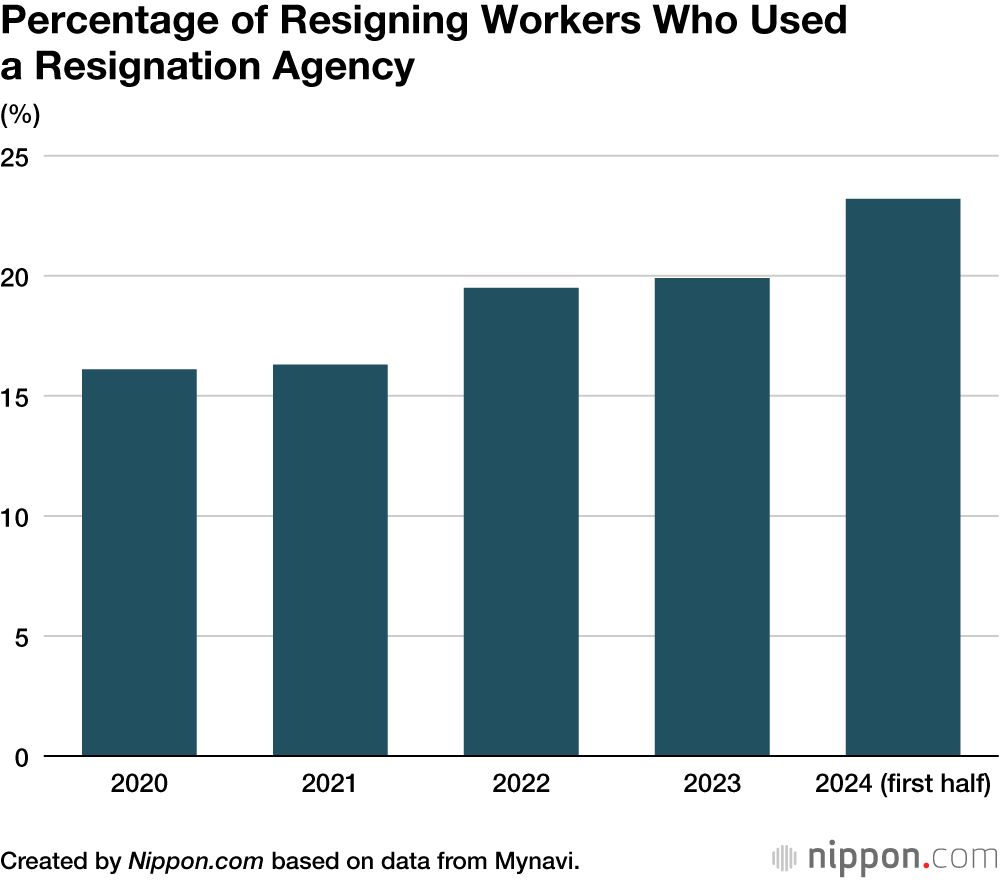
A growing number of workers in Japan are turning to resignation agencies, which handle the task of notifying employers of their intention to resign.
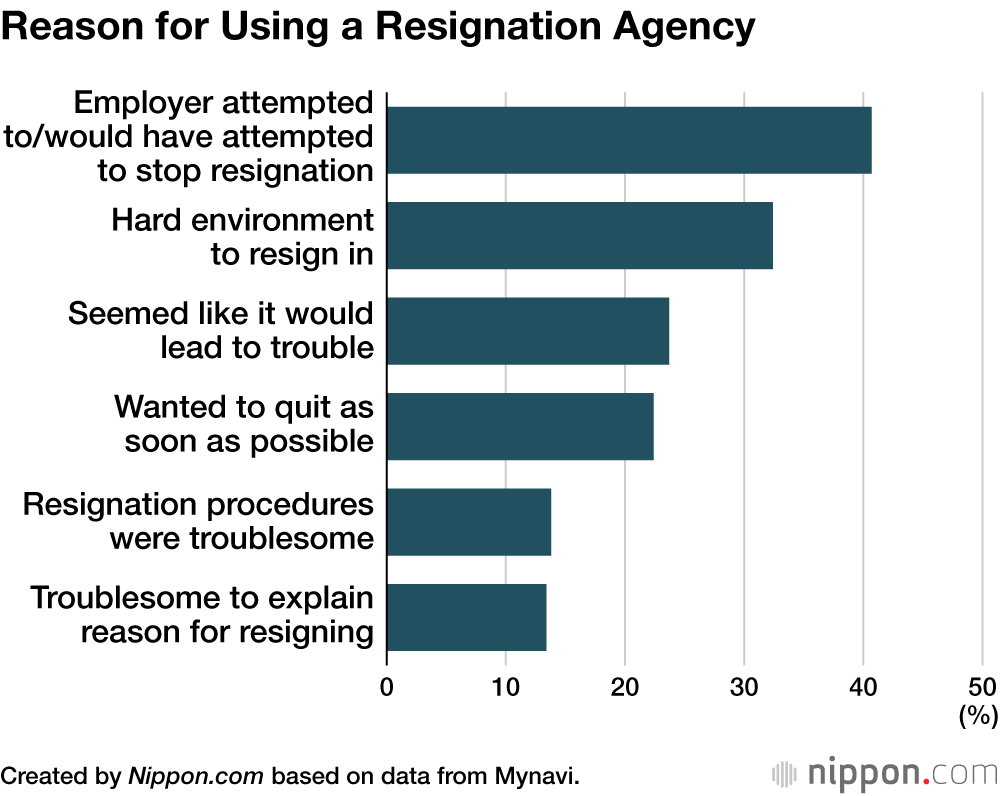
A report released in October 2024 by Mynavi, which runs a job-hunting and career-change platform, found that among 800 respondents (multiple answers allowed), the leading reasons for using a resignation agency were “They tried to stop me from resigning” or “They would have tried to stop me from resigning” (40.7%), followed by “I wasn’t in an environment where I could say I wanted to quit” (32.4%). In interviews conducted by the author, the latter was the reason most frequently encountered.
For example, there was a man in his late twenties who changed jobs to become an engineer with no prior experience. “If I continued working, I would be causing them trouble,” he said, “so I used a resignation agency.” He had been working at a client company as part of a team, and the work environment was positive. But although he studied during his free time to build his skills, he struggled to deliver results and soon felt he was holding others back. After a year, he developed a sleep disorder, fell into depression, and started missing more days at work. Unable to make normal judgments, he could not bring himself to say he had reached his limit, even as he continued meeting with his supervisor.
In this case, the employer was not involved in any wrongdoing. For employees whose earnest approach to work leads to mental depression, the act of telling a superior they want to resign may be extremely stressful.
Harassment an Issue
There are also cases, however, where the company clearly bears responsibility. A typical example involves harassment. One woman who entered a company as a new graduate and quit after just three months had turned to a resignation agency. Her supervisor repeatedly called her “too fat” in front of coworkers and yelled at her for no good reason, leaving her unable to go to work and prompting her to seek help from an agency.
Because she worked at a large corporation, it can be assumed that there were internal consultation channels available. However, it is not realistic to expect a new employee who feels cornered to calmly assess the situation and be able to use such an option. Even if she did raise a complaint, there was no guarantee the problem would be solved. Confrontation with the supervisor could be risky, and bringing up the topic of resignation was itself difficult.
Here is one more example. A woman in her forties who had just recently switched jobs to join a medium-sized company was approached by her new superior who confessed romantic interest in her. She rejected his advances, but then became the target of his persistent verbal attacks. Although she was an experienced professional with a strong record and had gone through job changes before, she still felt unable to confront her harasser.
In the end, she felt she needed to change jobs again, but her employer was uncooperative about resignation procedures. “I never thought I’d use a resignation agency,” she reflected.
Unable to Resign
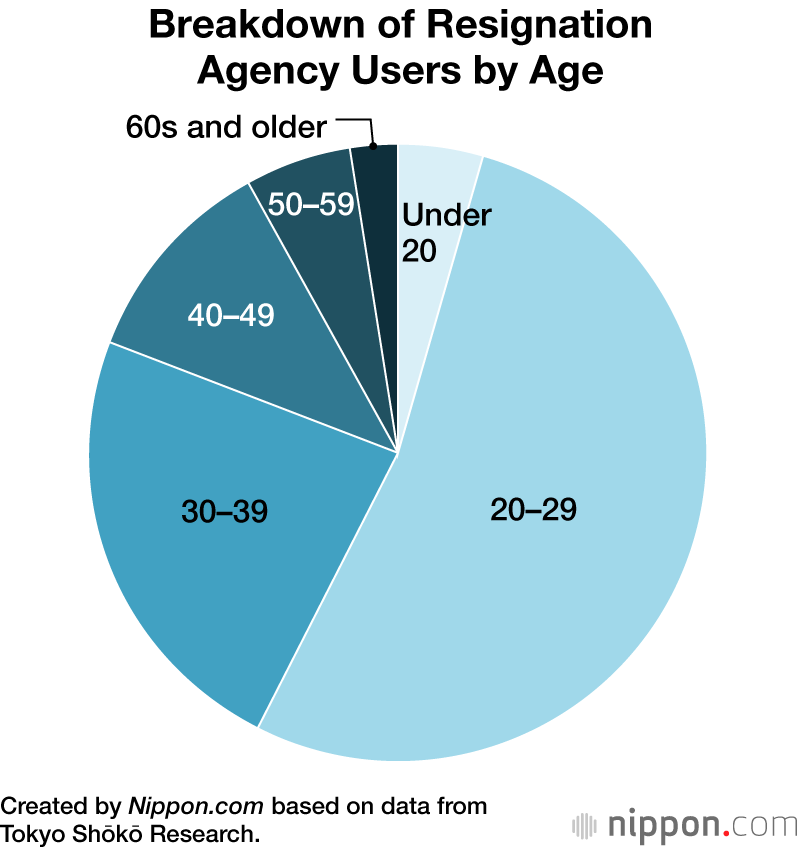
As seen in the case of the woman in her forties, it’s not only young workers in their twenties who are using resignation agencies. A survey by Tokyo Shōkō Research conducted from June 2 to 9 found that while 53.7% of users were in their twenties, 35% were in their thirties and forties. This shows that resignation agencies now have demand among mid-career workers as well, and not just younger employees.
Regardless of age, the core issue appears to be companies’ limited understanding and consideration for employees who want to resign. One woman in her thirties who worked at a leading manufacturer said, “Even though I’d already secured my next job, they wouldn’t process my resignation.”
That company had a compliance system in place, but since the supervisor had put off the resignation procedures, it was not moving forward. Once the resignation agency got involved, HR stepped in and the employee was able to leave according to her preferred schedule.
For employees, there is no certainty that resignation negotiations with their employer will go smoothly. There have always been cases where workers trying to resign faced strong resistance or were showered with insults. This is because, in a corporate culture that values seniority and pursuit of results, HR staff can feel betrayed by employees who choose to resign.
It could be argued that the rise of resignation agencies merely exposes a problem that had previously been concealed. In the past, workers often held back to avoid trouble, and these services have simply made that underlying tension visible.
Need for Better Systems
According to the Ministry of Internal Affairs and Communications’ Labor Force Survey, 3.3 million workers changed their jobs in 2024, while 10 million wished to change.
Back when lifetime employment was the norm and resignations were rare, having supervisors handle resignation procedures may not have caused many problems. Now that the number of resignations has increased due to more frequent job changes, supervisors have more to manage and may develop negative feelings toward employees who resign. This situation could lead to compliance risks.
Preventing these risks requires companies to share legal knowledge internally, including that employees may resign with 14 days’ notice and can use their paid leave when leaving, and to set clear rules for resignation negotiations based on company work regulations. Since some employees do not fully understand how to resign, the process should be openly explained and supported by mechanisms involving third parties, HR staff, or dedicated systems.
But the establishment of systems and rules regarding resignations will take time. Until they are set in place, the number of workers who make use of resignation agencies is expected to continue increasing. Workers must also be careful when using such services.
Resignation agency services are provided by private companies, labor unions, and law firms. Private companies that do not have attorney qualifications are only allowed to notify the employer of the employee’s intention to resign. This means that if matters such as paid leave, unpaid overtime, or other conditions need to be negotiated, the employee may have to get involved directly. Only attorneys can handle legal negotiations about working conditions. If a company without attorney qualifications like the prominent agency Mōmuri gets involved in negotiations, it may be considered “unlicensed legal representation” and violate the Attorney Act.
In an era when workers are expected to acquire skills and build independent careers, making resignation more open and acceptable is an important issue. Will a time come when resignation agency services are no longer necessary?
(Originally published in Japanese on December 4, 2025. Banner photo © Pixta.)