Japan’s Convenience Store Restrooms: A Public Service or a Business Burden?
Society Lifestyle- English
- 日本語
- 简体字
- 繁體字
- Français
- Español
- العربية
- Русский
Open to the Public
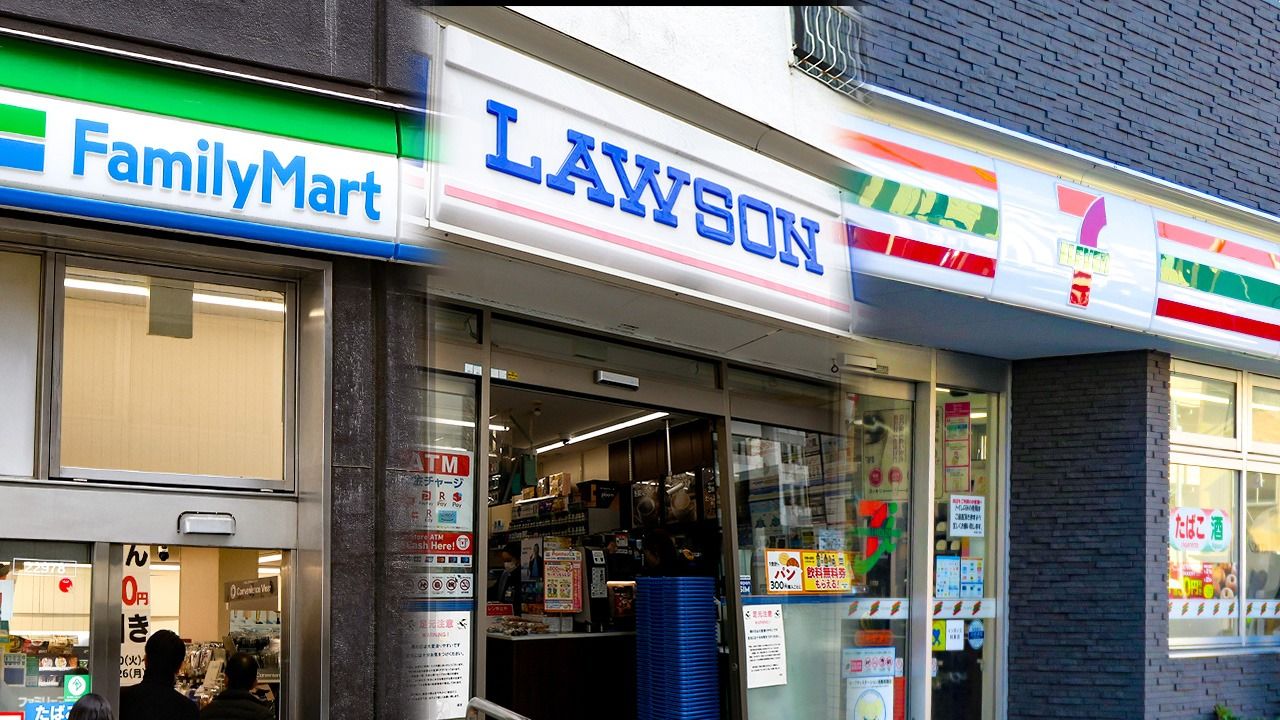
Japan’s largest three convenience store chains are Seven-Eleven, with 21,000 stores across the country, FamilyMart with 16,000, and Lawson with 14,000.
Shoppers are able to use restrooms in the majority of these stores. However, as individual store owners decide whether to install toilets and make them available to customers, the main franchises do not have exact figures on how many there are.
Convenience store restrooms were not always open to the public. While Seven-Eleven has had restrooms for customer use since starting business in Japan in the 1970s, Lawson’s toilets were once in the back of the store and only for employees.
Lawson responded to customer wishes to be able to use its restrooms by opening them up in 1997. Since then, customer restrooms have become common in its stores. Now, an estimated 1 million people use Lawson restrooms across Japan each day.
Millions of Toilet Rolls
For customers, being able to freely use the toilets is an important aspect of these stores’ “convenience.” However, individual outlets must shoulder the associated costs.
According to Lawson, 10 million rolls of toilet paper are used in its Japanese stores each year. Frequent cleaning is also required; including inspections of the restrooms, some outlets conduct such operations 10 times a day.
The stores must handle this work and cover the associated cost of labor, as well as of toilet paper and other supplies, water, and electricity. In some stores, users have caused problems in these restrooms, leaving them in a filthy state or even committing vandalism or other criminal acts. While stores take on costs and risks in providing the facilities, users may feel that they are naturally entitled to them. Some stores even received complaints when they closed their restrooms during the COVID-19 pandemic to prevent infection.
No Purchases
For stores, the service targets increased customers and sales, but the reality is not so straightforward.
Around 90% of respondents said that convenience store restrooms were necessary in a survey conducted by Lawson in April 2025 of 1,200 people across Japan aged from 15 to 69. However, some 40% of those who used restrooms said they did not buy anything.
Lawson President Takemasu Sadanobu commented, “I hope that restroom users act with consideration and think about the next people to use them and the employees who will do the cleaning. While it is not necessary to buy anything, it is preferable to do so if possible. Fundamentally, such purchases help pay for proper maintenance of restrooms.”
Keeping Things Clean
Store managers and employees presumably hope that customers will at least keep restrooms clean. However, Iimori Kenji, who manages a Lawson store in the Yokohama tourist spot Bashamichi, recalls, “It was quite a shock once to find a stool still sitting there on the floor, after someone didn’t make it to the toilet.” In stores with several izakaya pubs nearby, staff members may have to clean up the vomit of drunken customers.
Lawson has made a number of experiments with the aim of reducing the burden on stores. One of these is the “art toilet” approach, in use since 2022. There are restrooms with designs by artists in welfare facilities or selected from public submissions at 12 stores in 10 prefectures.
When I visited Lawson’s Kōtō Shinonome store in Tokyo in November 2025, there was a vivid picture of a whale against the white of one of the restroom walls, along with a turtle and other sea creatures.
The manager Ōgushi Yūzō says that since the completion of the art toilet, only light cleaning has been required. “Before, the toilet lid got broken one time, maybe because somebody climbed on it when they were drunk.” He adds, “Perhaps it only needed some beautiful art for customers to think ‘I’d better try to keep the room clean.’”
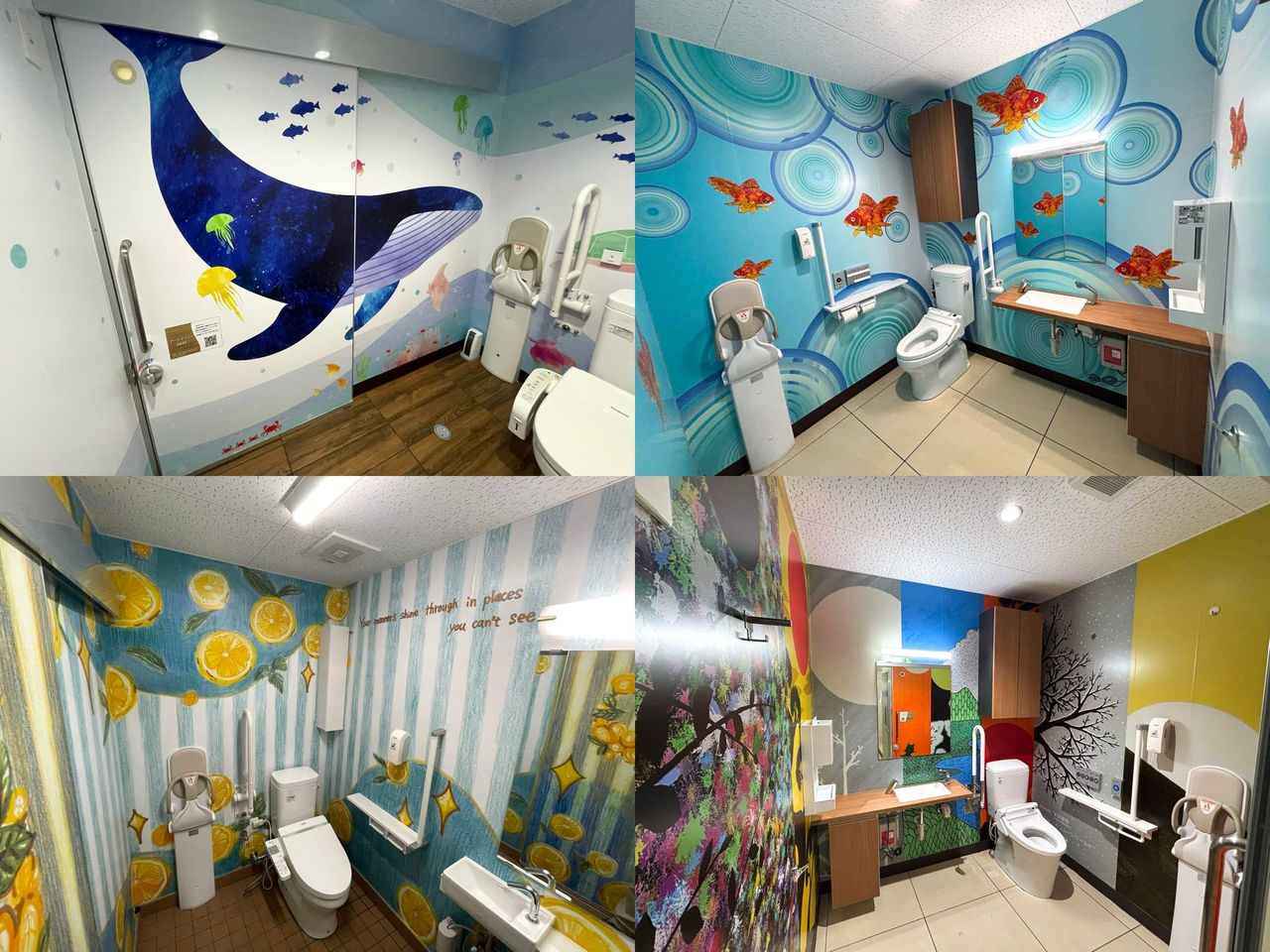
Lawson’s art toilets. Clockwise from top left: Kōtō Shinonome (Kōtō, Tokyo), Utsunomiya Higashi Sanchōme (Utsunomiya, Tochigi), Wakamatsu Futajima Sanchōme (Kitakyūshū, Fukuoka), and Daisen Horiminai (Daisen, Akita). (All © Lawson)
Locks and Fees
In Britain, France, and other European countries, a fee is charged for use of many public toilets at stations, airports, and tourist spots.
Komatsu Yoshinori, an associate professor at the Nagoya Institute of Technology who is knowledgeable about the issue of public restrooms, says attendants may collect the money, and that, “Even in some offices, it is necessary to borrow a key from the reception desk. Many foreign visitors must find it strange that it is possible to use clean restrooms in Japan for free.”
In another experiment, Lawson introduced restroom locks in some of its Japanese stores in April 2025. These were opened by typing in a code on a keypad, and customers had to ask staff members to get the code. However, this took up the time of both customers and employees, and the practice did not get past the experimental stage.
Also in Japan, some branches of Starbucks have restrooms with locks, ostensibly for security reasons. The code is written on receipts, meaning only customers who have made purchases can unlock and use them, but this kind of system is still unusual.
Komatsu says, “It is best to devise designs and systems that encourage customers to keep restrooms clean. Charging money or installing locks risks conveying the sense that it doesn’t matter if they get dirty.”
Official Support
There are cases too where local governments establish restrooms that charge a fee. To the east of Akihabara Station in Chiyoda, Tokyo, there are public restrooms costing ¥100 per person (people with disabilities and children in elementary school or younger can use them for free). However, because there are also free restrooms in the area, few people use the paid ones, and it is difficult to raise enough from the fees to cover the cost of running them.
There is also a movement among local authorities to position convenience store restrooms as public toilets and provide financial support.
In May 2024, after a pilot program, the Yokohama municipal government launched its “public restroom partner store” initiative, subsidizing convenience stores that make their restrooms available for public use. The city had received requests from seniors and others to provide more public toilets to support people in leaving the home. However, as there were few suitable locations in built-up areas, it turned to the retail outlets.
Two Lawson stores are taking part in the initiative, displaying corresponding stickers at the entrance and on restroom doors. Subsidies range from ¥78,000 to ¥96,000 each year, depending on the number of toilets.
The city of Yamato, Kanagawa, also began designating convenience stores as public restroom partner stores in February 2022. At present 13 outlets—from Lawson, Seven-Eleven, FamilyMart, and Ministop—have received the designation, and the municipality provides each of them with official stickers and 200 rolls of toilet paper each year.
President Takemasu of Lawson comments on this movement: “Convenience stores are being recognized for their role as infrastructure. If there are issues with public restrooms in the community, we want to work together to solve them.” At the same time, he says, “The stores must be sustainable as businesses though. To ensure that we can continue meeting customers’ restroom needs, it’s important that customers themselves keep the facilities clean, that we make them even cleaner, and that the stores continue to run steadily as businesses.”
A Form of Social Contribution
Convenience store chains open and close outlets flexibly, based on the numbers of customers. For this reason, Komatsu says, “Unlike parks or other locations where constant maintenance is required, using convenience stores makes it easier to match restroom supply with local demand.” However, he adds, “I don’t think that having restrooms increases store profits. They provide them as a form of social contribution.”
Indeed, the number of “partner stores” like those in Kanagawa described above remains quite low. For the businesses, apart from the small apparent potential for direct financial benefit, it is a big step to state explicitly that their restrooms are provided for free as a public service. This may risk sending a message to users that there is no need for them to buy anything while in the store.
It seems in any case that the idea is already widespread that because there are convenience stores, there are enough restrooms. Unless there are particularly notable demands, there is also little incentive for local governments to support convenience store restrooms in order to improve services for residents.
After describing this situation, Komatsu emphasizes: “Cities where clean restrooms are available 24 hours a day are highly attractive. This is fundamentally the responsibility of local governments, though.” He adds, “Before talking about whether to provide subsidies, they should first commend the work of convenience stores in contributing to improving the appeal of the area.” There is a need to reconsider how restroom services should be provided.
(Originally published in Japanese on April 14, 2026. Banner photo: Convenience stores from FamilyMart [© Jiji], Lawson [© Jiji], and Seven-Eleven [© Pixta].)