Japan’s World Cup 2026 Preview: Samurai Blue Faces Ongoing Challenges, Hopes for Historic Run
Sports Society Culture- English
- 日本語
- 简体字
- 繁體字
- Français
- Español
- العربية
- Русский
Giant Slayers
Japan is making its eighth straight appearance at the FIFA World Cup, a run that started with its debut at the tournament in France in 1998. In that time, the team has made it to the knockout stage on four occasions. While the quarterfinals remain an elusive hurdle, expectations are high that the current Samurai Blue squad, which is being billed as the strongest to date, will soar higher than ever before.
These hopes were given a boost by Japan’s 1–0 upset of England in a friendly at a packed Wembley Stadium in London on March 31. A first-half goal by striker Mitoma Kaoru, who plays for Brighton in the Premier League, delivered Japan, currently ranked eighteenth internationally, its first win in four meetings against fourth-ranked England.
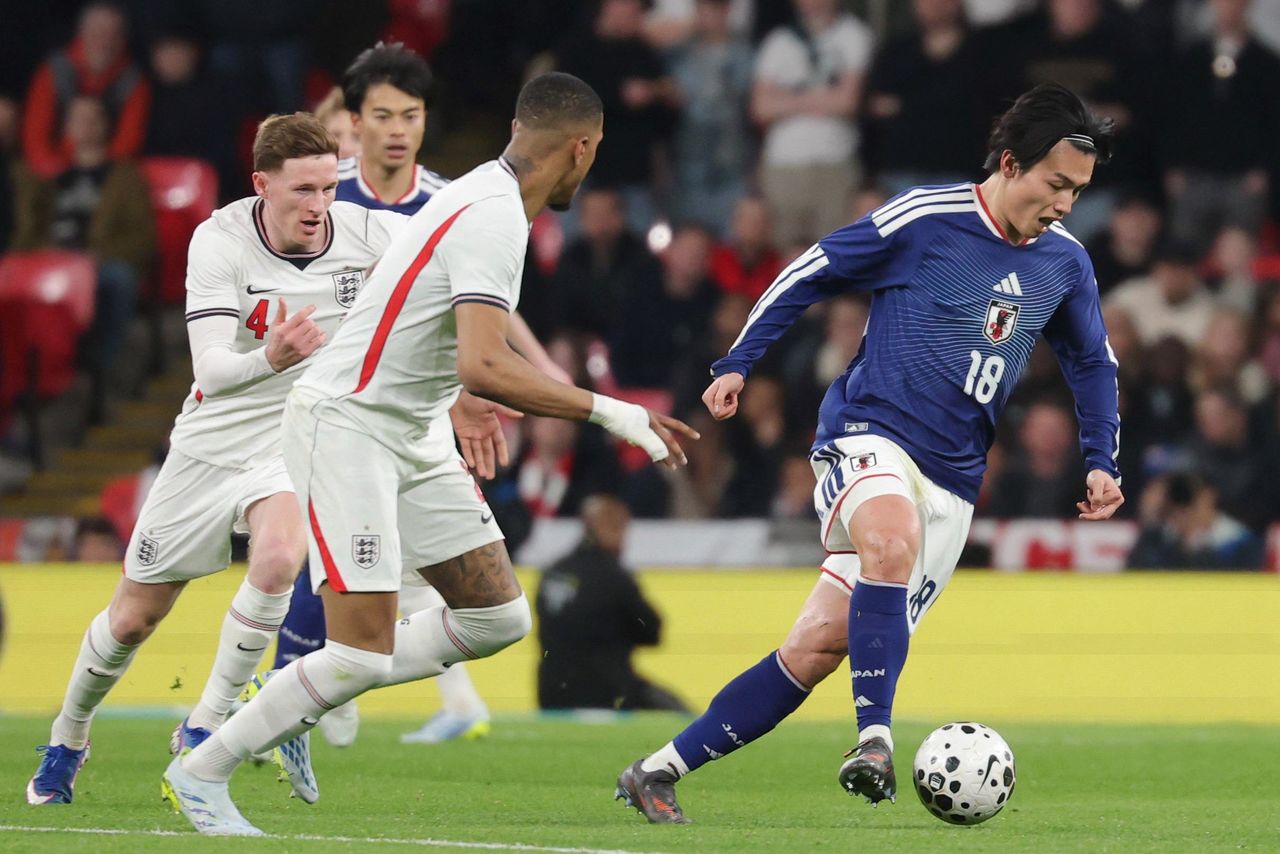
Ueda Ayase (right) dribbles against England players in a friendly match at London’s Wembley Stadium on March 31, 2026. (© Jiji)
Japan manager Moriyasu Hajime praised his team, saying that winning at Wembley is never easy and that his players maintained their focus. However, he kept the victory in perspective, noting that without captain Harry Kane, England was not at its strongest, adding that a friendly is not a World Cup match. At the same time, he acknowledged that the win gave Japan confidence going into the tournament.
Anyone seeing the win as a fluke, though, need only look at Japan’s upset of Brazil in a friendly five months earlier. Playing in Tokyo in October 2025, Japan fought back from a two-goal deficit to sink the South American powerhouse 3–2, giving Samurai Blue its first ever victory against the five-time World Cup champions in 14 meetings. This has raised hopes that Japan will be a force to reckon with at this year’s finals.
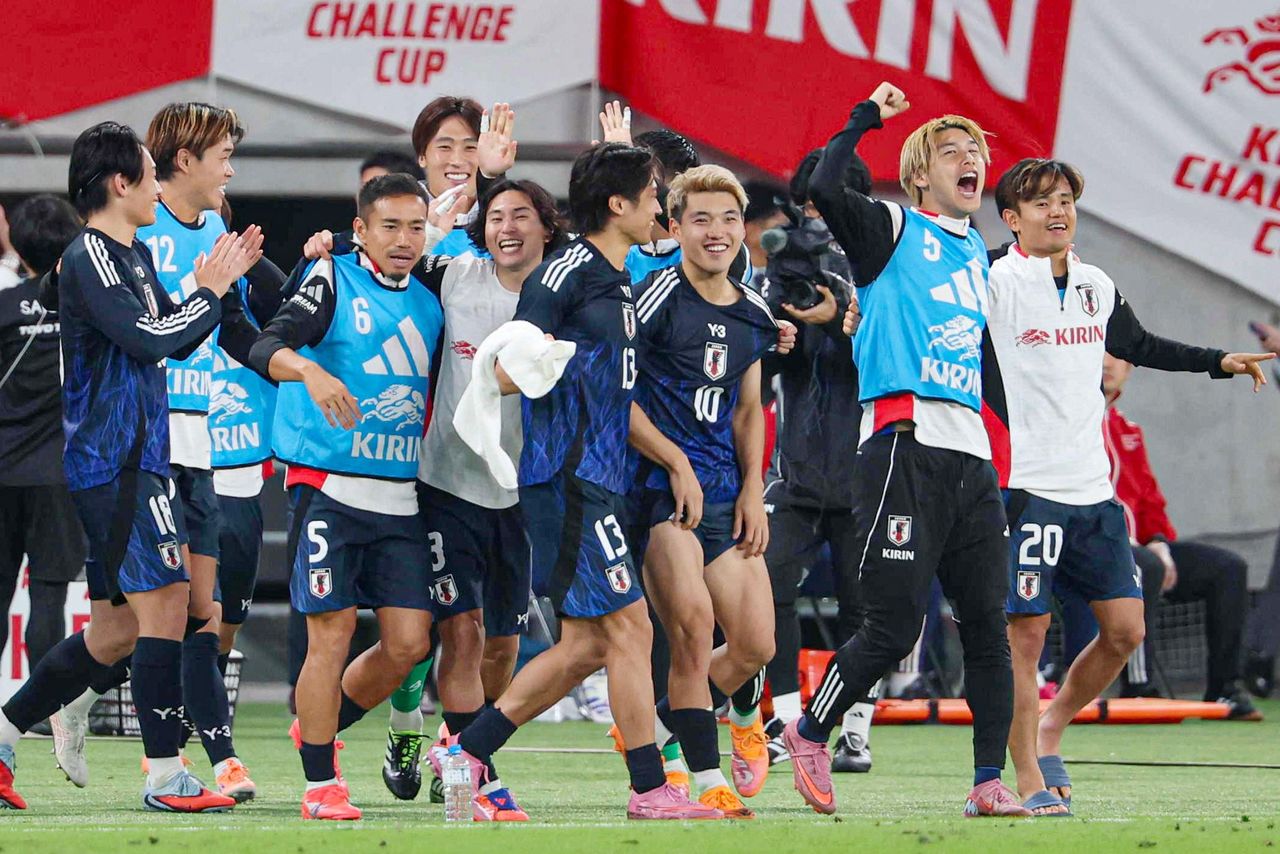
Japanese players celebrate their come-from-behind win against Brazil in Tokyo on October 14, 2025. (© Jiji)
Aiming for the Stars
Japan, ranked eighteenth internationally, is competing in Group F alongside the Netherlands, Sweden, and Tunisia. It kicks off its campaign against the seventh-ranked Netherlands on June 14 (June 15 in Japan), with all eyes tuned to whether it can extend its streak of upsets to include the three-time runner-up.
Japan’s National Team World Cup Schedule
(Dates and kickoff times in Japan)
| Group Stage Matches (Group F) | Opponent |
|---|---|
| June 15 (Mon), 05:00 | Netherlands (Dallas) |
| June 21 (Sun), 13:00 | Tunisia (Monterrey) |
| June 26 (Fri), 08:00 | Sweden (Dallas) |
“In the JFA Declaration announced in 2005, we set the goal of Samurai Blue winning the World Cup by 2050,” comments Moriyasu. “Considering that our best result to date has been the round of sixteen, reaching the quarterfinals at the 2026 World Cup would seem like a realistic target, but we cannot expect growth if that is all we aim for.”
Moriyasu has high expectations for his squad at the World Cup. Speaking in June 2025, he declared that with several appearances in the round of 16, the obvious next target is reaching the quarterfinals. He adds, though, that if Japan truly aims to improve it will need to aim higher.
The Japan Football Association, in outlining its roadmap in 2005, set winning the World Cup by 2050 among its vision for Japanese soccer. While several hurdles remain in Japan’s path to fulfilling such a lofty objective, the quarterfinals are certainly not out of the question.
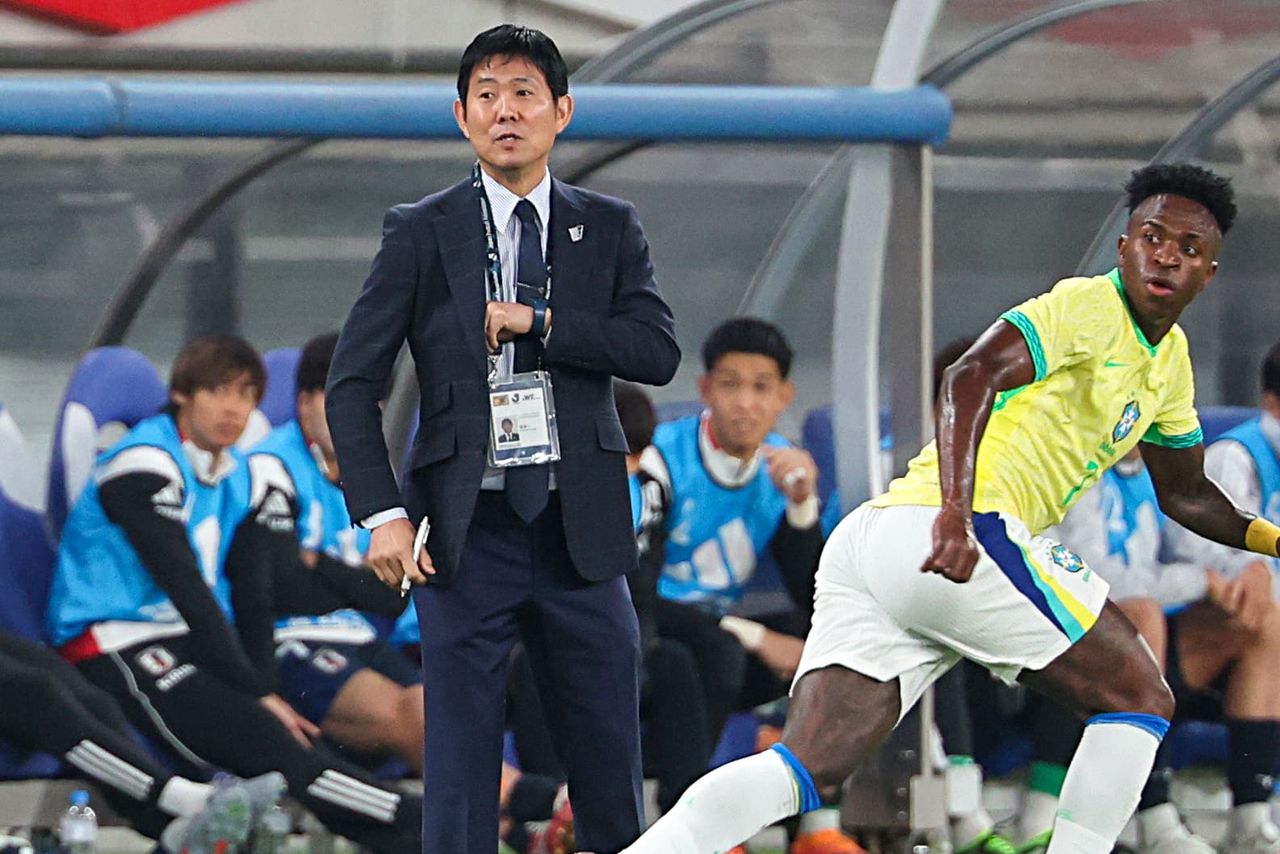
Japanese manager Moriyasu Hajime watches the action during the first half of Japan’s friendly against Brazil in Tokyo on October 14, 2025. (© Jiji)
Japan just missed making it to the quarterfinals at the 2018 World Cup in Russia after a late collapse allowed Belgium to score the winning goal in the dying seconds of stoppage time. It was even closer at the 2022 tournament in Qatar, where under Moriyasu the team was eliminated by Croatia on penalties. Reflecting on the loss, the Japanese manager said, “I felt certain that if we had cleared the hurdle of the round of sixteen, we had the ability to make it all the way to the final match, and could have even won the championship.” Looking toward the 2026 tournament, Moriyasu stands by his belief that Japan has the drive and talent to lift the cup at this year’s tournament.
A Europe-Heavy Roster
The Japanese team is dominated by players based in Europe. Of the 26-man squad, only three play in the domestic J. League, although one of them—defender Nagatomo Yūto, who is making his fifth World Cup appearance—spent more than a decade at different clubs in Europe, including a long stint at Inter Milan.
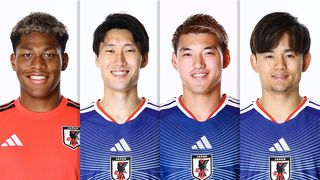
This is a major change from Japan’s first World Cup appearance in 1998, when not a single member of the national team played abroad. Starting with Nakata Hidetoshi’s move to the Italian Serie A side Perugia following the tournament, though, there has been a growing stream of Japanese players leaving the J. League for European teams. Currently, more than 100 male and female Japanese players compete in leagues in Europe.
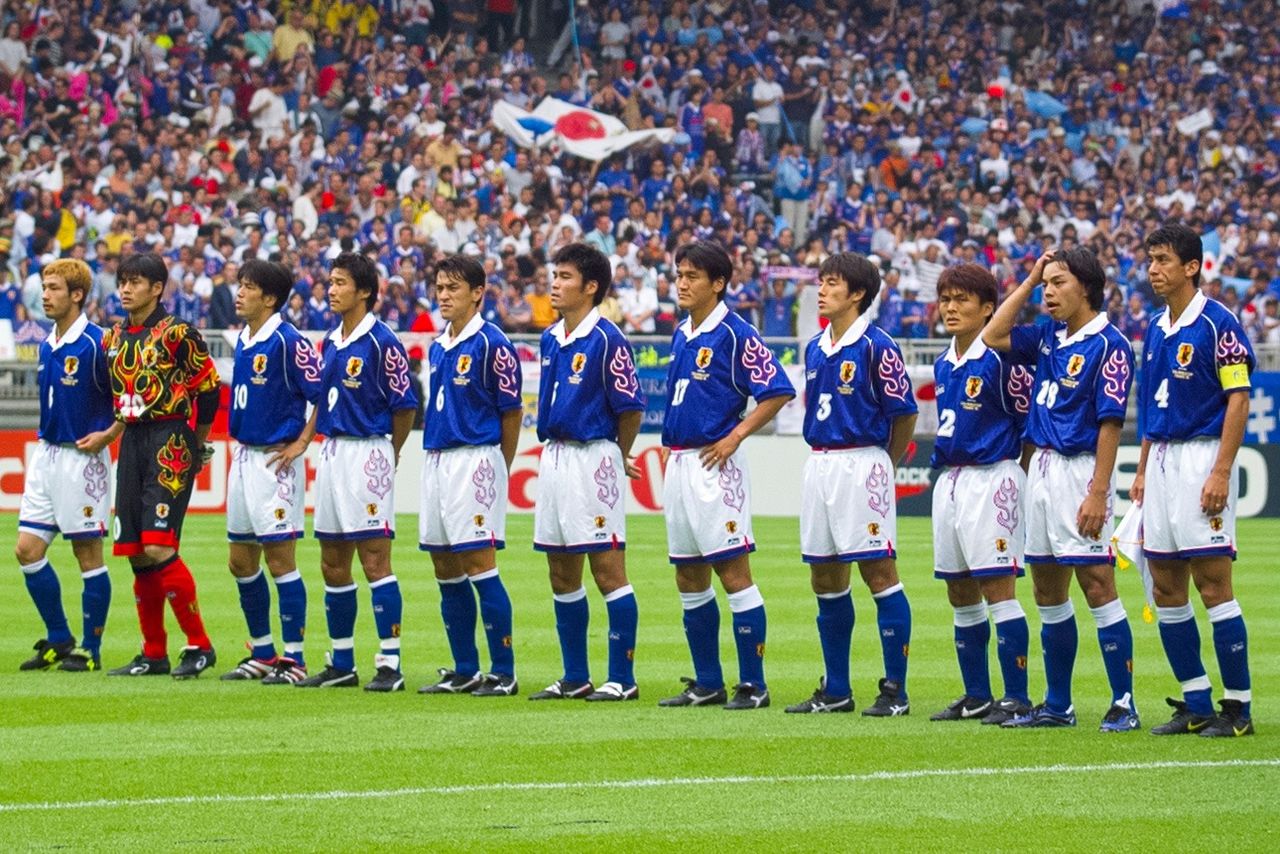
Japan ahead of its match against Jamaica at the 1998 World Cup in Lyon, France, on June 26, 1998. (© Jiji)
Europe, as the pinnacle of professional soccer, now stands at the center of Japan’s strategy. Its leagues, populated by the best players from around the globe, have served as the training grounds for Japan’s top footballers, who have honed their individual talents in line with playing styles on the continent. For validation of Japan’s strategic shift to Europe, one has to look no further than the national team’s 7–1 record against European sides, including stunning wins against powerhouses Germany and Spain, under Moriyasu.
However, Japan’s hopes of extending its winning record received a blow with the injury of Mitoma Kaoru, who will miss the tournament with a hamstring tear. The Brighton playmaker has been a linchpin of Japan’s attack, but even without the left winger, the squad boasts a roster of talent that has sharpened its skills in what are arguably the top five leagues in the world.
An Expanding Domestic League
The J. League, Japan’s top-flight professional soccer competition, has over its more than 30 years raised the level of domestic play and firmly established the popularity of the sport. Starting with just 10 clubs in 1993, today it consists of 60 teams, with all but five of Japan’s 47 prefectures having at least one team in one of the league’s three tiers.
The national team’s focus on players based in Europe has significantly reduced the presence of J. League talent on the roster. However, European scouts have taken notice of Japan’s pool of talented footballers, and the number of players moving from the Japanese league to a team on the continent has continued to grow. Moriyasu at the press conference announcing the Samurai Blue squad noted the importance of the J. League as a proving ground for young Japanese talent, saying that “it prepared them to play at the international level.”
Helping raise the visibility of domestic players was the J. League’s long-term broadcasting deal inked in 2017 with the sports-focused streaming giant DAZN. The current 11-year contract runs to 2033 and will bring ¥239.5 billion into the league’s coffer to be distributed among the teams. Clubs have also received a boost from growing attendance, which in 2025 hit a record high of 13.5 million, with the attendance at first-division J1 matches averaging 21,246.
Wooing Casual Fans
At the same time, soccer must contend with a recent loss of popularity in the Japanese market. In a 2025 survey of interest in sports by the Japanese advertising giant Dentsū, baseball ranked highest at 36.0%, followed by men’s soccer at 25.8%. When respondents were asked about athletes they follow in the news, only Mitoma Kaoru and Kubo Takefusa made the top 20 from the soccer contingent, coming in at sixth and seventh, respectively.
Soccer ranked even lower in terms of interest in major tournaments and leagues. The FIFA World Cup was sixth overall behind the World Baseball Classic, the Summer and Winter Olympics, the spring and summer national high school baseball championships held at Kōshien Stadium, and the Hakone Ekiden long-distance relay race. The J. League languished at twentieth, and European soccer failed to make the top 20.
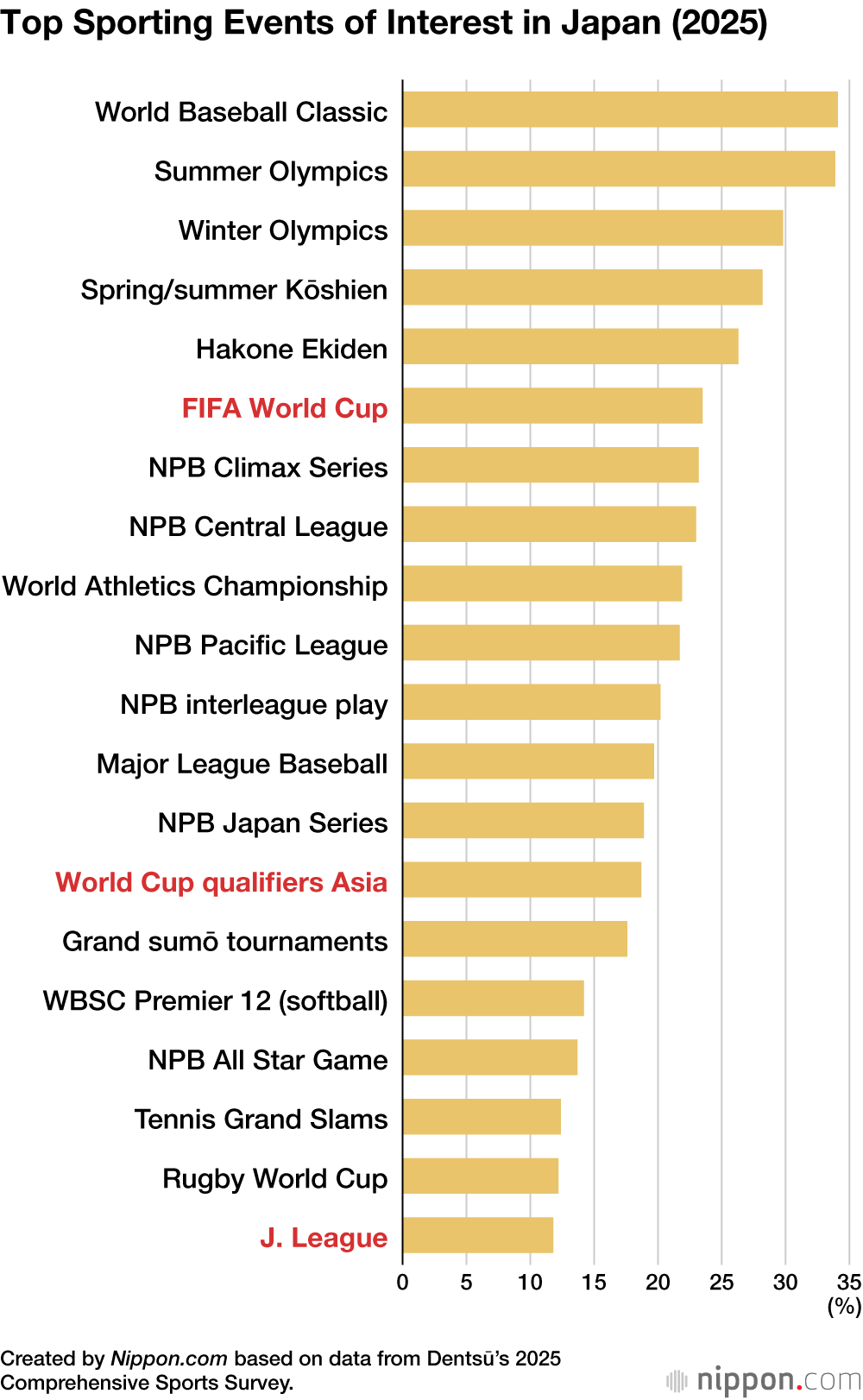
Soccer’s low ranking in the survey is influenced by the fact that most J. League matches are only available to watch on DAZN, which requires a subscription, and that national team players, based far away in Europe, receive only limited domestic media exposure. FIFA expanding the World Cup from 32 to 48 teams has also had an impact by reducing the one-time thrill of qualifying rounds, with Japan facing far less competition in securing one of the 8.5 spots now available, compared to when there were only 4.5 up for grabs.
The overall result is soccer’s overall diminishing domestic profile. Casual soccer followers are inundated daily with news of Major League Baseball star Ohtani Shōhei but only hear snippets of the exploits of Japanese footballers, a situation that has improved little even with the approach of the World Cup. This has created a growing divide between casual fans and dedicated supporters who actively follow J. League clubs and the national team.
A Mounting Sense of Urgency
The JFA has awoken to the urgency of this situation, and has begun to push for more terrestrial broadcasts of national team matches. In March of this year, it signed a four-year deal with Dentsū starting from 2027 designed to prevent exclusive paid streaming of Samurai Blue games.
It will take time to raise interest among the public, however. Japan’s historic win against England was aired live on public broadcaster NHK, but limited prematch coverage and a 3:45 am kickoff time in Japan kept viewership (as measured in the Kantō region) to a dismal 2.9%.
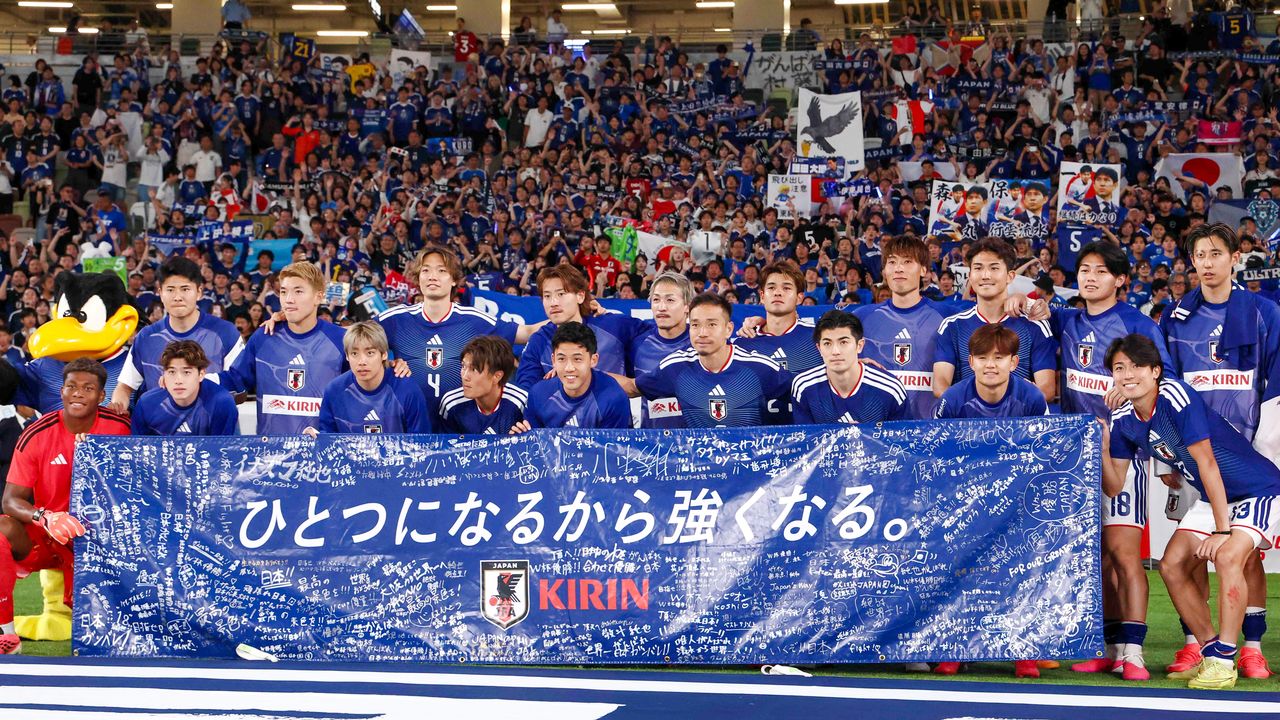
A better crowd was on hand for the May 31 friendly against Iceland, ranked seventy-fifth in the world, with more than 62,000 seats filled at the National Stadium in Tokyo. Worries continued to mount for Moriyasu’s squad, though, with Mitoma being joined on the injury list by another offensive mainstay being considered for inclusion on the team roster, Minamino Takumi (Monaco). In the end, Japan eked out a 1–0 win in the last minutes of play.
All 104 World Cup matches will be streamed live on DAZN and broadcast live or delayed on one of NHK’s satellite channels. NHK will also carry 34 matches on its general terrestrial channel, including all of the Japanese national team games, with an additional 15 shown by commercial broadcaster Nippon TV and 10 by Fuji TV.
Moriyasu has emphasized the importance of Japanese fans getting behind the team as it kicks off the final stages of the World Cup campaign. However, it has yet to be seen to what degree the Japanese public will take an interest in the exploits of Samurai Blue and the tournament more broadly.
(Originally published in Japanese. Banner photo: Members of Samurai Blue pose for a commemorative photo ahead of the May 31, 2026, friendly against Iceland at the National Stadium in Tokyo. © Jiji.)