New Handbook Supports Japanese Communities with Growing Foreign Populations
Newsfrom Japan
Society- English
- 日本語
- 简体字
- 繁體字
- Français
- Español
- العربية
- Русский
Lessons from Communities with Experience
At the end of 2025, Japan was home to a record 4.1 million foreign residents—surpassing 4 million for the first time and marking a 9.5% increase from the previous year. While foreign workers and their families have long been concentrated in manufacturing hubs, they are now settling in municipalities across the country, including farming communities, resort areas, and suburbs surrounding major cities.
Communities with decades of experience have developed support systems, offering Japanese-language classes, consultation services, and educational assistance for children. Elsewhere, however, local governments are struggling to create opportunities for engagement with newcomers and often lack the budget, personnel, and know-how to launch new initiatives.
To support such communities, the Sasakawa Peace Foundation recently published Gaikokujin jūmin to no kyōsei handobukku (Handbook for Living Together with Foreign Residents), a Japanese text that showcases practical examples of how communities can begin efforts tailored to their local circumstances.
A Road Map for Inclusion
The handbook addresses topics such as creating opportunities for interaction with foreign residents, building partnerships among local organizations, identifying community needs through surveys, making plans and securing budgets, and encouraging participation in local decision-making. It highlights 27 pioneering case studies spanning seven fields: daily life support, Japanese-language education, schooling, employment, healthcare and mental health, welfare and pensions, and disaster preparedness.
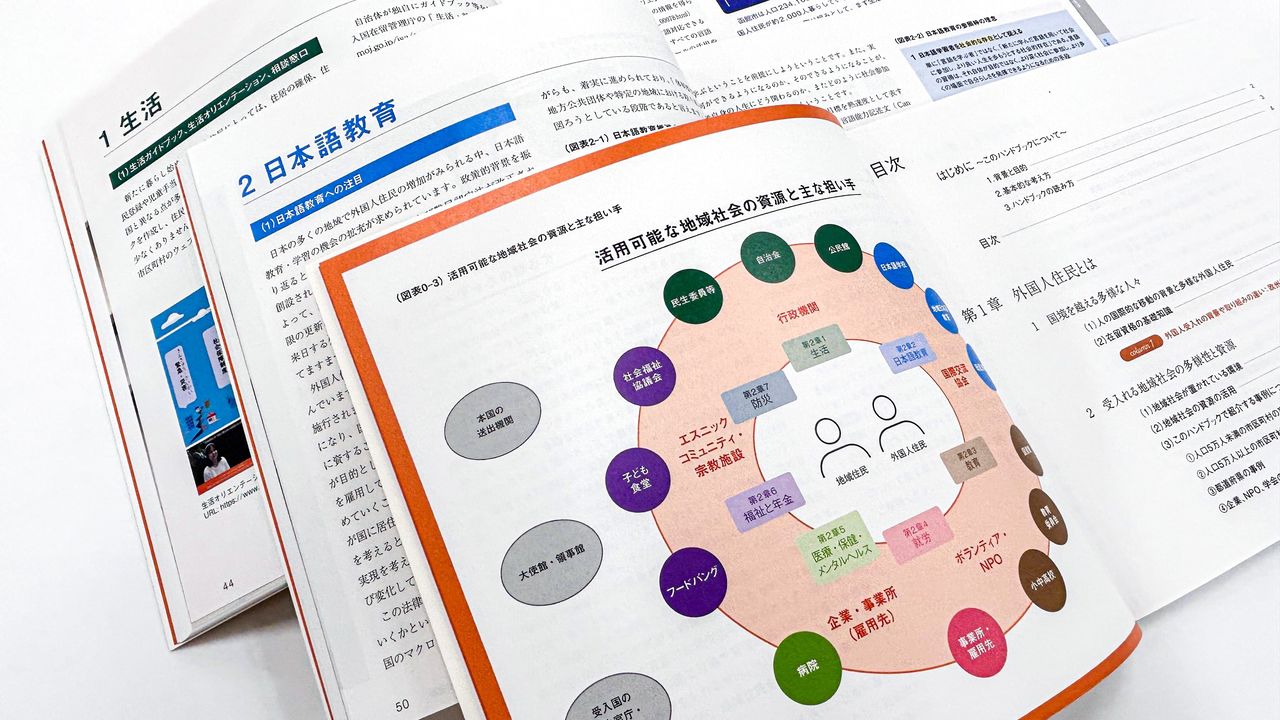
The handbook brings together best practices from across Japan. (© Matsumoto Sōichi)
In the field of Japanese-language education, it introduces an initiative by the town of Kanda in Fukuoka Prefecture, which mitigates a shortage of Japanese-language teachers by combining online lessons taught by specialists with in-person support from municipal employees. Another case study features a multilingual program launched by the city of Akita to help foreign residents prepare for work and childcare, making it easier for parents to balance employment and family responsibilities.
The guidebook notes that successful initiatives share several key characteristics: collaboration among local organizations, connections to prefectural and national support systems, and a commitment to involving both Japanese and foreign residents in community-building efforts. The featured initiatives were selected not only for their effectiveness but also for their potential to be replicated elsewhere using existing human and organizational resources.
Preventing Social Division
Speaking at a press conference marking the handbook’s publication, Sasakawa Peace Foundation President Sunami Atsushi emphasized that fostering inclusive communities is becoming increasingly important as Japan confronts demographic change. “With the country’s aging population and declining birthrate, the need for foreign workers is growing, and foreign residents are playing an ever more important role in local communities,” he said. “It’s vital that we think about—and put into practice—measures to prevent the presence of foreign residents from sowing social division.”
To encourage wider adoption of the activities presented in the handbook, the SPF plans to hold workshops connecting communities interested in launching new initiatives with organizations featured in the publication.
The 116-page handbook has been distributed to municipal and prefectural governments nationwide. A PDF version (Japanese language only) can be downloaded free of charge on the Sasakawa Peace Foundation website.
(Originally written in Japanese by Matsumoto Sōichi of Nippon.com. Banner photo: SPF’s handbook for living together with foreign residents, distributed to local governments nationwide. © Matsumoto Sōichi.)