Meticulous Experimentation Earned Soai Nobel
Newsfrom Japan
Science Society Technology- English
- 日本語
- 简体字
- 繁體字
- Français
- Español
- العربية
- Русский
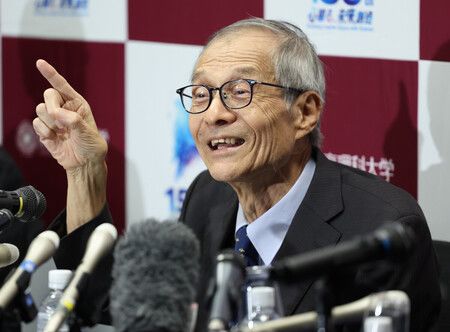
Tokyo, Oct. 8 (Jiji Press)--Kenso Soai, a 76-year-old Japanese researcher, won the 2026 Nobel Prize in Chemistry after spending day after day immersing himself in painstaking experimentation without complaint.
What is important in research is "to keep on conducting experiments," Soai said at a press conference Wednesday after the Royal Swedish Academy of Sciences announced its decision to confer this year's chemistry Nobel on Soai and French chemist Henri Kagan for "the discovery of non-linear effects and autocatalysis in asymmetric organic synthesis."
Molecules that comprise life exist as two forms that are each other's mirror image, but biomolecules on Earth consist of one of those forms.
Finding that fact to be "very wondrous," Soai, now professor emeritus at Tokyo University of Science, began his quest to understand the mechanism. In 1995, he discovered a catalytic reaction in which only one of the two possible mirror images was formed. Reproducing the reaction seen in nature was a breakthrough.
Soai had a rough road in his research. He said creating a target organic compound was like "climbing a mountain to reach it." In contrast, he recalled his research as "not knowing if there even was a mountain. It felt like walking in the dark with a headlamp on, following the ground."


[Copyright The Jiji Press, Ltd.]