A Guide to Preparing for Disaster in Japan
Guideto Japan
Society Disaster
Tamura Tarō
Born in Hyōgo Prefecture in 1971. Founded the Multicultural Center Osaka after the Great Hanshin-Awaji Earthquake in 1995. As representative director of the Institute for Human Diversity Japan, which he founded in 2007, he provides support in disaster areas and encourages diversity initiatives in companies and local authorities.
- English
- 日本語
- 简体字
- 繁體字
- Français
- Español
- العربية
- Русский
Staying Safe
In 2025, Japan welcomed more than 42 million visitors from overseas. While the country is known for its seasonal scenery and has a reputation for being safe, it also faces natural disasters from typhoons and heavy snow that disrupt transportation each year to occasional major earthquakes that may even cause loss of life. Below we talk with Tamura Tarō, a specialist in disaster response and preparedness measures, and present information that will help visitors to Japan if an emergency takes place during their time here.
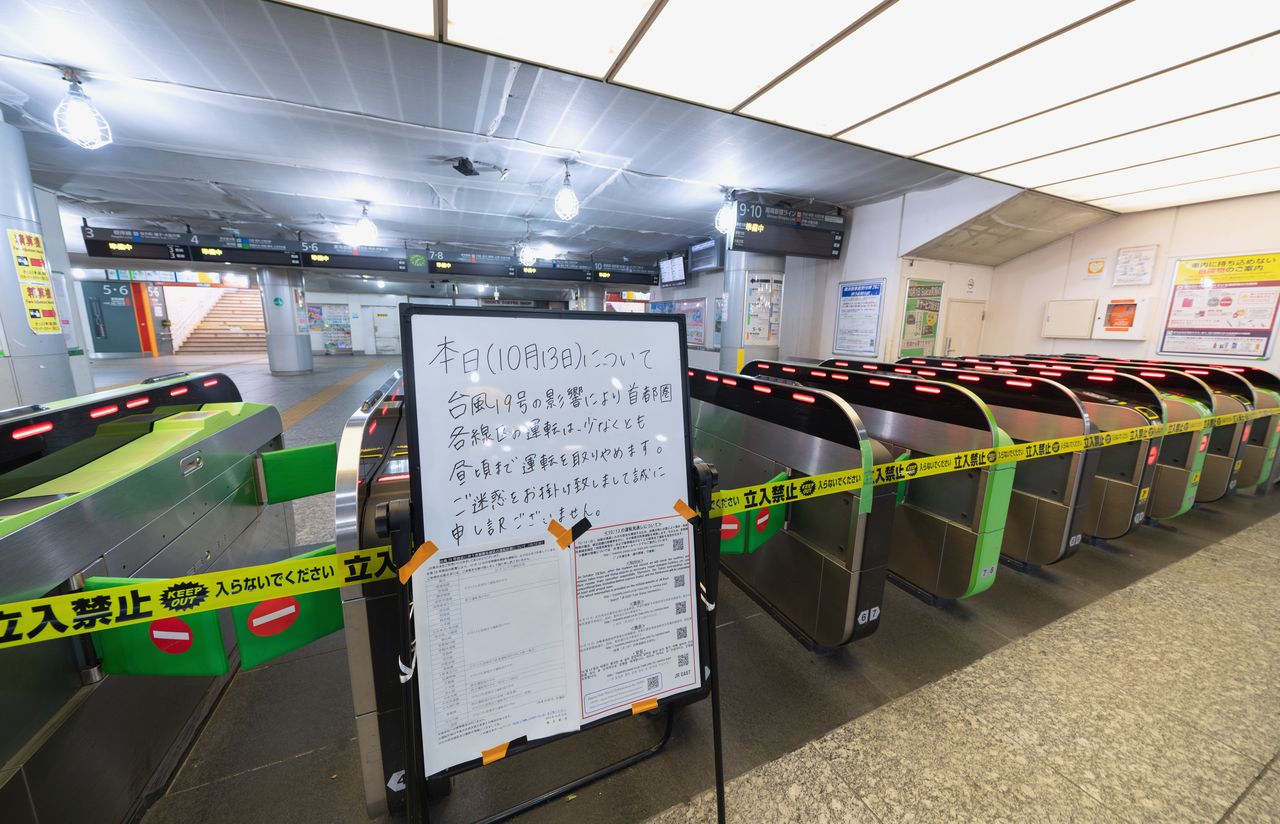
During severe weather, such as typhoons, public transportation stoppages are common. In the event of a disaster, stations, airports, and accommodation facilities may provide spaces where people can wait. (© Pixta)
Before Arriving in Japan
□Buy Travel Insurance
As visitors who require medical treatment in Japan must generally pay for it themselves, travel insurance is recommended.
□Read Disaster Preparedness Information
Learn the basics about disasters that commonly occur, such as via multilingual websites from official organizations.
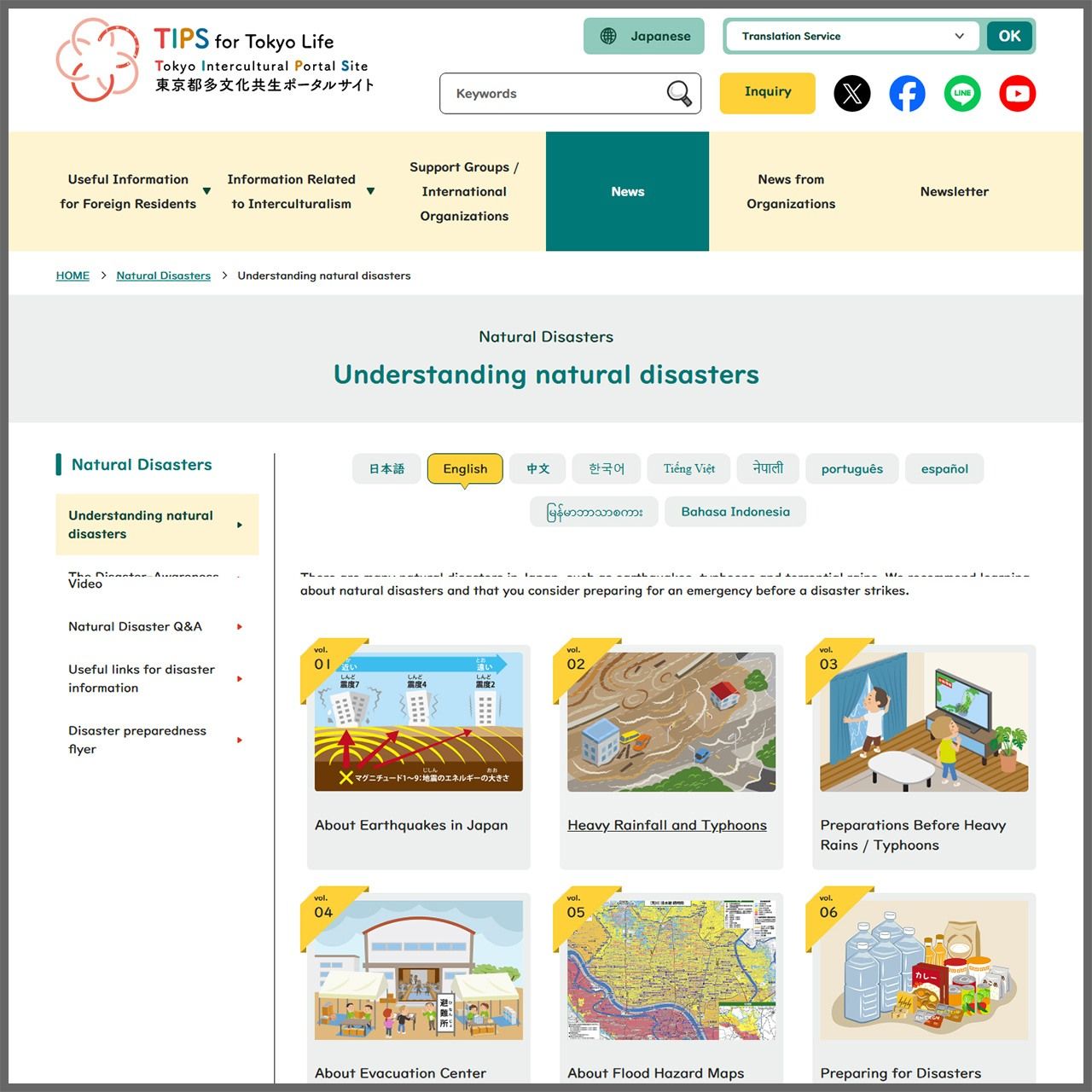
Understanding Natural Disasters on the Tokyo Intercultural Portal Site is one good option. It includes links to other recommended websites.
Getting Information on Disasters as They Happen
□Safety Tips App
The multilingual Safety Tips, overseen by the Japan Tourism Agency, provides alerts about earthquakes and other disasters, as well as evacuation information. Downloading this free app in advance is recommended.
□News
Users of the NHK World website and app from public broadcaster NHK can watch news about Japan, including disaster information. Audio is available in English, and text in a variety of languages.
□Visitor Hotline
The Japan National Tourism Organization operates a visitor hotline that is available around the clock, throughout the year, with support in Japanese, English, Chinese, and Korean.
050-3816-2787
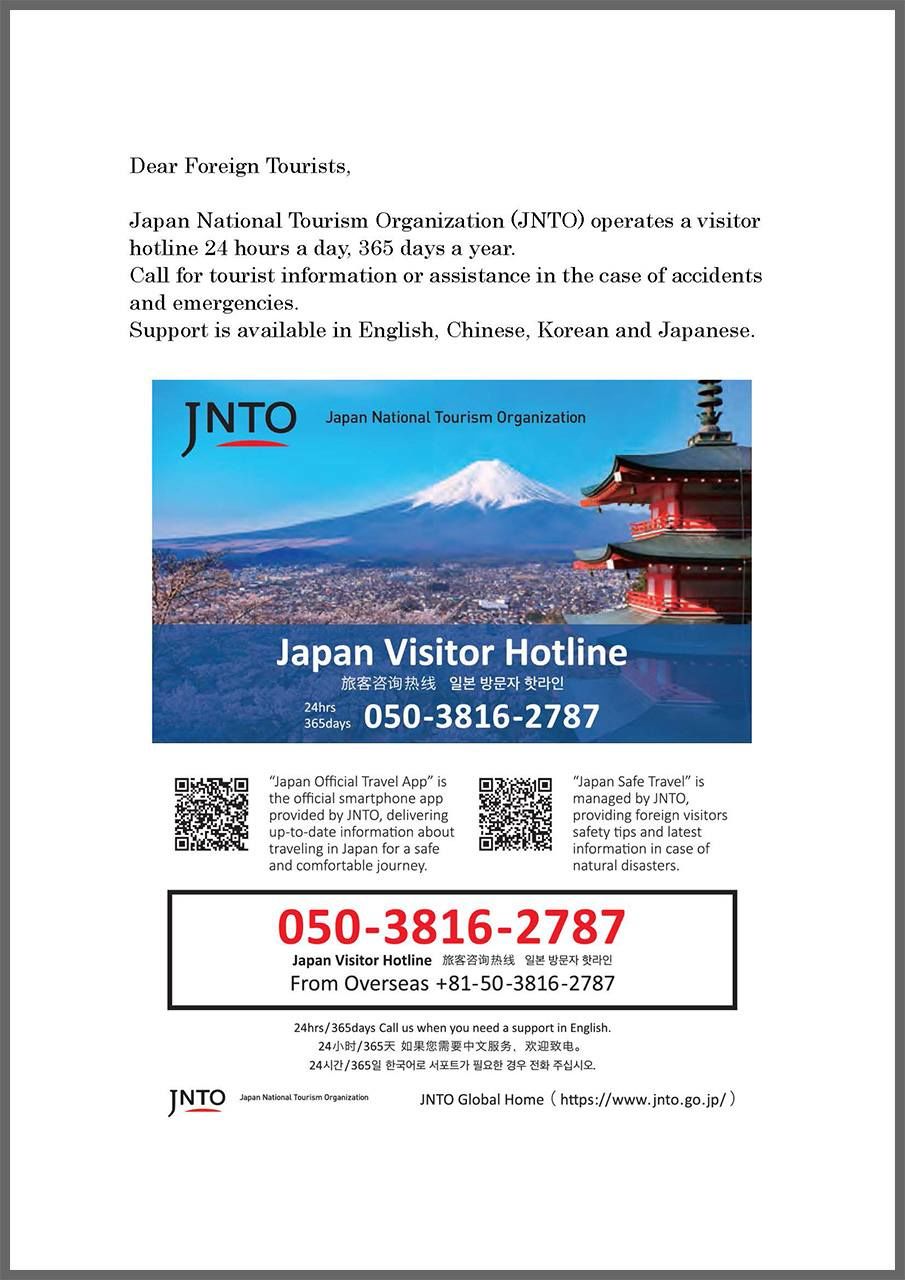
A poster advertising the Japan Visitor Hotline.
What to Do if Caught Up in a Disaster
□Getting Emergency Assistance
If injured or trapped in a building, call the toll-free number 119 immediately to reach emergency fire/ambulance services. They will assist anyone in need.
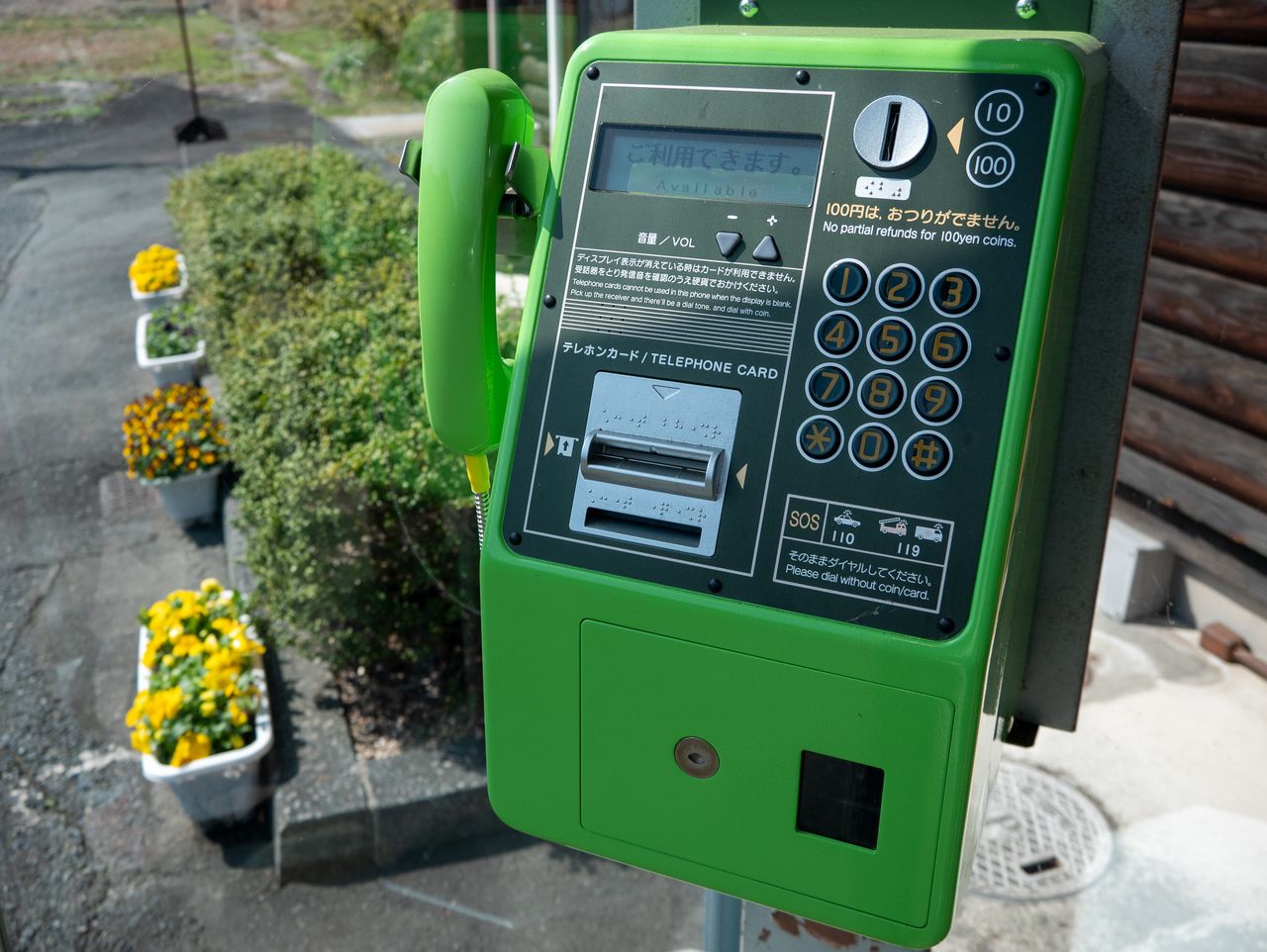
If you cannot use a mobile phone, look for a payphone. There is no need to insert coins for emergency calls. (© Pixta)
□Contact Your Embassy or Consulate
Embassies and consulates can help with finding medical facilities, and contacting family or insurance companies.
□Confirming Safety
During a disaster, when mobile phone services are difficult to access, calling 171 allows users to access the Disaster Emergency Message Dial service to record or play back messages. The automated phone menu is in Japanese only, but there are English instructions here. The Web171 message board system is available in English, Chinese, and Korean.
□Evacuating to a Safe Location
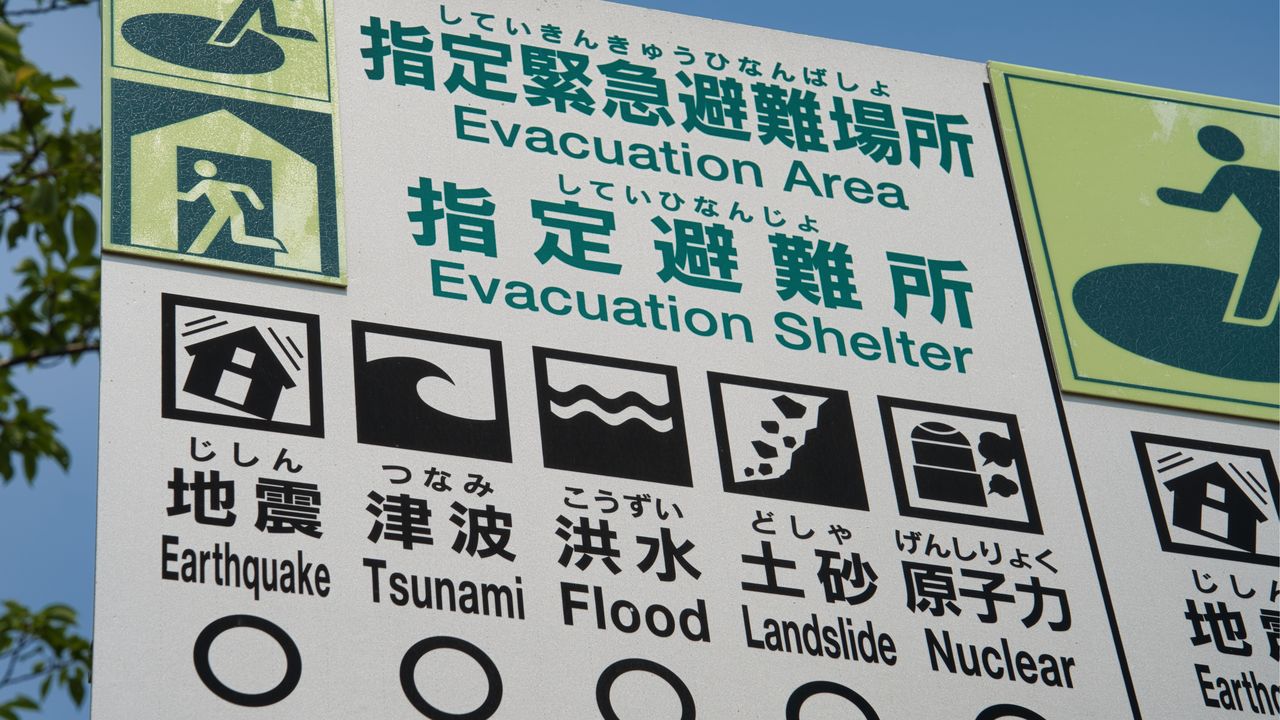
Evacuation areas (hinan basho): These are places where people can go to get away from the immediate danger of the effects of disasters, such as fires or collapsing buildings. Typically, they are in locations like parks or sports fields. In areas near the sea or rivers, where there is a tsunami risk, evacuate at once to higher ground or the upper floors of solidly constructed buildings.
Evacuation shelters (hinanjo): Places of accommodation for people unable to stay in their homes or facing difficulties reaching where they want to go after a disaster. Generally, they are public facilities like schools and gymnasiums. Water, food, blankets, and other necessary items are supplied free of charge.
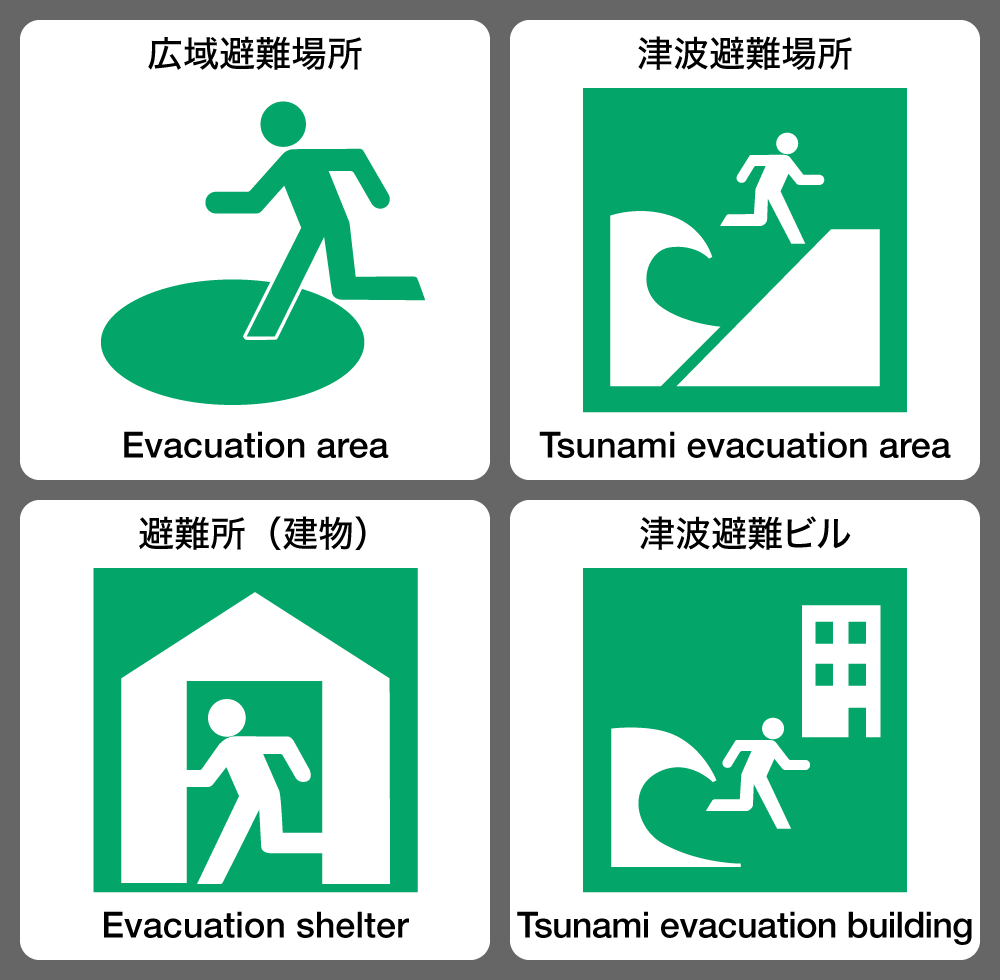
Pictograms indicating different kinds of indoor and outdoor evacuation locations. (© Pixta)
While disaster information on television is almost entirely in Japanese, there may be QR codes allowing device users to access multilingual websites. If a warning is issued, refrain from going outside.
Color coding is useful for people who do not understand Japanese. Earthquake and tsunami alerts on televisions show maps of Japan with zones colored purple or red indicating that people should immediately evacuate. Green, representing safety, is used for emergency exits and evacuation areas. Recent years have seen the spread of international standards for colors in emergency situations, like those for traffic lights and road signs.
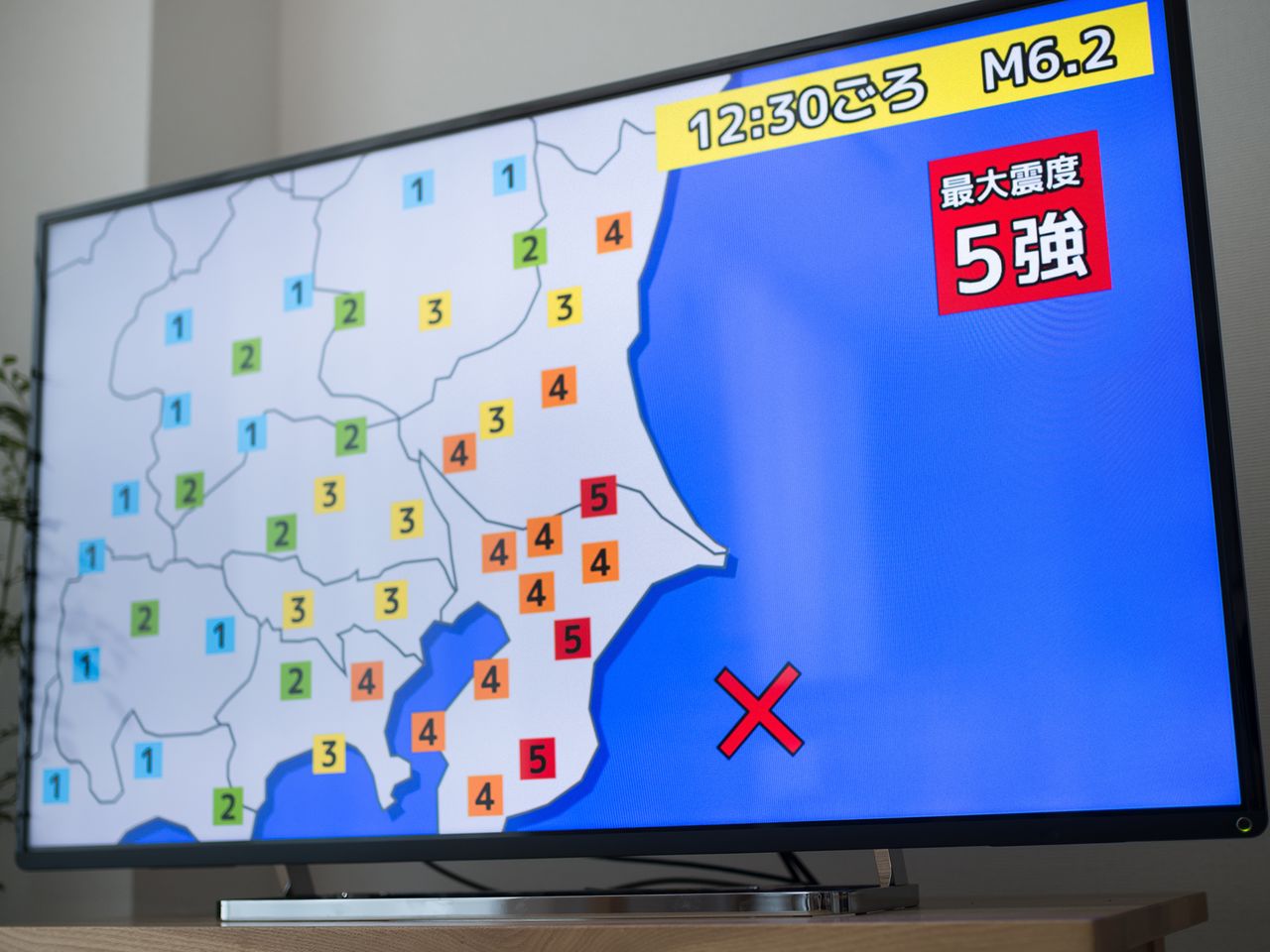
The level of shaking is indicated on maps with numbers and different colors indicating the level of danger. (Photo for illustrative purposes only; © Pixta)
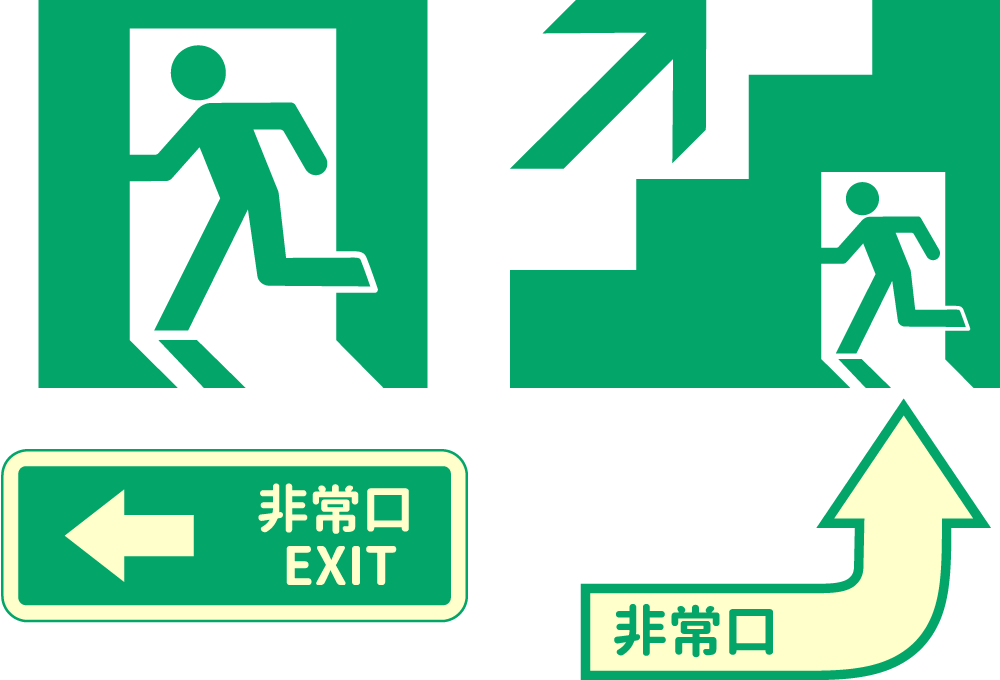
Green is used to indicate a route to safety. (© Pixta)
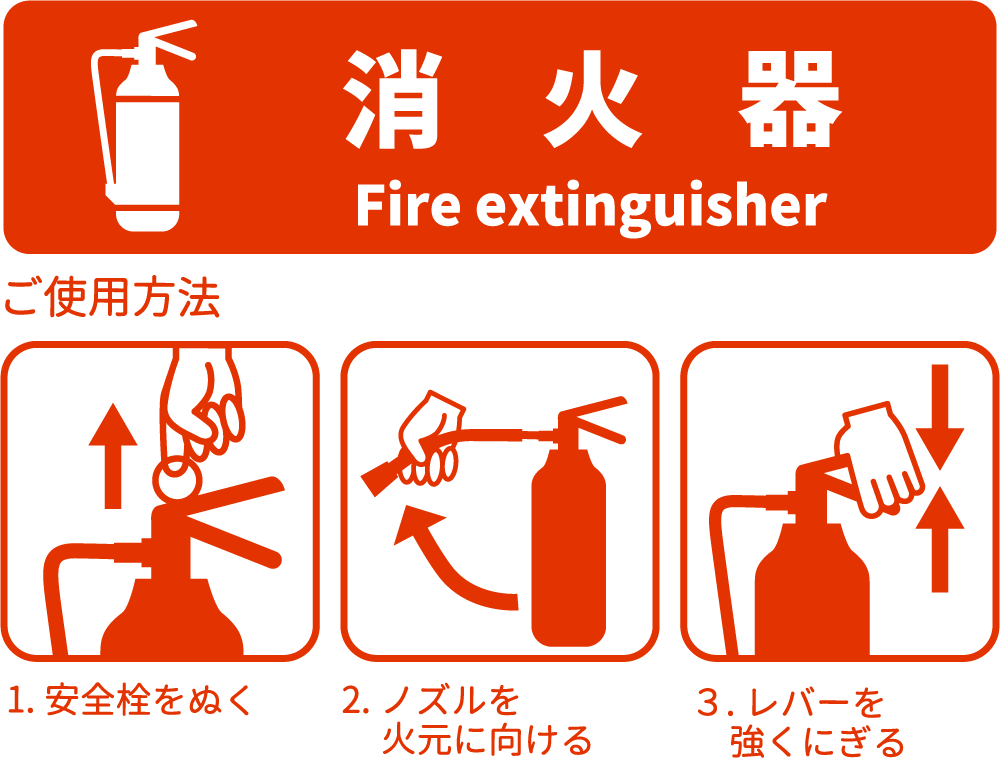
As well as indicating danger or emergency, red is used for fire safety signage. (© Pixta)
Official efforts to support foreign residents have made progress. For example, when disasters happen, local governments establish multilingual support centers with information available via telephone and online. However, as these are not permanent bodies, it is necessary to find the telephone number through an online search or another method.
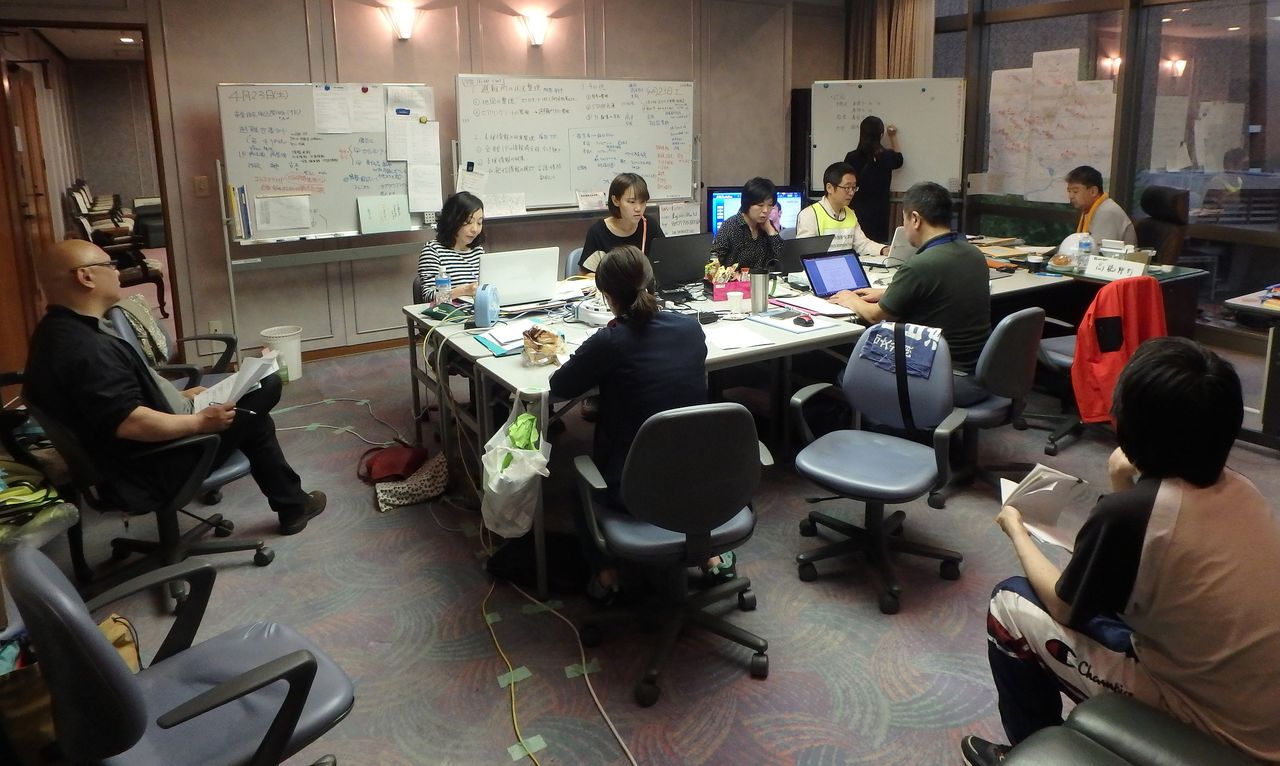
A multilingual support center established after the Kumamoto earthquakes. Photograph taken on April 23, 2016. (Courtesy NPO Tabumane; © Jiji)
Cultural Differences
Numerous public groups are now providing multilingual disaster preparedness information and tools. Additionally, “translation apps are now standard on smartphones, lowering the language barrier,” comments Tamura Tarō, representative director of the Institute for Human Diversity Japan. “You can find information or ask an AI tool for help. In fact, apart from water and food, power sources and Wi-Fi for internet access have been in greatest demand at evacuation shelters in recent years.”
Tamura was working at a rental video store for foreign customers on January 17, 1995, when the Great Hanshin-Awaji Earthquake took place. He and other volunteers established a 24-hour multilingual hotline for residents isolated by the disaster and unable to access information. This experience led him to work to build a society that embraces diversity and inclusion, and he was also involved in disaster relief efforts following the Great East Japan Earthquake in 2011, as well as earthquakes in Kumamoto in 2016 and the Noto Peninsula in 2024.
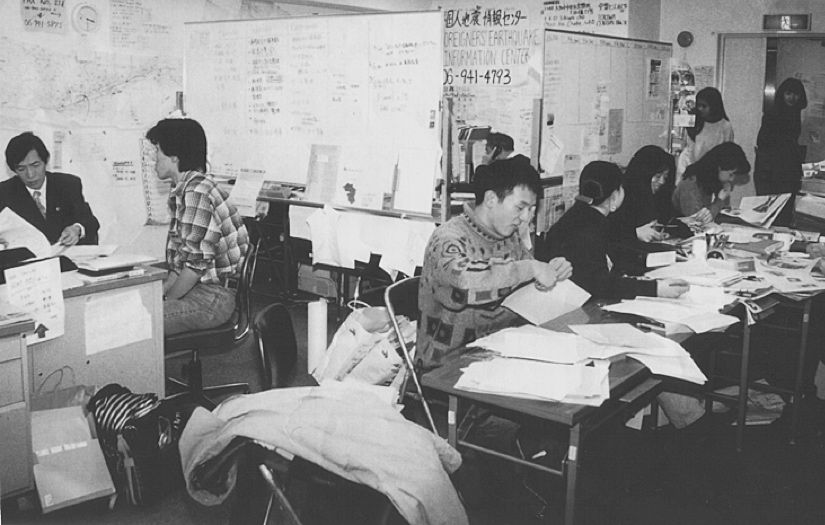
Tamura (second from left) at the Foreigners Earthquake Information Center, which he helped to establish in 1995. At this time, few people had mobile phones or access to the internet, and the center’s telephone number was publicized via flyers, newspapers and the radio. (© Institute for Human Diversity Japan)
Over the past 30 years, steady technological and institutional progress has boosted disaster preparedness, including the widespread use of smartphones and revisions to building standards to improve earthquake resilience. However, while the number of foreign residents has tripled and there are 12 times as many international visitors today, evacuation measures for foreigners are far from adequate. Tamura says, “We need to convey the dangers of earthquakes and typhoons to people from countries that don’t have them, as well as evacuation methods, but cultural differences are a barrier.”
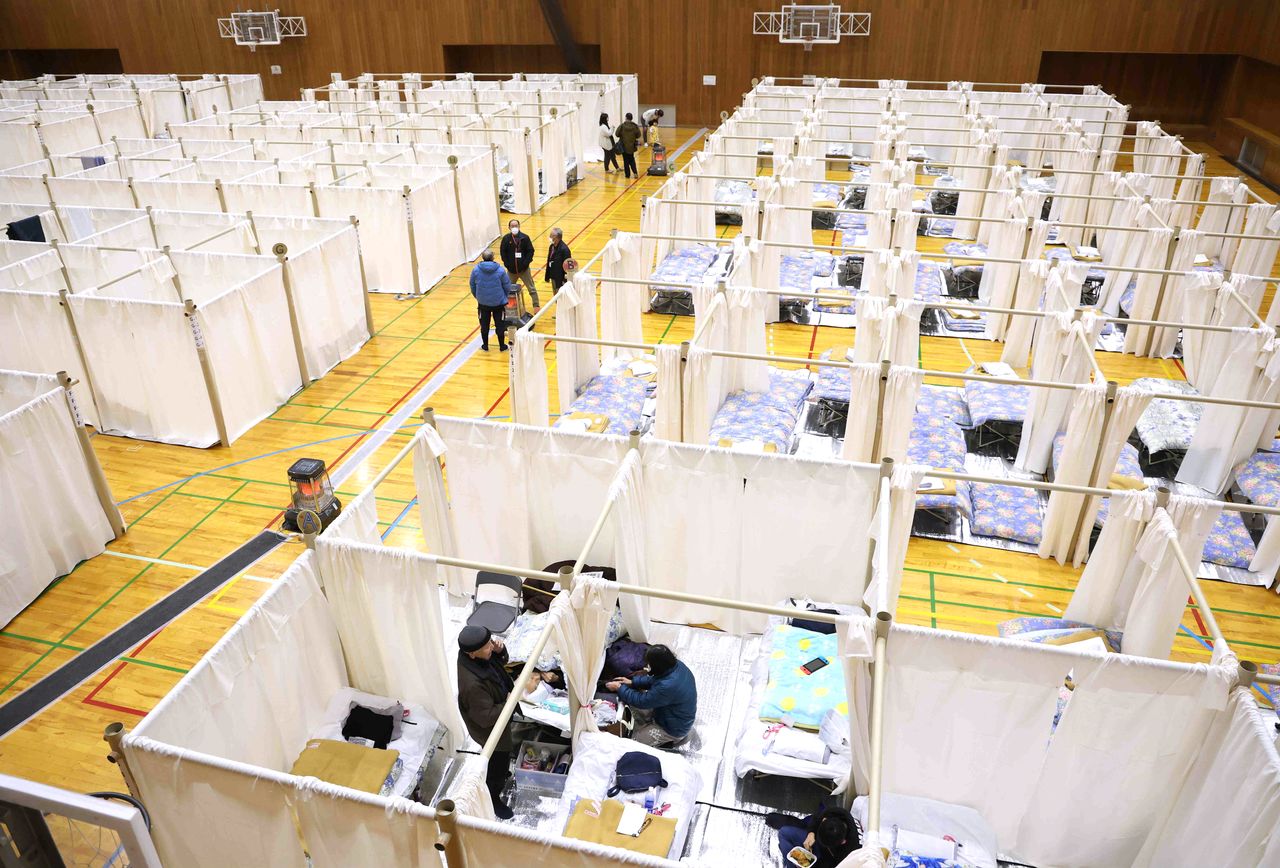
An evacuation shelter in Kanazawa on January 11, 2024, after the Noto earthquake. (© Jiji)
While Japan’s evacuation drills are for earthquakes and fires, people from many countries might associate such drills with terrorism or war. Also, it is common for evacuation facilities in other countries to involve setting up tents in open spaces, and Japan is comparatively rare in having people sleep indoors in places like school gymnasiums.
“In countries with a stone architecture tradition, many buildings collapse during earthquakes, and some people think that public buildings like schools are unstable and dangerous,” Tamura says. “At the time of the Kumamoto earthquakes, there was a case where some people evacuated to the park because they were afraid of buildings collapsing, and they were reported to the police as loitering foreigners.”
Evacuation shelters are available for everyone, regardless of nationality, but some foreign people are hesitant to use them. On the Japanese side, if there is little habitual contact with people from other countries, this often leads to misunderstandings and prejudice, so it can feel awkward even to start a conversation. Tamura is concerned about these psychological barriers.
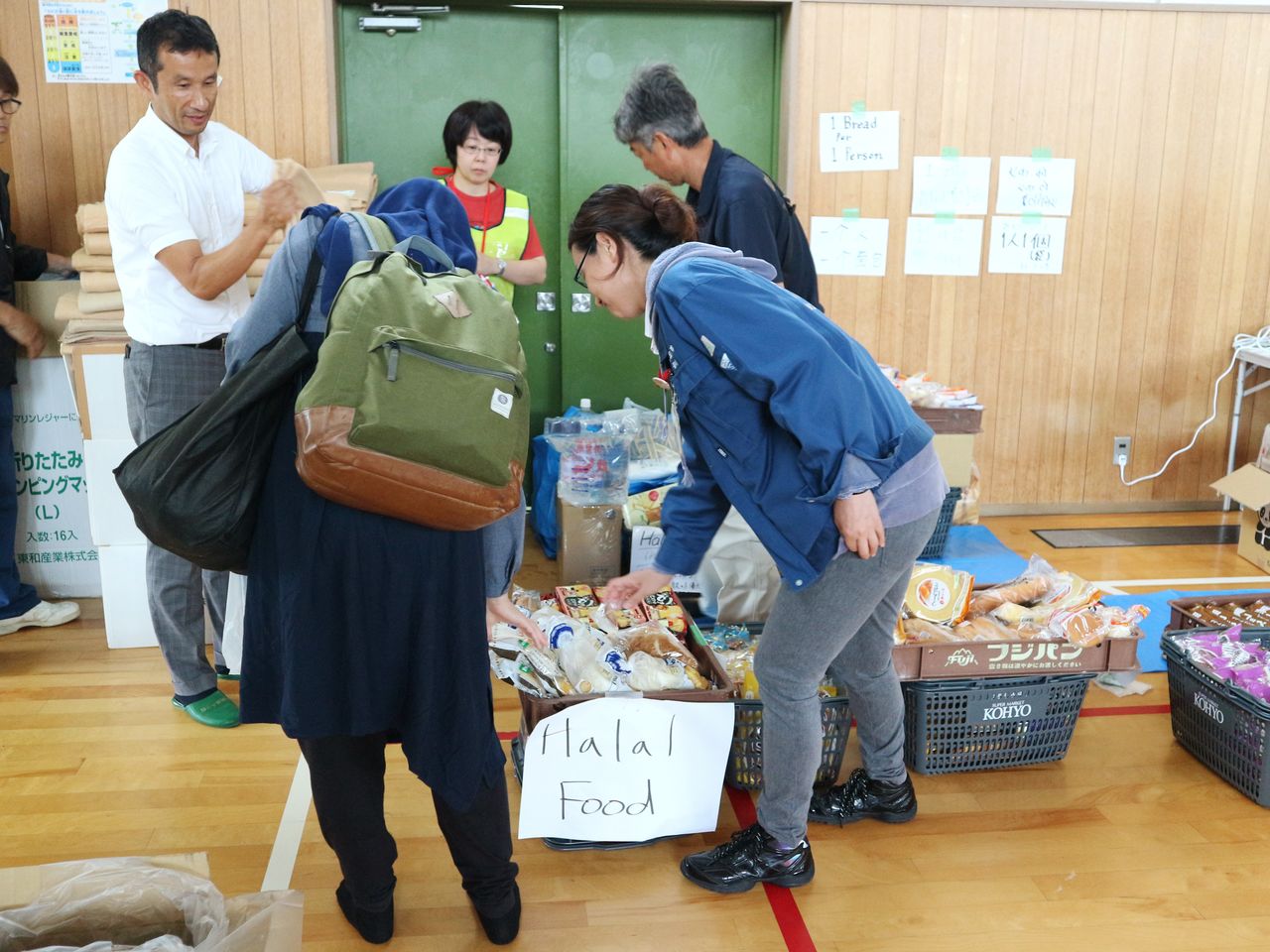
After a 2018 earthquake in Osaka, a city employee explained about halal food provided at an elementary school shelter in Minō, where most of those staying were foreign nationals. Photo taken on June 20, 2018. (© Jiji)
Shelters tend to provide the same supplies to everybody, and it is unusual for there to be emergency food meeting the specific needs of foreigners. This is where mutual aid activities by foreign communities cab show their value. After the earthquakes in Kumamoto and Noto, the Muslim community in Japan quickly provided support, distributing halal food to Muslims in the disaster areas, as well as serving up curry meals to Japanese citizens.
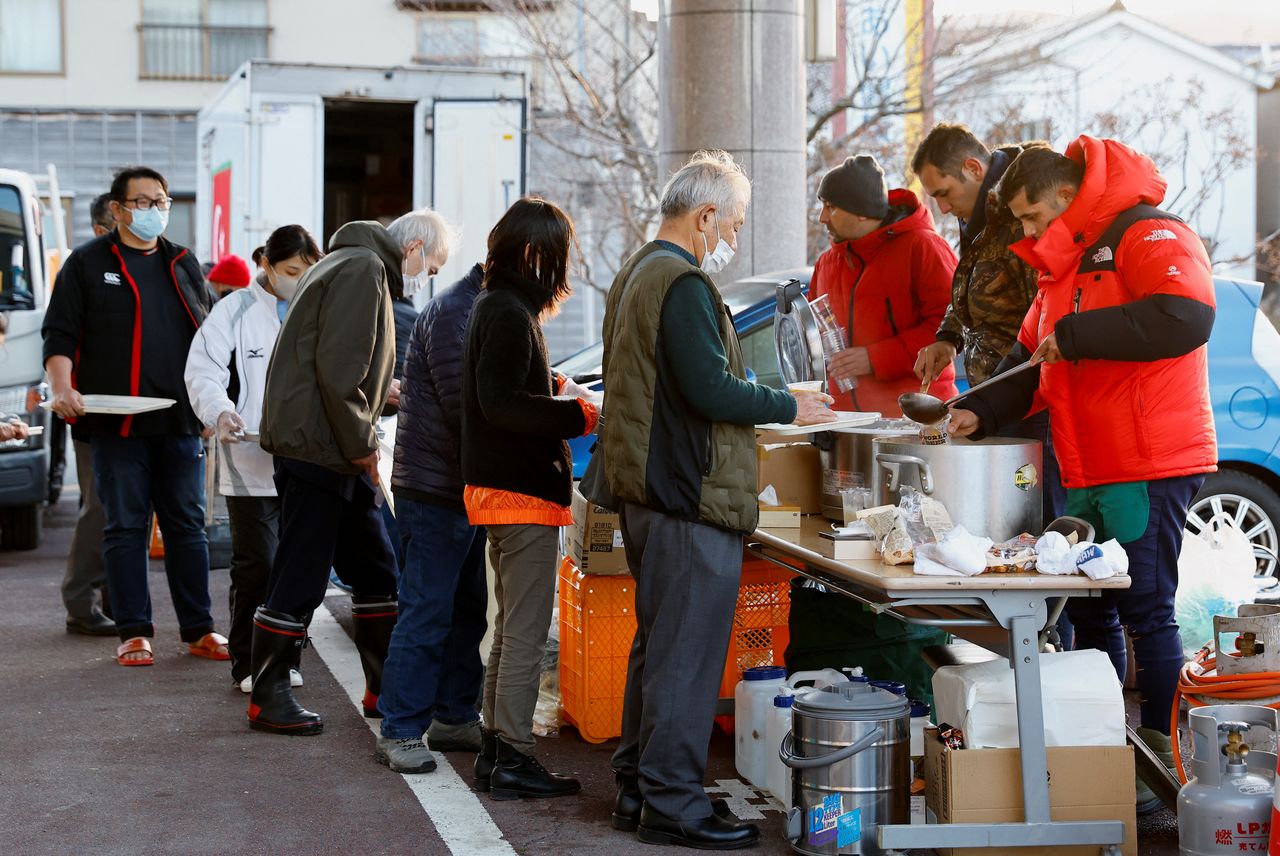
Foreign volunteers serving food on January 5, 2024, after the Noto earthquake. (© Reuters)
With the increase in local communities that are aging across Japan, Tamura hopes that foreign residents will step in to supporting roles. He recommends participating in disaster drills, community fire brigades, and local festivals. “In festivals, there are activities like carrying, pulling, and spraying water that are also useful in disaster situations,” he says, noting that getting involved can help revitalize the community.
If Japan can provide multilingual disaster preparedness information and incorporate foreign perspectives, it could become a model for others in its disaster measures.
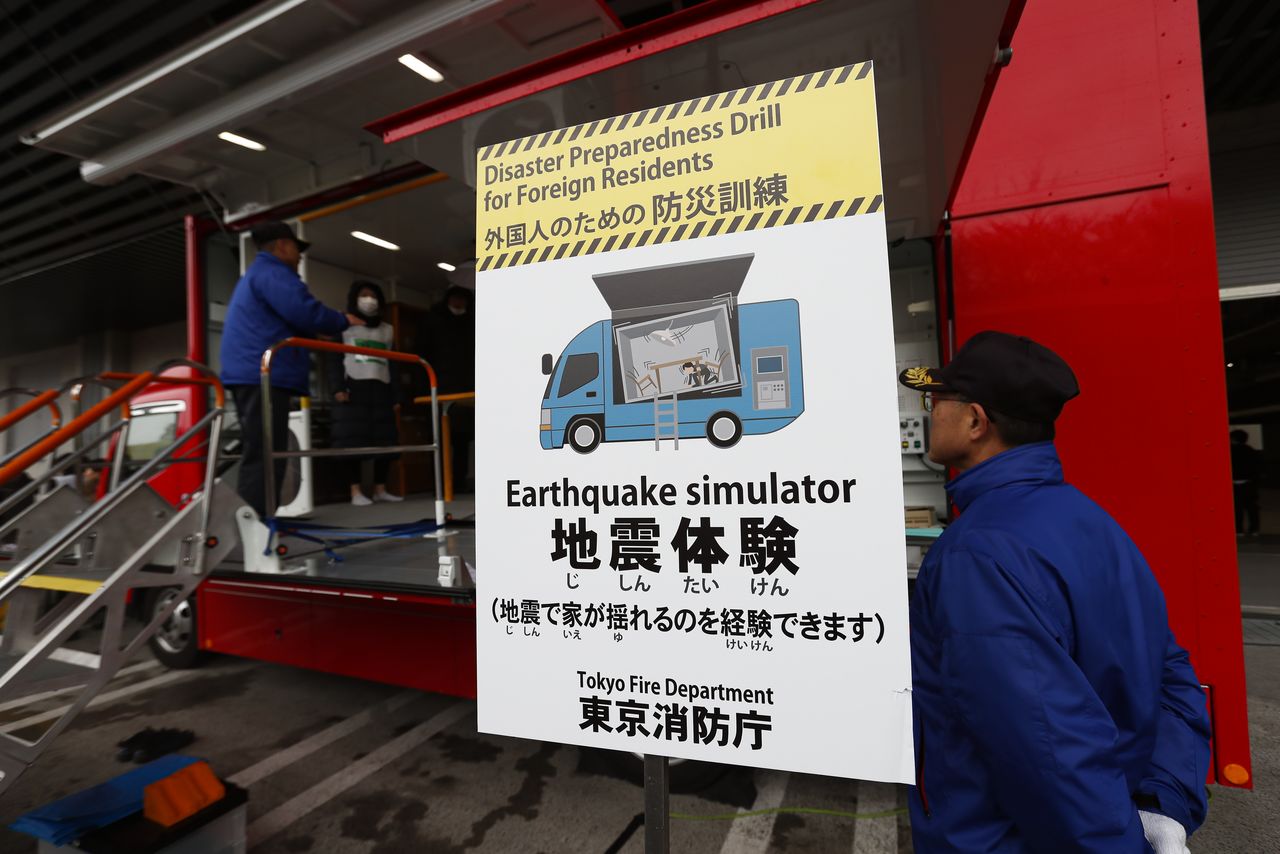
The Tokyo Fire Department regularly holds disaster preparedness training sessions for foreign residents. Photo taken on January 28, 2020. (© Zuma Press Wire via Reuters Connect)
(Originally published in Japanese on March 9, 2026. Text by Nippon.com. Banner photo © Pixta.)