Questioning the Traditional Thinking on Women in Japan’s Imperial Succession
Society Politics- English
- 日本語
- 简体字
- 繁體字
- Français
- Español
- العربية
- Русский
Legal Changes
Japan’s modern Imperial House Law, which sets out the rules on succession and other matters related to the imperial family, came into effect on the same day as the Constitution on May 3, 1947. Since then, it has never been substantially amended. However, the Liberal Democratic Party’s landslide victory in February’s general election has been a driver behind new efforts to change the law.
Following calls from the speakers and vice speakers of the Diet’s lower and upper houses, members of 13 political parties and groups from both the ruling coalition and opposition gathered for a meeting in April 2026 for the first time in a year, and all had presented their opinions by May. Based on this, the speakers and vice speakers submitted a draft of the “consensus of the legislature” to the government in early June. The government will use this as the basis for a draft amendment of the Imperial House Law, which it will present to the Diet with the aim of getting it approved by the end of the current parliamentary session on July 17.
Among the Japanese public, there has been rising enthusiasm for the idea of Emperor Naruhito’s daughter Princess Aiko ascending the throne. This is probably due to the feeling that it is natural for the emperor’s oldest child to succeed him. If enacted, however, the amendments being proposed would do nothing to open a path for her to become a female emperor.
The two proposals under discussion are to allow female members to retain their imperial status after marriage and to adopt male descendants in the male line into the imperial family (from branches that were removed during postwar reforms). The current Imperial House Law stipulates that women lose their imperial status when they marry and also forbids adoption, so amendments are necessary for both proposals.
In debates over allowing women to stay in the imperial family, views are split on whether their husbands and children should be given imperial status. Conservatives who support maintaining succession in the male line strongly oppose women’s family members having imperial status, seeing it as potentially leading later to an emperor in the female line.
The second plan would involve adopting descendants of branches removed from the family in October 1947. Conservatives insist that this would be a “return” for those descendants, but as they were born and raised as ordinary citizens, there are criticisms that this would go against the principle of equality in Article 14 of the Constitution, which prohibits discrimination based on family origin. Many citizens might also feel uncomfortable with such changes.
Both proposals are being massaged into a “consensus,” including suitable phrases indicating compromises, but the fundamental issues remain unresolved. Notably, it is unclear whether there are any specific candidates in mind for adoption, and there is deep-rooted skepticism about the plausibility of this option. It seems unlikely that an amendment would lead to any immediate adoptions, and that this is only a contingency plan in case the number of imperial family members reaches crisis levels.
Europe’s Royals Modernize Succession
The current debate over the imperial succession was prompted nine years ago, by a provision calling explicitly for consideration of the issue in the 2017 legislation that allowed Emperor Akihito to abdicate. There have been ongoing discussions since Prime Minister Koizumi Jun’ichirō established a panel of experts in 2005. But all this fuss has led nowhere, with no changes to the current system of succession.
European royal families once tended to favor males in matters of succession. Starting in 1980, though, Sweden, the Netherlands, Norway, Belgium, and Britain have officially switched to absolute primogeniture, whereby the firstborn child of either sex is first in line to the throne.
This broad trend has been rooted in the concept of gender equality, which is the social norm nowadays, but it is also spurred on by concerns that adherence to male primogeniture alone could lead to instability in royal families’ succession plans, due to factors including a lack of male children. While it is true that the risk remains in any case that a lack of children, whether from the male or female line, could threaten an end to a royal lineage, the chances are better when both genders are left in play.
If Japan followed the same system, we could avoid the inhumane way of thinking that pressurizes women who marry into the imperial family to keep giving birth until they produce a son. And if Japan took a rational approach, with respect for the people involved, it would have moved, like the European royal families, to absolute primogeniture, but that has not happened.
The widespread esteem for the emperor and imperial family is rooted in cultural and historical aspects that go beyond activities like their visits to disaster-hit areas. It could be said to involve elements of faith. This is why conservatives persist in the objectively irrational stance of excluding women and the matrilineal line.
Why Only the Male Line?
The question turns on whether there is any truth to the claim that being “a male offspring in the male line belonging to the Imperial Lineage,” to quote Article 1 of the Imperial House Law, is a fundamental aspect of being emperor. If this is dubious, the debate goes back to square one. A careful study of history, though, shows that one cannot say that male-line succession is central, and other factors may play the key role.
In the first place, empirical historiography sees the idea of an unbroken imperial line as a fabrication of the eighth century chronicles Kojiki and Nihon shoki. As such, the evidence for unbroken male-line succession is also shaky. Theories like “the Y chromosome has been passed down since the time of Emperor Jinmu, the first emperor” are no more meaningful than myths.
Some maintain that enthroning an emperor in the female line would mean starting a new dynasty. However, this argument is based on Chinese ideas about dynastic changes that are justified as the Mandate of Heaven, and the Chinese clan system, so it cannot be said to reflect the principles of the Japanese imperial line.
The commonly accepted idea for justifying patrilineal succession is only that it has always been done this way. However, this does not answer the fundamental question of why it should still be followed today.
The nature of the argument for succession in the male line was first articulated when the former Imperial House Law was enacted in the late nineteenth century. While the Ministry of the Imperial Household draft allowed for both female and matrilineal emperors, this was fiercely opposed by Inoue Kowashi, one of the writers of the Meiji Constitution. He formally submitted his opinion to Prime Minister Itō Hirobumi, rejecting the idea of a female emperor with reference to Chinese tradition and Europe’s former Salic law, which prohibited women from ascending to the throne.
However, Inoue’s opposition hinged on the assertion that it was contradictory to recognize a female emperor—the highest position in the land—when women did not have the vote.
The Meiji state had its foundations in patriarchy carried over from the samurai class in the Edo period (1603–1868). This was an ideology that saw the nation as a family. The patriarchy was underpinned by the “three obediences” of Confucianism, whereby women were expected to obey male heads of households throughout their lifetimes: their fathers before marriage, their husbands during marriage, and their sons after their husbands’ deaths.
Under the Civil Code in the Meiji era (1868–1912), women were “legally incompetent” and subordinate to men. In marriage, they were their husbands’ property. In a patriarchal society, where men were considered superior to women, even if there was a female emperor, her husband would be viewed as above her. Inoue’s opposition to a female emperor was thus a pragmatic one, based on his assessment of the social situation.
Based on Misogyny
This was, in a sense, an argument for patrilineal succession designed to eliminate the possibility of a female emperor, but why had succession through the male line continued before the Meiji era? The history suggests the aim was always to exclude women.
In the Asuka period (593–710) and Nara period (710–94), six women ascended the throne. What, then, is the reason that there were essentially no more female emperors from the Heian period (794–1185) onward? While there were two in the Edo period, they acted as stopgap leaders and had no real power. Female emperors are thought to have effectively come to an end in the Nara period.
The last of these leaders was Empress Shōtoku, who reigned twice in the eighth century, in 749–758 (she took the name Kōken during the former reign) and 764–770. Her death meant the end of the line of emperors descended from Emperor Tenmu, who ruled from 673 to 686. After this came emperors descended from Tenmu’s brother Tenji. Shōtoku, a fervent Buddhist, had tried and failed to put the monk Dōkyō on the throne; this and the number of female emperors in the Tenmu line were blamed for its ultimately dying out.
The spread of epidemics in Heiankyō (now Kyoto), newly established as the capital in 794, led to an exaggerated focus on the Shintō concept of impurity. This was another factor in the avoidance of female emperors, as Shintō views menstruation and childbirth as causing defilement.
Shintō-Buddhist syncretism led to misogyny within Buddhism. The “five obstacles” belief stated that after death, women cannot become a Brahma, a Shakra, a devil king, a wheel-turning king, or a Buddha. Hostility to women also spread to mountain worship, which excluded them from sacred sites.
Into the Edo period, the growing popularity of Confucianism further cemented the view that men were superior to women. It might be said that antagonism toward women led to the convention that the emperor must be male.
The kind of misogyny and discrimination described above underpins the history and tradition of limiting succession to the male line. Is it appropriate to hang on to these attitudes in the postwar era, when the emperor has become a symbolic role? Do citizens really prefer an emperor chosen on the principle of excluding women over one who has stood up for and shed light on the vulnerable and neglected, such as people with disabilities, the war dead, and disaster victims?
The debate over patrilineal or matrilineal imperial succession has fundamentally lacked consideration of whether past customs are suitable for today’s symbolic emperor system. As long as it continues to do so, it seems unlikely that an effective situation can be found to the crisis facing the imperial line.
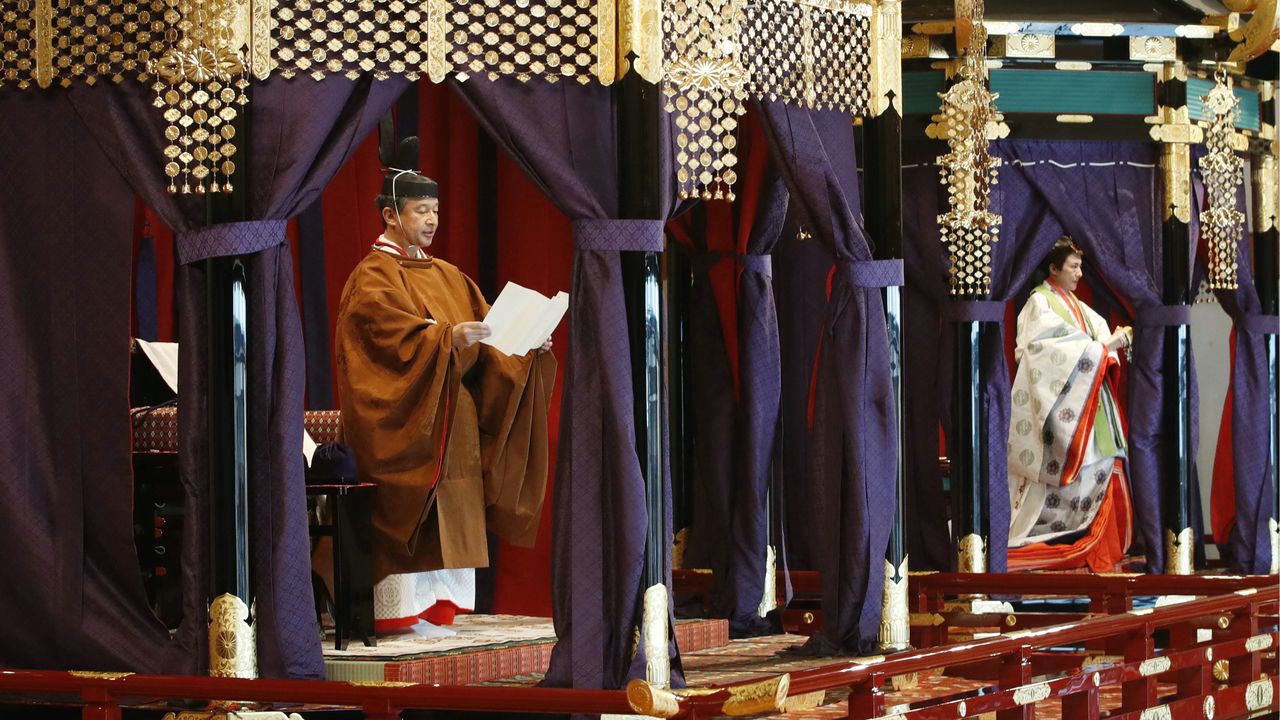
(Originally published in Japanese on June 4, 2026. Banner photo: Emperor Naruhito and Empress Masako at the Sokuirei Seiden no Gi formal enthronement ceremony at the Imperial Palace on October 22, 2019. © Jiji.)