Japan’s Nobel Laureates: Two Scientists Recognized in 2025
Science Society- English
- 日本語
- 简体字
- 繁體字
- Français
- Español
- العربية
- Русский
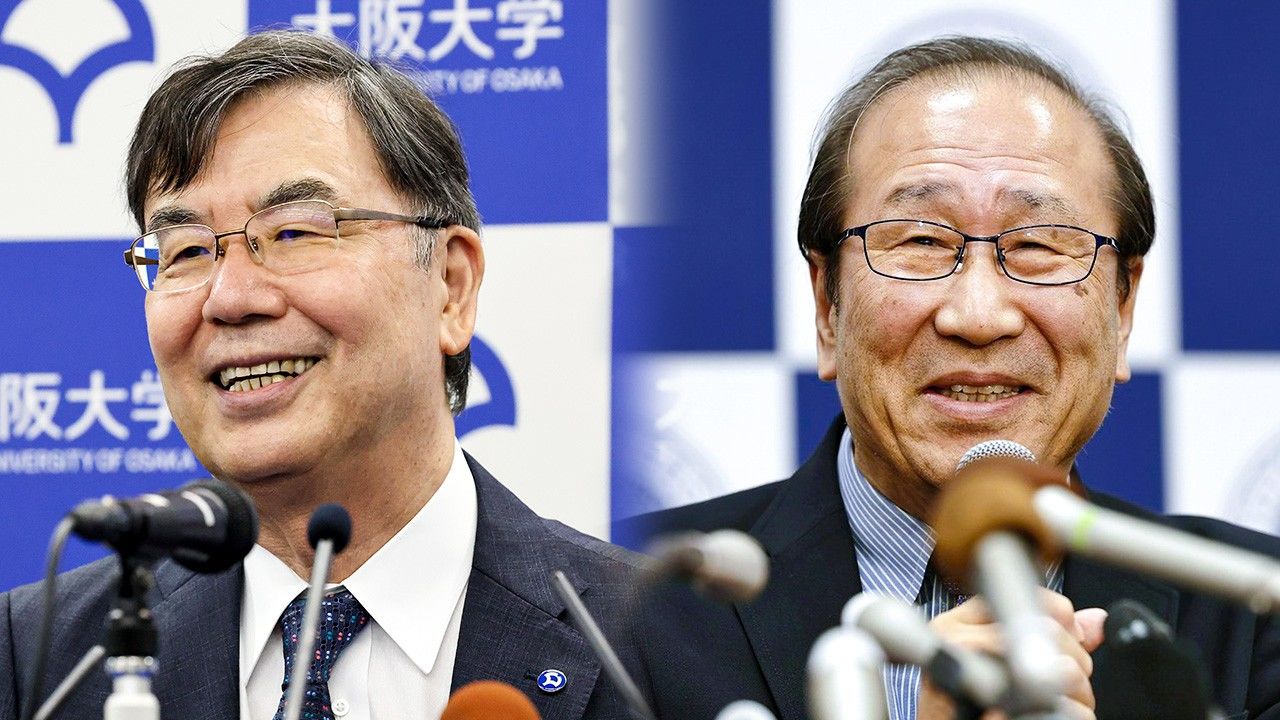
Two Japanese scientists received Nobel Prizes in October 2025. On October 6, Sakaguchi Shimon of the University of Osaka was one of three winners of the Nobel Prize in Physiology or Medicine for the discovery of regulatory T cells that suppress excessive immune responses. Two days later, Kitagawa Susumu of Kyoto University was among three recipients of the Nobel Prize in Chemistry for developing porous materials called metal-organic frameworks that could be used to separate and store, for example, greenhouse gases and harmful substances, and have the potential to contribute to tackling global environmental issues.
There are now 31 Japanese-born individual laureates in peace, the sciences, and literature. The last to be recognized for Physiology or Medicine before this year was Honjo Tasuku in 2018, and the most recent for Chemistry was Yoshino Akira in 2019.
Japanese Nobel Prizewinners
2025: Chemistry
Kitagawa Susumu
A distinguished professor at Kyoto University, Kitagawa was one of three recipients of the prize for “the development of metal–organic frameworks.”
2025: Physiology or Medicine
Sakaguchi Shimon
Sakaguchi, a specially appointed professor at the University of Osaka, won a third share of the prize for “discoveries concerning peripheral immune tolerance.”
2024: Peace
Japan Confederation of A- and H-Bomb Sufferers Organizations (Nihon Hidankyō)
The organization was named winner for “its efforts to achieve a world free of nuclear weapons and for demonstrating through witness testimony that nuclear weapons must never be used again.”
2021: Physics
Syukuro Manabe (Manabe Shukurō)
Manabe, a US citizen, is senior meteorologist at the Princeton University Program in Atmospheric and Oceanic Sciences. He was one of two winners for “groundbreaking contributions to our understanding of complex physical systems.”
2019: Chemistry
Yoshino Akira
An honorary fellow at Asahi Kasei and professor at Meijō University, Yoshino was one of three winners chosen for “the development of lithium-ion batteries.”
2018: Physiology or Medicine
Honjo Tasuku
A distinguished professor at Kyoto University, Honjo won half of the prize for “discovery of cancer therapy by inhibition of negative immune regulation.”
2017: Literature
Kazuo Ishiguro
A British citizen born in Japan, Ishiguro was honored as a writer “who, in novels of great emotional force, has uncovered the abyss beneath our illusory sense of connection with the world.”
2016: Physiology or Medicine
Ōsumi Yoshinori
Ōsumi, professor emeritus at the Tokyo Institute of Technology, won the prize for “his discoveries of mechanisms for autophagy,” how unnecessary or dysfunctional proteins in cells are degraded and recycled.
2015: Physics
Kajita Takaaki
The director of the University of Tokyo’s Institute for Cosmic Radiation Research, Kajita was one of two recipients selected for “the discovery of neutrino oscillations, which shows that neutrinos have mass.”
2015: Physiology or Medicine
Ōmura Satoshi
Ōmura, distinguished professor emeritus at Kitasato University, was one of three winners of the prize, with his recognition coming for “discoveries concerning a novel therapy against infections caused by roundworm parasites.”
2014: Physics
Akasaki Isamu, Amano Hiroshi, Nakamura Shūji
The three Japan-born recipients (Nakamura, professor at the University of California, Santa Barbara, is a US citizen) shared the prize for “the invention of efficient blue light-emitting diodes, which has enabled bright and energy-saving white light sources.” Akasaki is professor at Meijō University and professor emeritus at Nagoya University; Amano is professor at Nagoya University.
2012: Physiology or Medicine
Yamanaka Shin’ya
Yamanaka, professor and director of Kyoto University’s Center for iPS Cell Research and Application, was one of two winners for “the discovery that mature cells can be reprogrammed to become pluripotent.”
2010: Chemistry
Negishi Eiichi, Suzuki Akira
Negishi (distinguished professor at Purdue University) and Suzuki (professor emeritus at Hokkaidō University) were two of the three winners for “palladium-catalyzed cross-couplings in organic synthesis.”
2008: Physics
Nanbu Yōichirō, Kobayashi Makoto, Masukawa Toshihide
Nanbu, a US citizen and professor emeritus at the University of Chicago, won half of the year’s prize for “the discovery of the mechanism of spontaneous broken symmetry in subatomic physics.” The other half was shared by Kobayashi (professor emeritus at the Japanese High Energy Accelerator Research Organization) and Masukawa Toshihide (professor emeritus at Kyoto University) for “the discovery of the origin of the broken symmetry which predicts the existence of at least three families of quarks in nature” (the Kobayashi-Masukawa Theory of CP violation).
2008: Chemistry
Shimomura Osamu
Professor emeritus at Boston University, Shimomura was one of three recipients of the prize for “the discovery and development of the green fluorescent protein, GFP.”
2002: Chemistry
Tanaka Kōichi
A fellow at Shimadzu Corporation, Tanaka was one of three winners for “development of soft desorption ionization methods for mass spectrometric analyses of biological macromolecules.”
2002: Physics
Koshiba Masatoshi
Koshiba, professor emeritus at the University of Tokyo, won half of the prize for “pioneering contributions to astrophysics, in particular for the detection of cosmic neutrinos” (using the Kamiokande facility in Gifu Prefecture).
2001: Chemistry
Noyori Ryōji
A professor at the Nagoya University School of Science, Noyori won a fourth share of the prize for his “work on chirally catalyzed hydrogenation reactions.”
2000: Chemistry
Shirakawa Hideki
Shirakawa, professor emeritus at the University of Tsukuba, was one of three recipients for “the discovery and development of conductive polymers.”
1994: Literature
Ōe Kenzaburō
Ōe was hailed as a writer “who with poetic force creates an imagined world, where life and myth condense to form a disconcerting picture of the human predicament today.”
1987: Physiology or Medicine
Tonegawa Susumu
A professor at the Massachusetts Institute of Technology, Tonegawa won the prize for “his discovery of the genetic principle for generation of antibody diversity.”
1981: Chemistry
Fukui Ken’ichi
Fukui, a professor at the Kyoto University School of Engineering, was one of two recipients for theories “concerning the course of chemical reactions.”
1974: Peace
Satō Eisaku
The prime minister of Japan won for his renunciation of the nuclear option for the nation and his efforts to further regional reconciliation.
1973: Physics
Esaki Reona
One of three recipients of the year’s prize, Esaki—a researcher at the IBM Thomas J. Watson Research Center—won a fourth share of the award for “experimental discoveries regarding tunneling phenomena in semiconductors and superconductors, respectively.”
1968: Literature
Kawabata Yasunari
The author was picked for “his narrative mastery, which with great sensibility expresses the essence of the Japanese mind.”
1965: Physics
Tomonaga Shin’ichirō
Tomonaga, a professor at the Tokyo University of Education, was one of three recipients for “fundamental work in quantum electrodynamics, with deep-ploughing consequences for the physics of elementary particles.”
1949: Physics
Yukawa Hideki
The physicist Yukawa, professor at the Kyoto University School of Science, won for “his prediction of the existence of mesons on the basis of theoretical work on nuclear forces.”
(Translated from Japanese. Banner photo: Sakaguchi Shimon, at left, and Kitagawa Susumu, the Japanese winners of Nobel prizes in 2025. © Jiji.)