
Damage Projections for Nankai Trough and Greater Tokyo Earthquakes
Society Disaster- English
- 日本語
- 简体字
- 繁體字
- Français
- Español
- العربية
- Русский
Disaster Scenarios
On September 1, which is Disaster Preparedness Day in Japan, we present an overview of two potential disasters that would cause catastrophic damage, based on forecasts from the national government.
Nankai Trough Earthquake
This describes a massive earthquake that has repeatedly occurred at intervals of around 100 to 150 years along the plate boundary off the Pacific coast of Japan, stretching from Shizuoka Prefecture’s Suruga Bay in the northeast to the Hyūganada Sea off Miyazaki Prefecture in the southwest. In September 2025, the government revised its forecast of the probability of a Nankai Trough earthquake within the next 30 years to from 60% to over 90% according to one model, and from 20% to 50% based on an alternative model.
If a megaquake strikes, there could be shaking near the epicenter of 7 on the Japanese seismic intensity scale, and massive tsunamis of more than 10 meters striking the Pacific coast from the Tokyo area to Kyūshū.
On August 8, 2024, a magnitude 7.1 earthquake under the Hyūganada Sea off Miyazaki Prefecture led the Japan Meteorological Agency to issue its first ever megaquake alert. The call for heightened precautions was officially lifted one week later, on August 15.
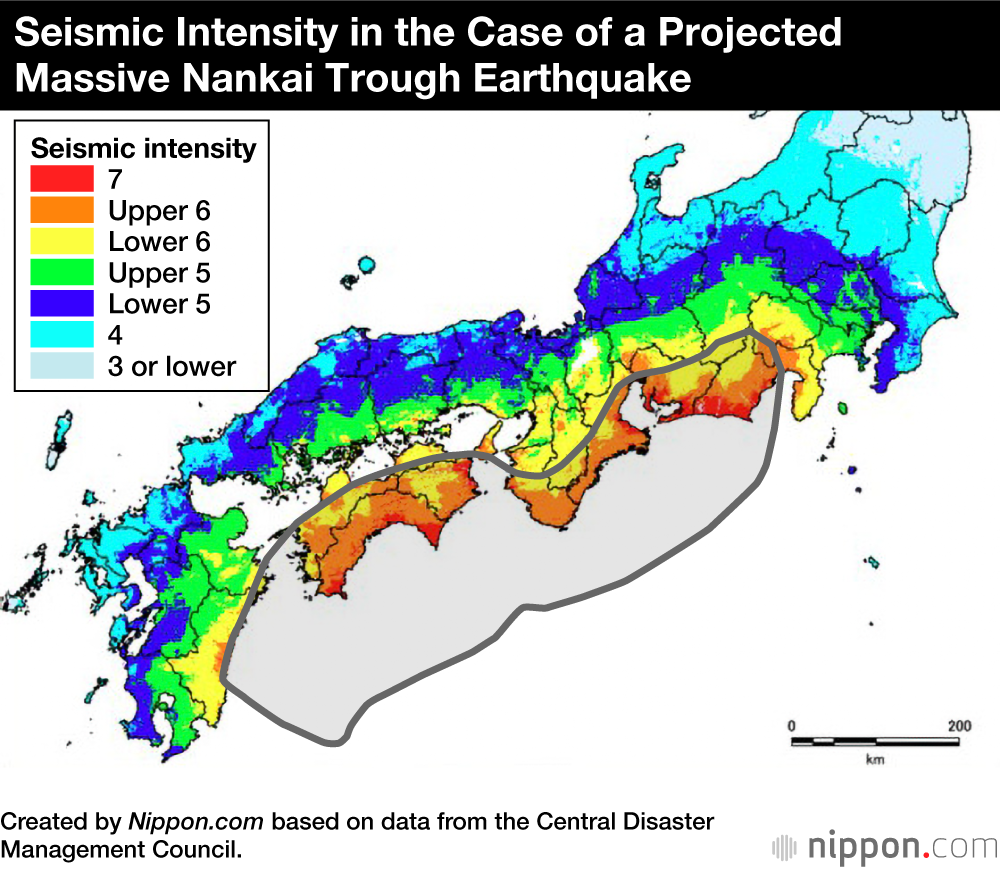
A working group of the Central Disaster Management Council projected in March 2025 that up to 298,000 people would die if a Nankai Trough earthquake strikes late at night in winter. This worst-case scenario assumes a relatively low percentage of people evacuating from tsunamis that would heavily impact the densely populated Tōkai region, with tsunami-related fatalities alone expected to exceed 200,000. However, if early evacuation rates are high, and there is effective communication of tsunami information and calls to evacuate, estimated tsunami deaths would drop to around 90,000.
In this scenario, there could be up to 950,000 people injured and 12.3 million evacuees, with up to 2.4 million buildings destroyed in the disaster or subsequent fires. Total economic losses are estimated at ¥292 trillion, equivalent to more than 40% of Japan’s nominal GDP of ¥670 trillion for fiscal 2025.
Massive Earthquake Under Tokyo
According to the government’s Headquarters for Earthquake Research Promotion, there is a 70% probability that a magnitude-7 earthquake will strike directly beneath the Tokyo metropolitan area within the next 30 years. The last time a major earthquake struck the region was the catastrophic Great Kantō Earthquake in 1923, which caused more than 100,000 fatalities.
A March 2025 projection analyzed 19 potential patterns, among which the most destructive would see seismic intensity of 7 in Kōtō, Tokyo, and lower or upper 6 across Tokyo and the nearby prefectures of Kanagawa, Saitama, Chiba, and Ibaraki.
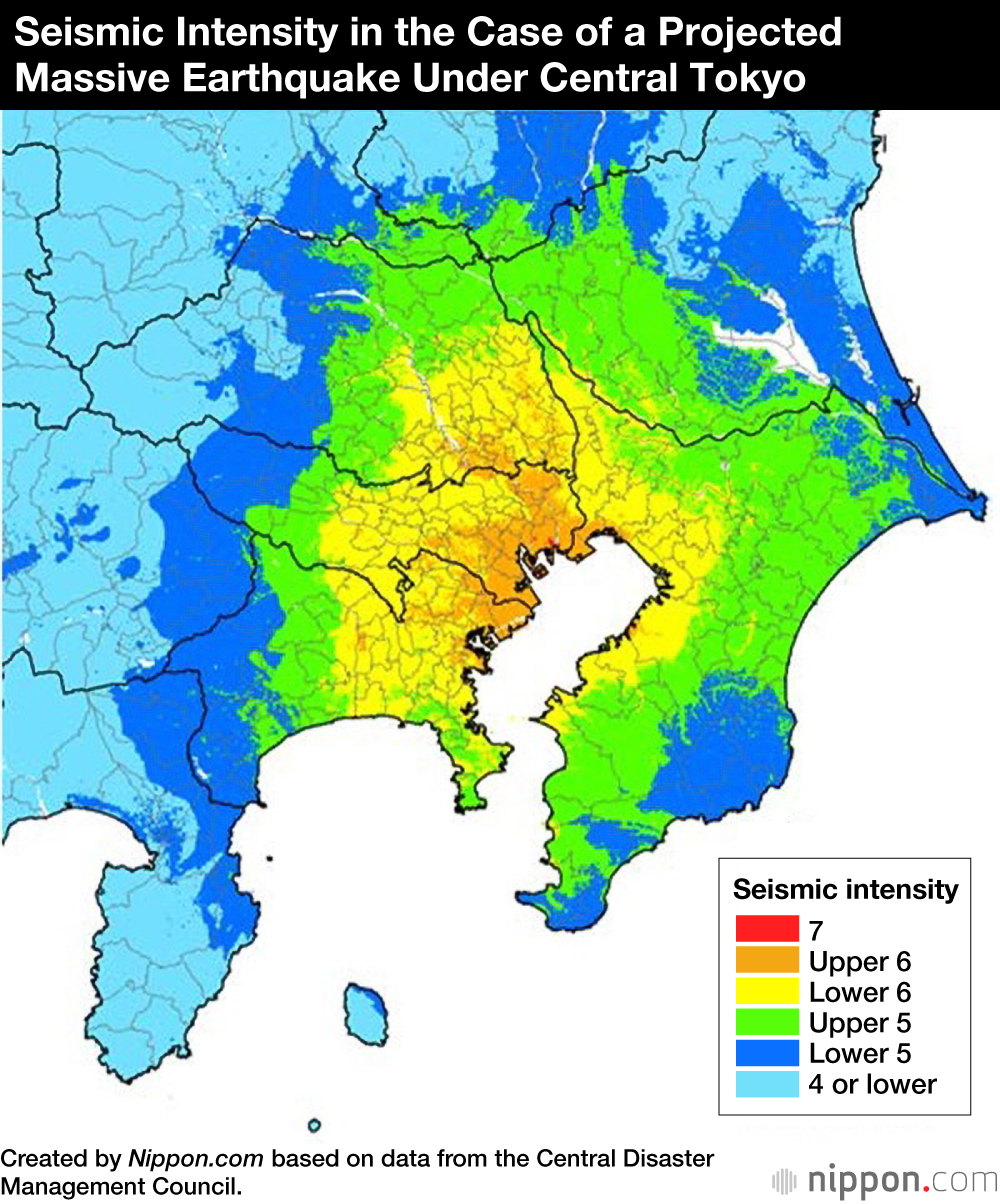
A worst-case scenario would be for an earthquake to strike on a windy winter evening, leading to the spread of fires after the initial collapse of buildings in the tremor. This would mean a death toll of 18,000 with up to 400,000 buildings destroyed.
Up to 16 million households would suffer power outages in nine prefectures from Shizuoka to Ibaraki, while around half of all telephone lines would be unusable due to power cuts or physical damage to infrastructure. There could be up to 4.8 million evacuees and estimated economic losses of ¥83 trillion.
Data Sources
- Data from forecasts on an earthquake under central Tokyo and a Nankai Trough earthquake (Japanese) from the Cabinet Office
- Information on a Nankai Trough earthquake (Japanese) from the Japan Meteorological Agency
(Translated from Japanese. Banner photo: A disaster response drill based on a Nankai Trough earthquake is held in Kasaoka, Okayama, on November 16, 2025. © San’yō Shimbun/Kyōdō.)