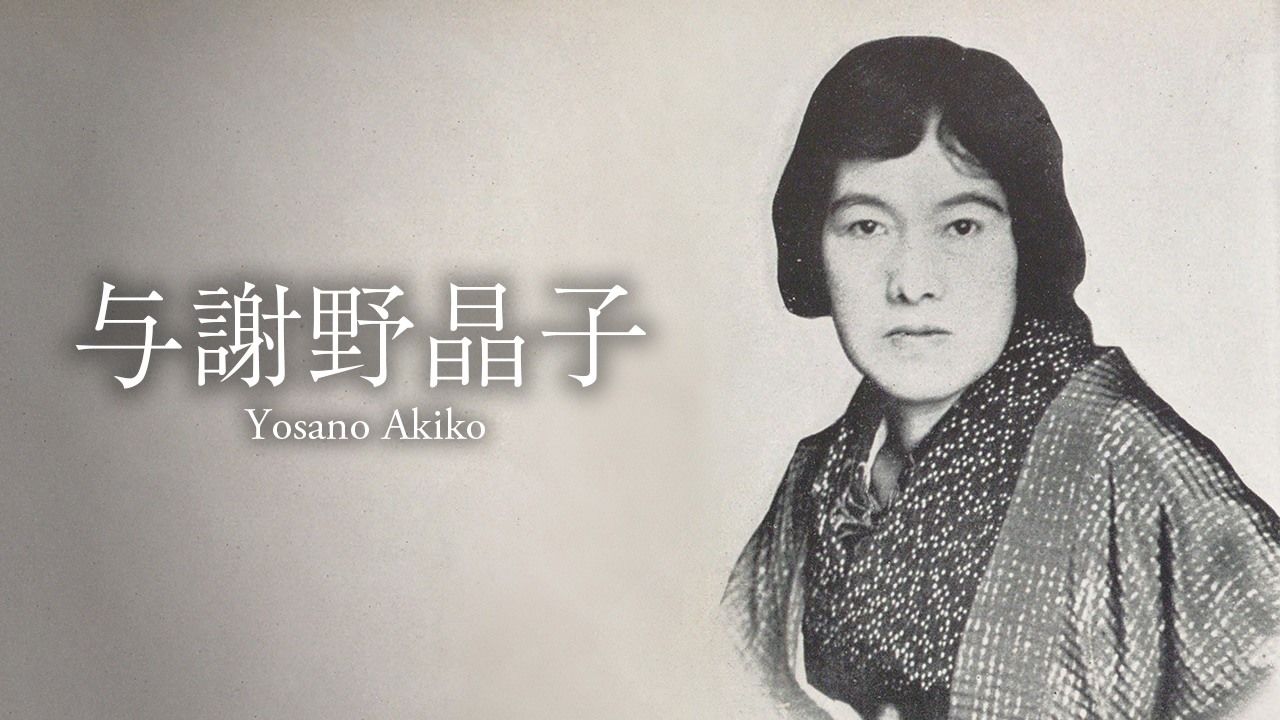
Yosano Akiko: Passionate Poet and Prescient Journalist
Society Culture Society History- English
- 日本語
- 简体字
- 繁體字
- Français
- Español
- العربية
- Русский
A Woman in Love
Yawa hada no / atsuki chishio ni / fure mo mide / sabishikarazu ya / michi o toku kimi
This hot tide of blood
beneath soft skin and you don’t
even brush it with a fingertip
Aren’t you lonely then
you who preach the Way?
Many Japanese people who hear the name Yosano Akiko will recall this famous tanka of hers. It appeared in Tangled Hair, her 1901 collection of dazzling, free-spirited love poems. At a time when women’s lives were restricted by the traditional household system and old-fashioned values, Akiko expressed without restraint what it felt like to be a young woman in love. As well as her 24 volumes of tanka (including coauthored works), she produced translations of The Tale of Genji and many other classics into modern Japanese, in addition to writing over 100 children’s stories and more than 600 other poems and children’s songs.
Apart from her literary activities, she wrote for a long period for newspapers and magazines on topics like education and gender equality. This was collected into 15 volumes of commentary, but her journalistic activities, brimming with foresight, have still not received proper recognition. Akiko was also a working mother, who raised 11 children, and this is likely to have influenced her contemporary stance on women’s lives.
Freedom and Equality

The cover of Tangled Hair. (Courtesy the National Diet Library)
Yosano Akiko was born in 1878, in Sakai, Osaka, to the owners of a traditional confectionery store. Her older brother Hō Hidetarō studied at Tokyo Imperial University (now the University of Tokyo) before becoming a professor of engineering at the institution and a famous scientist. Akiko herself excelled at science and mathematics, but as a girl she was not able to further her studies as she wished, only completing the equivalent of junior high school today. She was made to help with bookkeeping at the store from her early teens, and thus keenly felt the irrational nature of gender inequality.
In 1900, she joined Shinshisha (New Poetry Society), headed by Yosano Tekkan, who was at the center of a movement to revolutionize the traditional waka form. Her poems appeared in the group’s journal Myōjō (Bright Star), and her sensuous debut collection Tangled Hair was published the following year, when she was 22. It left behind the elegant depictions of nature that were customary in traditional Japanese poetry, showing that Akiko had a reformer’s spirit from the start, and was a firm devotee of the new wind blowing through Japanese poetry.
This was a time when freedom of speech was severely restricted. Bright Star’s use of an illustration of a naked woman was judged to be disturbing public morals, and the issue was suppressed, while other leading literary figures of the time like Nagai Kafū and Mori Ōgai had their books banned. Akiko herself must have felt how her freedom of thought and expression were under threat.

Yosano Tekkan. (Courtesy the National Diet Library)
For this reason, equality and freedom were vital keywords for Akiko from the beginning. And that she learned this through personal experience rather than at school or in books was her strength, more than anything.
A Social Critic
Ah, my brother, I weep for you
Thou shalt not die.
You, the last-born
were most cherished of us all—
would your parents put a sword into your hands
and order you to slay a man?
Would they bring you up to twenty-four
then say “Go kill, then die”?
Akiko’s poem expressing concern for her soldier brother “Thou Shalt Not Die” was published in Bright Star in September 1904, in the middle of the Russo-Japanese War. It was criticized as being out of step with the mood in Japan, but Akiko countered that it should be taken only as a poem. It was not necessarily antiwar, as an expression of natural concern for her brother, while at the same time it demonstrated that she was not afraid to write what she really felt. By this point Akiko was 25, and married to her poetic mentor Tekkan, with two children already.
In 1909, Akiko showed her satirical side, first with a tanka responding to successive bans on works by Kafū that made an ironic comparison with the prohibition of sales of horse racing betting slips. In a second poem, she made reference by their given names to Komatsubara Eitarō, the minister of education, and Hirata Tōsuke, the home minister, mocking them as ignorant of literature. These two men were most closely involved in censorship and to rail at them openly shows Akiko’s startling courage. Readers who went into a frenzy over Tangled Hair may have been baffled by the change in register.
Her magazine articles of the period also ridicule censors and describe her unique method of trying to keep her children unaware of the differences between boys and girls until adolescence. Her 1912 trip to Europe with her husband helped these aspects of her writing to blossom. She met with the sculptor Auguste Rodin and was interviewed by the press in France, which fostered her confidence and pride as a journalist.
The Rise of Women’s Magazines
There are two major reasons why Akiko wrote so much social commentary after her return from Europe. One was that the media saw her as a vital contributor, and another was that she had topics that she wanted to write about.
Akiko put the most energy into this form of writing in the Taishō era (1912–26), when Japan’s print media was in its heyday and at its most influential. As the people matured as citizens and sought out information, newspaper circulation soared. The rise in female readers cannot be ignored. Government support for girls’ secondary schooling had resulted in more educated women, and many women’s magazines were founded to cater for them. As someone who had broadened her horizons through travel to Europe and also had experience of motherhood, Akiko must have been in great demand as able to write on a wide variety of topics. From this perspective, it was not so much that the media needed Akiko as that the times did.
Akiko also had topics she wanted to write about, including how to achieve equality and freedom. She wrote for the media for more than 20 years, because she felt that she herself had room for improvement, due to a lack of schooling and culture, and even when swamped with things to do, she never stinted on reading books, newspapers, and magazines. One of her rare talents was the ability to deepen her personal thinking in this way.
“In the ideal family, women are financially independent and men and women are equal.”
“Men today work for too long. They should be involved with raising children and housework.”
“If we became a society where everyone worked, working hours would be shortened, and we could use our leisure time in many different ways.”
“Learning should not only take place in school. People should learn throughout their lives.”
Akiko’s writings are full of prescience, considering that she was writing at a time when there was no concept of gender equality, work-life balance, or lifelong learning. As the number of women working in factories was increasing, there was a growing debate over ideal ways to “protect motherhood,” touching on issues including the improvement of poor labor conditions that impacted mothers’ health and economic measures to support them. Akiko engaged in debate with the commentator Hiratsuka Raichō and the activist Yamakawa Kikue, but her views were so far ahead of their day that the two sides were constantly at cross-purposes. Only a handful of people must have been able to understand Akiko’s ideal for the social system and individuals’ way of life.
A Celebrity and Influencer
Akiko’s media involvement went beyond her work with newspapers and magazines. With the economic development of the Taishō era came urbanization, the emergence of a mass consumer society, and advertising culture. As the slogan “Today the Imperial Theater, tomorrow Mitsukoshi” indicates, department stores like Mitsukoshi were blossoming as enticing new spaces. Akiko became an advisor to Takashimaya Department Store, and was involved in organizing the store’s Hyakusenkai event for kimono designs for more than 20 years. This meant not only judging products sent from across the country each season but also performing the tasks of a contemporary copywriter, such as selecting and naming fashionable colors and providing poems for posters and guides.

Jānaristo Yosano Akiko (Yosano Akiko, Journalist) by Matsumura Yuriko, 2022. The cover photograph shows Akiko at the Hyakusenkai venue. Published by Tanka Kenkyūsha.
In 1920, advertisements for the Calpis beverage using Akiko’s poems appeared several dozen times in newspapers, such as: Karupisu wa / kushiki chikara o / hito ni oku / atarashiki yo no / kenkō no tame (By the power / of Calpis— / The miracle of / health for / our new world).
Mishima Kaiun, who created the lactic acid drink Calpis (known overseas as Calpico), was a skilled marketer, and after visiting the Yosano home with samples of the beverage, asked Akiko if she could write poems to use in advertisements. This episode indicates her power as a celebrity and influencer. “Health” was a relatively new concept at the time, showing Akiko’s discernment in using it in a poem.

Frontispiece photograph for the 1923 commentary collection Ai no sōsaku (The Creation of Love). (© Kyōdō)
Politics and Poetry
Akiko’s eighth collection of commentary was called Gekidō no naka o iku (Passing Through a Turbulent Age). Indeed, she lived through a time when Japan was involved in a major conflict around every decade, from the 1894–5 Sino-Japanese War through the Russo-Japanese War to World War I. She expressed her wish for peace in an article titled “Sensō ni tsuite no kōsatsu” (Thoughts on War) written for a magazine in April 1918, toward the end of World War I.
If individuals kill and wound each other to prove they are right, or take weapons and force their way into unarmed people’s homes to attain justice, they are clearly evil, no matter how beautiful the words used to express such acts. . . . Is it possible to say that something unforgivable for individuals is glory, justice, or good conduct when performed by a state?
In July of the same year, she wrote the following poem for a newspaper. It was later included in her collection The Firebird.
Onna yori / chie ari to iu / otokotachi / kono tatakai o / yamenu kashikosa
We are wiser than
women, goes the male claim
How superior the wisdom
that can not stop
this war!
There was no contradiction in Akiko between being both a poet and a journalist. Her constant interest in what was taking place in the world can still encourage us today.
- Tangled Hair was published in Japanese under the title Midaregami, and The Firebird as Hi no tori.
(Originally published in Japanese on June 20, 2025. All poem translations © Janine Beichman. Banner photo courtesy National Diet Library.)