Tea, Faith, and Gardening: “Camellias and Japanese Culture”
Books Culture- English
- 日本語
- 简体字
- 繁體字
- Français
- Español
- العربية
- Русский
Japanese Flowers Introduced to Europe
The importance of camellias (tsubaki) in Japanese culture goes back to the very beginning. As Sawada Yōko explains in her new book Camellias and Japanese Culture, the word appears in Kojiki, Japan’s oldest history, as well as in the Manyōshū, its oldest collection of poetry, dating from the second half of the seventh century. In the Tale of Genji, written in the early eleventh century, one chapter features confections known as tsubai-mochi. This delicacy, made by placing a filling of sticky rice between two camellia leaves, has been described as the first wagashi, or Japanese sweet. It is still served by traditional wagashi shops today in February, to mark the arrival of spring according to the traditional calendar.
Camellias are widely distributed across Asia, and are found in China and Vietnam as well as throughout Japan, where four distinct species are recognized: yabu-tsubaki, yuki-tsubaki, sazanka, and hime-sazanka.
The wild yabu-tsubaki, with its red flowers and single, non-overlapping petals, occurs naturally throughout Japan. Camellias are also a familiar sight in temples and shrine precincts. Through hybridization, spontaneous mutation, and selective breeding, they have become one of the best-known Japanese horticultural species. The flowers range from double blooms to the rose-like sen’e-zaki (thousand-petalled) variety with its layered petals. The colors are equally diverse, including deep crimson, white, various shades of pink and yellow, and variegated patterns.
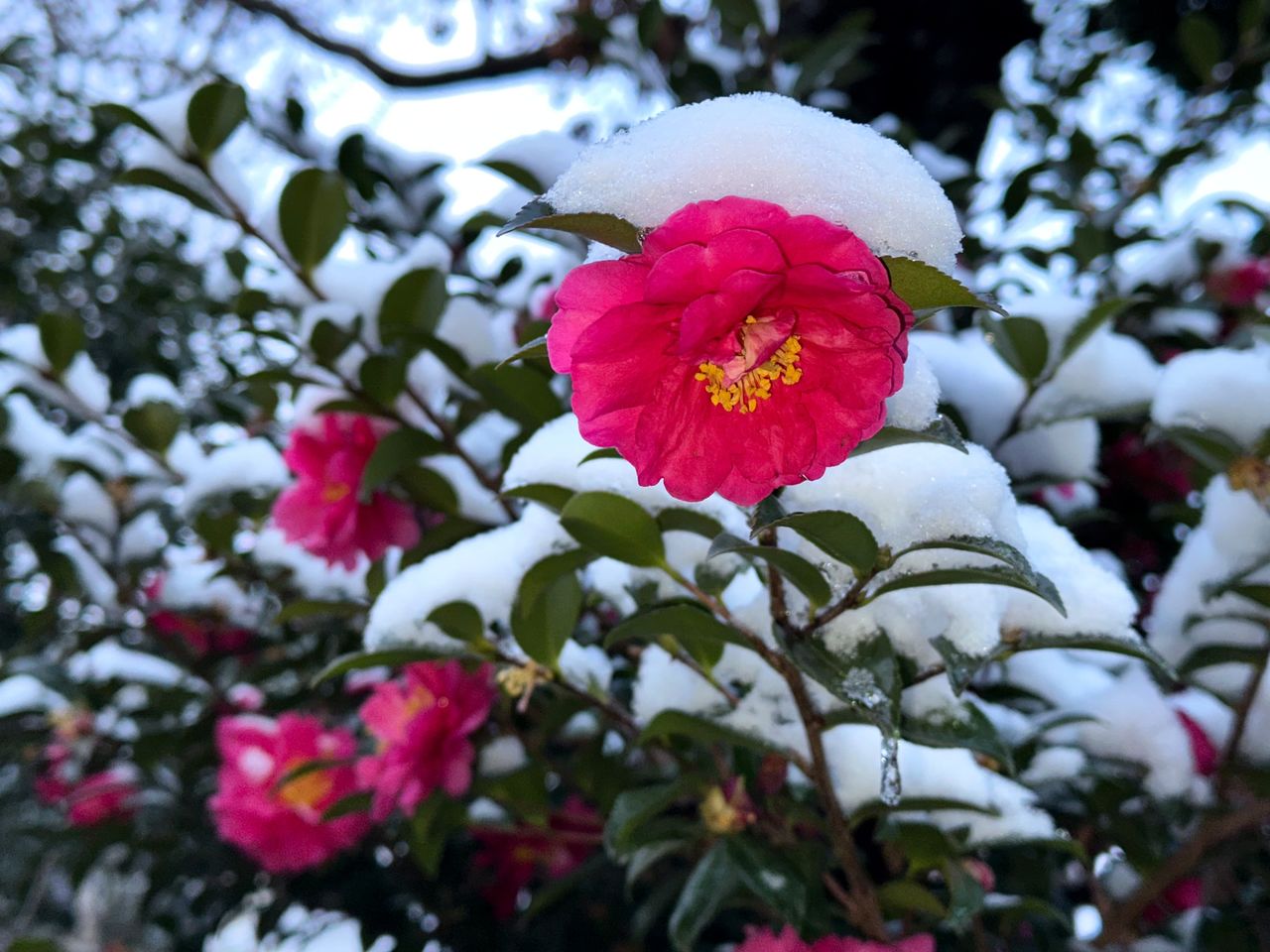
Camellias in the snow at Enyūji, a temple in Tokyo founded in 853, photographed in February 2026. (© Izumi Nobumichi)
When the Edo shogunate came to power in the early seventeenth century, it ushered in an era of peace that lasted more than 250 years. The first three Tokugawa shōguns, Ieyasu, Hidetada, and Iemitsu, were all fond of flowers. In the peaceful society of the time, an enthusiasm for flowers swept through all ranks of society, with camellias at the forefront of the trend. Gardening books such as Hyakuchinshū (Collection of One Hundred Camellias) and Chinka zufu (Illustrated Compendium of Camellia Flowers) were popular, inspiring enthusiasts to develop increasingly splendid cultivars and unusual specimens.
These varieties proved popular when introduced to Europe, where the camellia became known as the “winter rose” and the “rose of the Orient.” Starting in the Meiji era (1868–1912), enthusiasm for the flowers spread to the United States as well. Today, there are said to be more than 2,000 Japanese cultivars.
Symbolism and Beliefs
The author, Sawada Yōko, has an unusual background. Born in Aichi Prefecture in 1949, for many years she was an instructor in the traditional arts of the tea ceremony, flower arranging, and calligraphy. But since childhood, she had always been particularly fond of camellias, and eventually she decided to study them in more depth. She closed her school and entered the graduate program at Aichi Gakuin University. In 2023, she received a doctorate in literature for a dissertation on the symbolism and beliefs associated with camellias.
Based on that dissertation, this book brings together her research on Japanese culture and beliefs related to camellias. She was drawn to study the flowers by a question about their curious duality: although camellias have long been cherished as harbingers of spring, they are also regarded as inauspicious in many contexts.
When camellia flowers reach the end of their bloom, the petals do not fall one by one. Instead, the entire flower drops to the ground. This has often been said to evoke the image of a severed head, and gave rise to inauspicious associations. The author recalls her own experiences as follows:
When I began studying the tea ceremony and ikebana, I felt an inexpressible beauty in the camellias placed in the tearoom, and in the large blossoms that were used to accent the mizugiwa [the part of the plant standing up from the water in the vase] in formal rikka arrangements. At the same time, however, I was always being told that fully opened flowers should not be used as tea flowers, and that camellias should never be taken when visiting someone in hospital. From then on, whenever I placed camellias in a tearoom or used them in an ikebana arrangement, I found myself wondering what could explain the inauspicious connotations that had become associated with these beautiful flowers.
The Transformation of the Tea Ceremony
The classic simplicity of the room used for the tea ceremony dates back to the ideas formulated by Sen no Rikyū (1522–91), the great master who brought the art of tea to its maturity. Camellias play an important role in the tea ceremony, as the main flowers used to decorate the tearoom from winter into spring.
In the Muromachi period (1333–1568), when the tea ceremony first developed, fully open camellia blossoms were used. Today, however, the flowers must be still in bud. Having wondered about this for many years, the author set out to investigate the question by examining illustrations of tea flowers and other visual materials in chronological order. As a result of this research, she was able to demonstrate that fully opened camellias were the norm until the Edo period (1603–1868), and that the shift to budding flowers took place in the years after the Meiji Restoration.
In samurai society, the tea ceremony functioned as a cultivated pursuit and a marker of cultural refinement. The Meiji Restoration of 1868 marked a turning point. With the fall of the samurai, the tea ceremony underwent a major transformation, and became something of a polite feminine art practiced by women as a form of etiquette training. The author analyzes this shift as follows.
After the Meiji Restoration, only budding camellias were used in the tea ceremony. This reflected changes that were taking place in women’s education under the influence of Confucian ideas introduced in the wake of the Restoration, and a growing emphasis on modesty and restraint in the tea ceremony.
Visits to Japan’s 43 “Camellia Shrines”
Another feature of the book is its focus on camellias and belief, supported by extensive fieldwork and analysis of an impressive body of collated materials.
According to the author, there are 43 Shintō shrines, found from northeastern Honshū to southern Kyūshū, that contain camellias in their name, written either with the regular character 椿 or with other characters that spell out tsubaki phonetically. Between 2000 and 2024, the author visited every one of these “camellia shrines” to investigate their history and geographical setting.
The book provides a detailed explanation of each shrine, with photographs. In the case of the Tsubaki Ōkami Yashiro shrine in Suzuka, Mie Prefecture, for example, the author notes that it is now second only to the famous Ise Shrine in popularity. A sacred camellia stands in front of the main hall, while some 5,000 camellias grow on the hillside behind the shrine. The book includes a comprehensive table listing all 43 shrines, giving details including their names (with their origins), location, foundation dates, principal deities, and the dates of the author’s visits. It is a labor of love, and an impressive attempt to lay the foundations for a new field of “camellia studies.”
A Cultural Duality
Scholar and author Okakura Tenshin (also known as Okakura Kakuzō) played a critical role in the development of modern Japanese art and helped to raise its global profile. In The Book of Tea, published in New York in 1906, Okakura gave two representative examples of tea flowers: a budding camellia in late winter, and a single lily in the summer. He wrote: “In joy or sadness, flowers are our constant friends. . . .We wed and christen with flowers. We dare not die without them.”
The author points out that camellias have a curious cultural duality: there is something “slightly discomfiting about them, and yet they hold a mysterious allure.” As well as being acclaimed as the “queen of tea flowers,” camellias are associated in the minds of many Japanese people with the uncanny. In the West, it is the lily that is the “queen of the flowers,” appearing prominently in myths and legends and in the Bible. The lily has a similar duality—a complexity explored by US writer Marcia Reiss in her cultural study of the lily, which she describes as a “flower of contradictions.”
And even the beautiful rose has its thorns. Perhaps in all places and all periods of time, our favorite flowers have always symbolized these contrasting images of light and shadow.
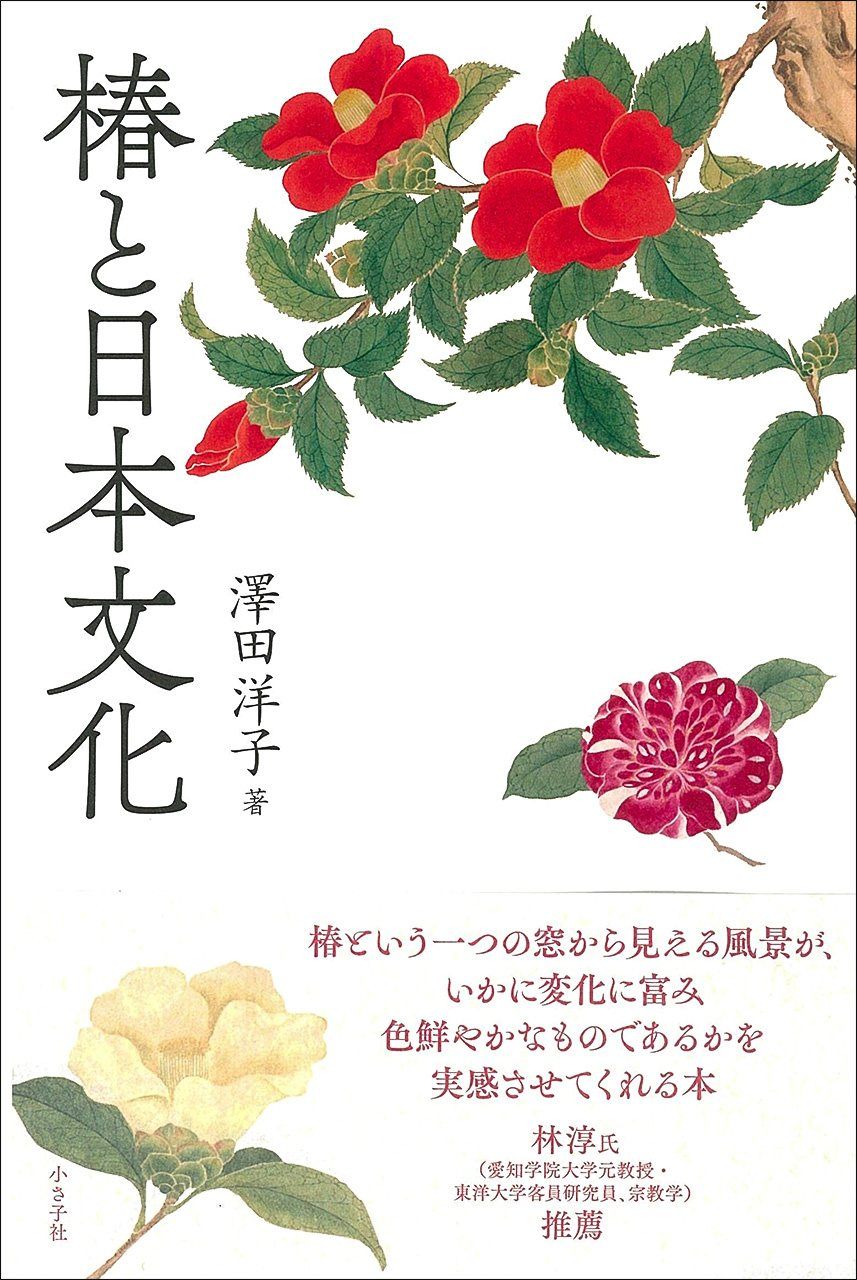
Tsubaki to Nihon bunka (Camellias and Japanese Culture)
By Sawada Yōko
Published by Chiisagosha in 2026
ISBN: 978-4-909782-27-4
(Originally published in Japanese on February 20, 2026. Banner photo: A white camellia. © Pixta.)