“Kuma” Declared the Kanji of the Year for an “Unbearable” 2025
Society Language Culture- English
- 日本語
- 简体字
- 繁體字
- Français
- Español
- العربية
- Русский
A Beastly Character Comes Out on Top
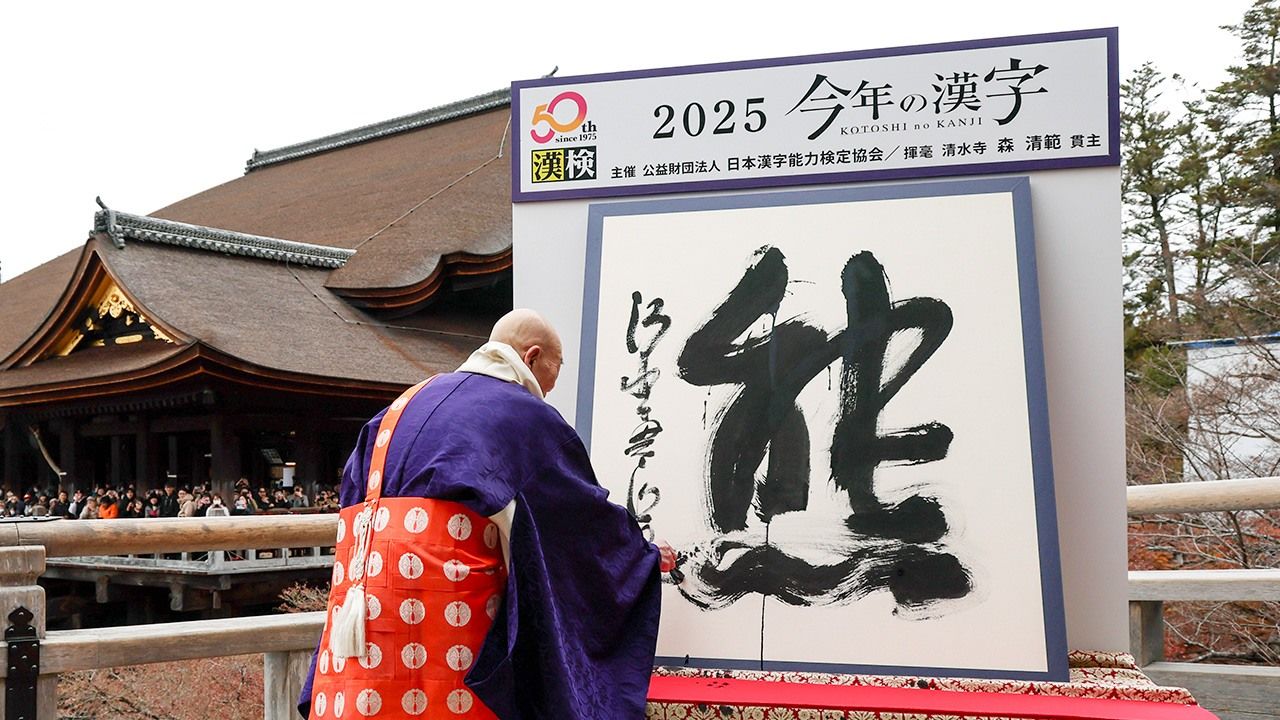
December 12 has rolled around once more, meaning it’s time for the Japan Kanji Aptitude Testing Foundation to announce the Kanji of the Year. On this date, whose 12/12 form can be read as a goroawase for ii ji ichi ji (a single good character), the announcement came this year that 熊 (kuma, or “bear”) was the winner.
The winning character is selected by a popular vote, with participants sending in postcards, casting their ballots in person at bookstores nationwide, or voting online. “Bear” came out on top on the strength of a steady stream of news stories in 2025 on appearances and attacks by wild bears in communities in Japan.
The bear kanji was locked in a close race with 米 (kome), a character meaning “rice” and also used in the name of the United States, a major factor in news stories impacting the nation during the year. Comparing these first- and second-place finishers shows how 熊 was an unusual winner in the history of the competition, where characters like last year’s 金 (meaning gold, as in the medals brought home by Japanese athletes in an Olympic year, and money, another concept looming large in the popular mind in a dicey economy) have multiple senses recommending them to voters. The character for bear, meanwhile, is just a bear—these powerful creatures clearly captured the national imagination in 2025.
High Rice Prices and Expo Memories
Below we present the top 10 vote getters this year. As noted above, barely losing out to the top finisher was 米, for its associations with America, an increasingly unstable ally for Japan, as well as its more basic meaning of “rice,” the staple food whose price continued to climb, troubling Japanese diners. In this connection, the third-place finisher, 高, also received votes for its sense of “high” (as in rice and other consumer prices), as well as its position in 高市, the surname of Prime Minister Takaichi Sanae, who took office in October as the first-ever woman to do so.
In fourth place came 脈 (myaku), which some voters noted in their comments signified the “pulse” of history as felt in the emergence of Japan’s first female leader and various momentous global events, along with the name Myaku-Myaku, the mascot of the Expo 2025 Osaka Kansai. The fifth-place kanji, too, 万, appears in the word 万博 (banpaku), meaning “world expo.” Some voters also explained their choice of this character, which means “ten thousand,” in terms of the Nikkei index reaching the 50,000 mark for the first time in history.
- 熊 (yū/kuma). Bear. 23,346 votes.
- 米 (bei, mai/kome). Rice; America. 23,166 votes.
- 高 (kō/takai). High; expensive. 18,300 votes.
- 脈 (myaku/suji). Pulse. 6,418 votes.
- 万 (man, ban/yorozu). Ten thousand; myriad. 5,656 votes.
- 変 (hen/kawaru, kaeru). Change; strange. 5,296 votes.
- 博 (haku/hiroi). Broad; plentiful. 5,114 votes.
- 女 (jo/onna). Woman. 3,682 votes.
- 新 (shin/atarashii). New. 3,658 votes.
- 初 (sho/hajime, hatsu). First. 3,067 votes.
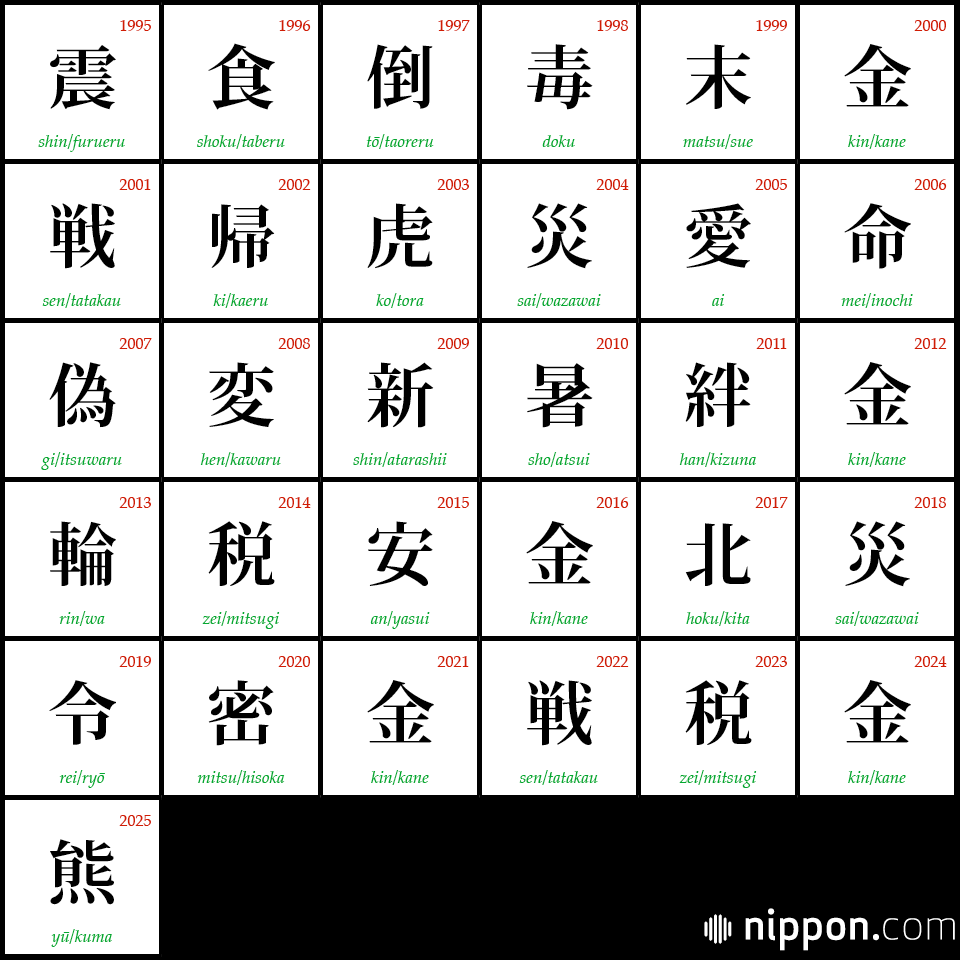
Below is our list of all the Kanji of the Year since the contest kicked off in 1995. Here’s hoping 2026 is a year that’s easier to bear than this one has been!
Data Sources
- The Kanji of the Year (Japanese) from the Japan Kanji Aptitude Testing Foundation.
(Originally written in English. Banner photo: Mori Seihan, Kiyomizudera’s head priest, writes 熊, the Kanji of the Year for 2025, on December 12 at the Kyoto temple. © Jiji.)