Hakuba: Nagano Ski Resort Follows Its Own Vision in Capitalizing on Inbound Tourism Boom
Society Economy Travel- English
- 日本語
- 简体字
- 繁體字
- Français
- Español
- العربية
- Русский
Looming Overtourism Crisis
The town of Hakuba in northern Nagano Prefecture is no stranger to global attention. A winter sports mecca, it hosted the alpine and Nordic skiing competitions at the 1998 Nagano Winter Olympics. The valley is home to world-class ski resorts like Happō-One (pronounced oh-ne) that boast quality powder and stunning panoramic views, which along with its abundant hiking courses and hot-spring bathing make Hakuba a haven for domestic and international tourists.
In the last several years, though, Hakuba has seen an unprecedented jump in popularity among foreign travelers. On any given day during the ski season, luggage-laden foreign tourists crowd Nagano Station’s bus depot in order to board the shuttle for the one-hour, 40-kilometer ride to Hakuba. A telling indication of the explosion of travelers to the area is the price of a one-way ticket on the bus, which just five years ago went for ¥1,800 but has since more than doubled to ¥3,800. For comparison, a seat on the bus from Nagano to Tokyo Disneyland, a distance of some 250 kilometers, can be had for around ¥4,000.
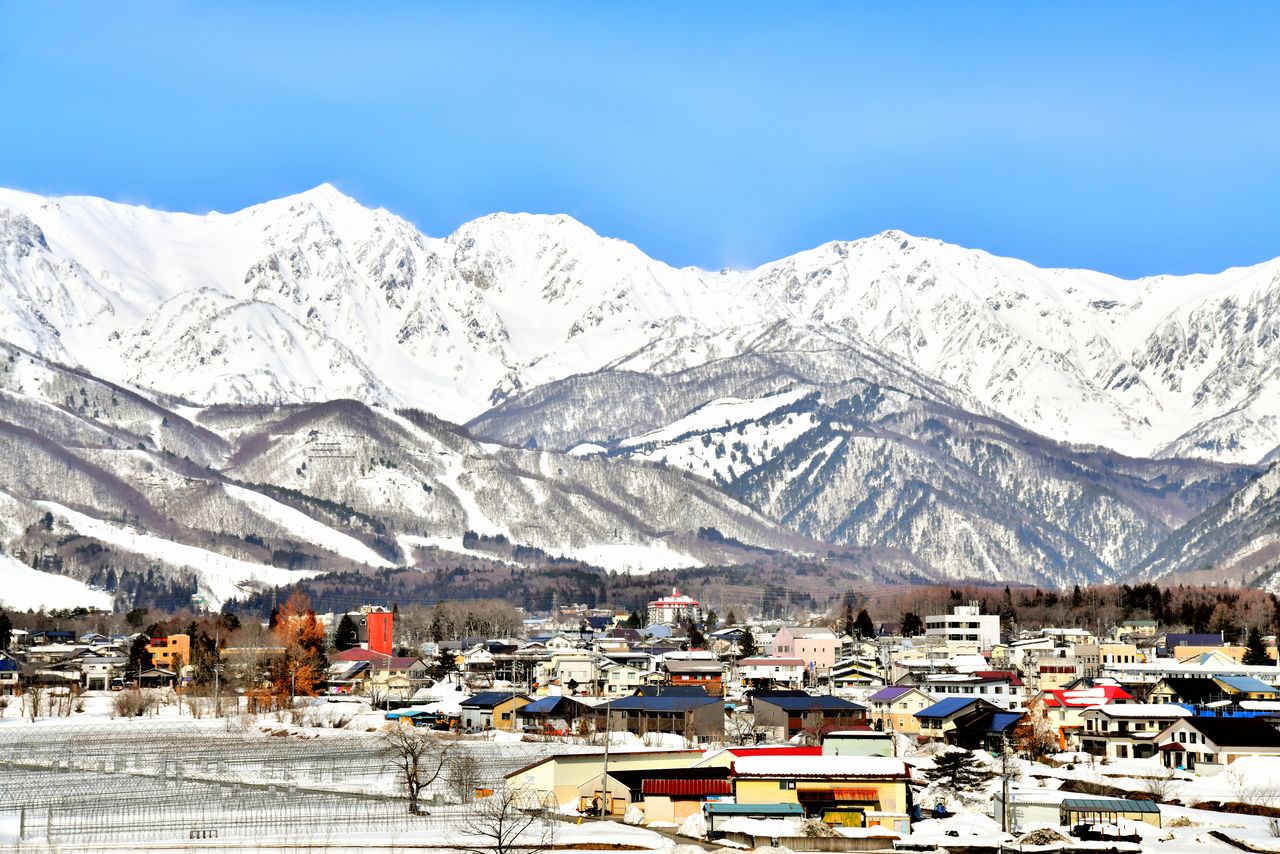
The town of Hakuba and the three snow-covered peaks of the Hakuba Sanzan in March 2025. (© Pixta)
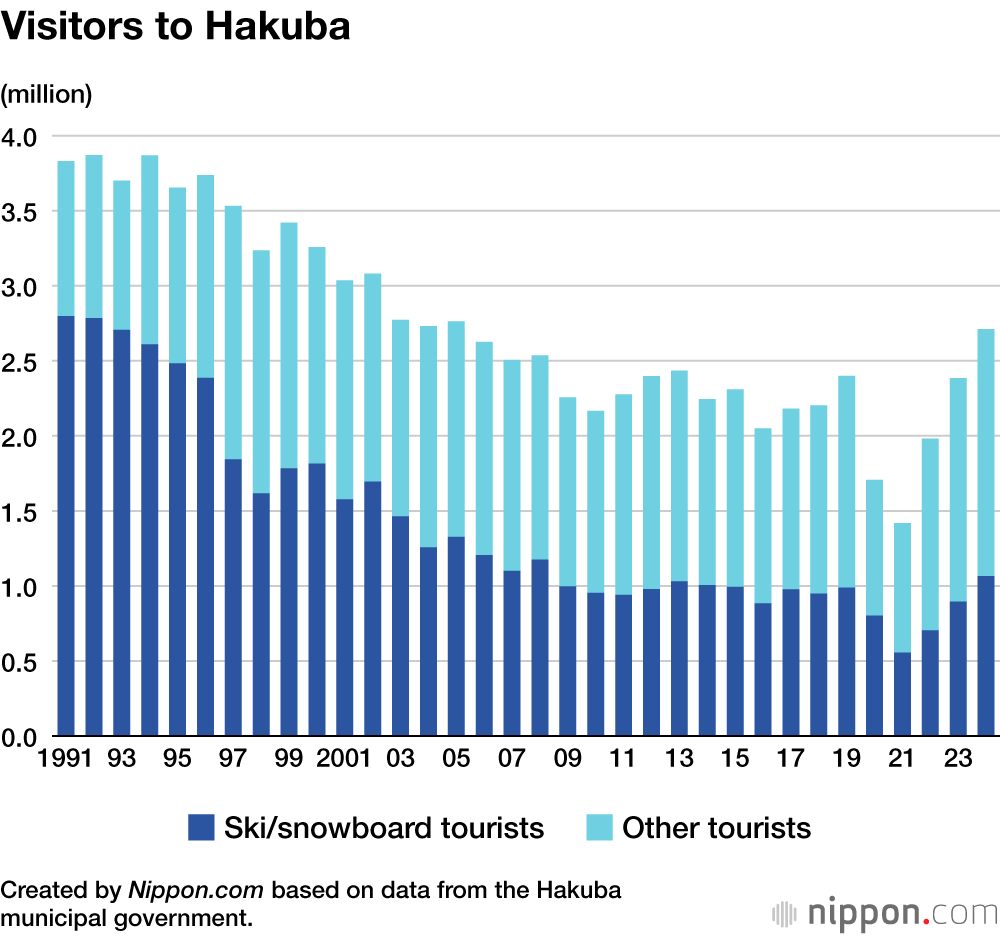
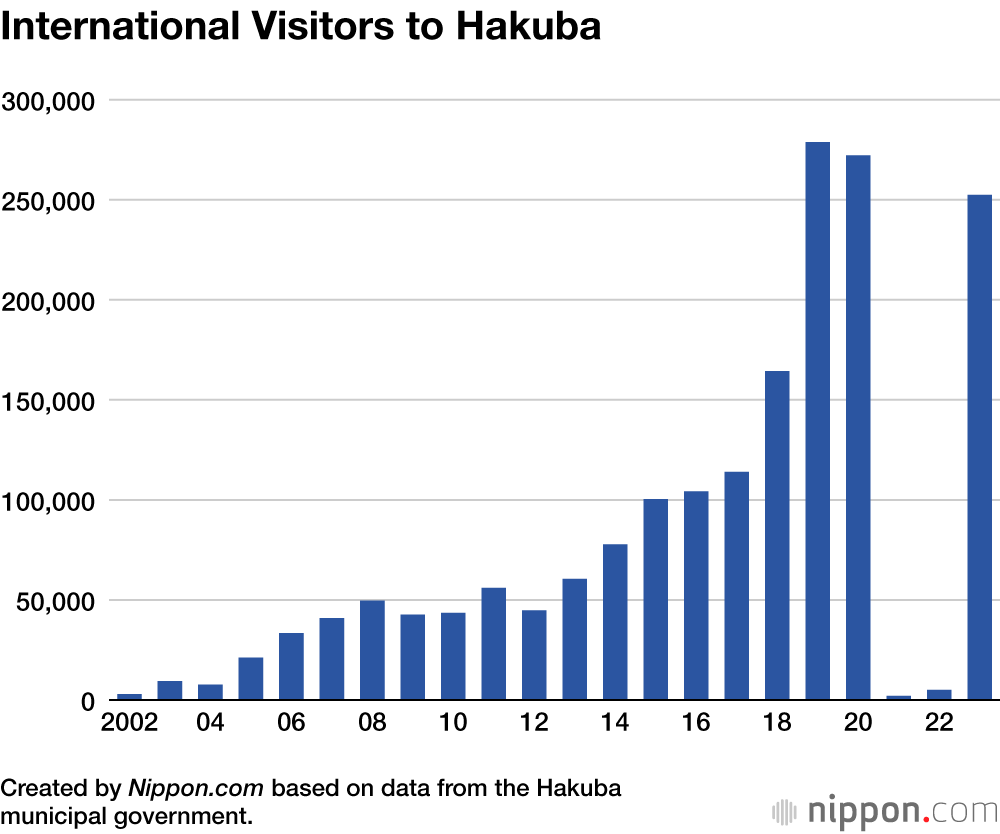
Tourism to Hakuba, which had been on a slow-but-steady decline for decades, has made a dramatic about-face as tourists from around the world pour into Japan. According to Hakuba’s tourism department, the town welcomed 2.71 million visitors in 2024, returning to a level last seen 20 years earlier. During the peak travel season from November 2024 to February 2025, some 1.3 million people travelled to Hakuba, up 14% from the same period the previous year, reaching the highest total over the last two decades. The town’s ski resorts were the main destination, with more than 890,000 people taking to the slopes, of whom 46% were from overseas.
The influx of tourists has pushed up demand for hotel rooms and condominiums, inflating real estate prices. As of September 2024, land prices in Hakuba had increased by 30% year on year, the fourth steepest rise nationally. Local real estate agents have welcomed the renewed interest in the area but play down the rate at which land prices are increasing, asserting that it is moderate compared to Niseko in Hokkaidō, another winter sports center popular with overseas visitors. Unlike Niseko, a tourism hot spot that has seen a huge influx of foreign investment, Hakuba’s realtors expect to draw moderate interest from bargain-hunting investors overseas.
Aside from land prices, Hakuba is suffering many of the same growing pains as Niseko. The welcomed boost in tourism is driving up costs, such as the aforementioned Hakuba-Nagano shuttle, and for things like ski-slope fare, with one food-truck charging an eyewatering ¥2,500 for a simple beef bowl. The influx of travelers has impacted taxi companies, which are struggling to find drivers to keep up with the growth in demand. Ski slopes and roads are more crowded, and the cost of living is going up, which bodes poorly for locals.
An Eye to Americans and Europeans
Hakuba first began courting overseas travelers in 2005. Around the time, a group of Canadian transplants in the village had launched an English-language tour guide service and ski school that was gaining traction among visitors from English-speaking countries. Seeing an opportunity, the town tapped into these and other networks and took advantage of funding through the government’s “Visit Japan Campaign” to promote itself abroad.
Taking a page from Niseko’s promotional playbook, it first turned its sights to Australia, with its shorter flight times and smaller time zone difference, in the hopes of attracting Aussies with the allure of world-class snow during the southern hemisphere’s summer. In 2014, the town started working with 10 local resorts to promote Hakuba as a ski destination. The initiative succeeded in boosting the number of Australian and Chinese-speaking skiers to the area, but Hakuba remained just one among a host of ski options overshadowed by Japan’s premier resort Niseko.
The town ramped up its efforts to distinguish itself from the competition starting around the mid-2010s. Fukushima Yōjirō, who heads Hakuba’s tourism bureau, points out that while Niseko has gentle slopes, Hakuba offers sheer, rugged terrain. “We felt that Hakuba’s steep slopes and backcountry skiing appealed to skiers from North America and Europe, so we made these core to our branding efforts,” he says.
As part of these efforts, in 2017 Hakuba hosted a qualifying event on the Freeride World Tour, becoming the first Asian stop in the global skiing and snowboarding competition. Well-known skiers and snowboarders shared videos of Hakuba’s snow-stacked slopes, with the name Japan Alps striking a chord and helping raise awareness of the valley as a winter sports destination among travelers from Europe and North America.
Along with skiing, Hakuba in the last few years has also garnered interest among Asian travelers keen to enjoy Japan’s autumn colors.
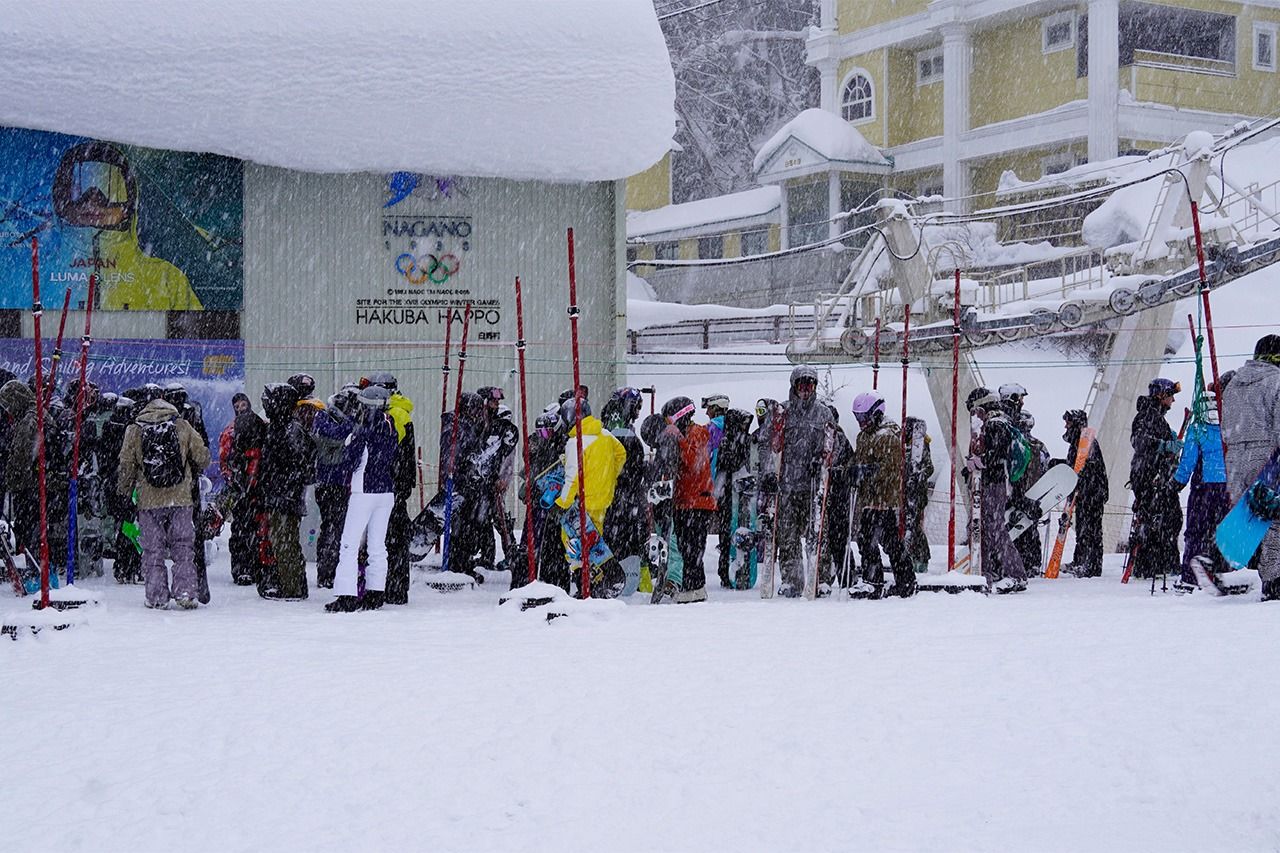
Skiers from around the globe enjoy the powder at Hakuba Happō-One Snow Resort. (© Nakahara Mieko)
Stepping from Niseko’s Shadow
Hakuba’s growing popularity with international tourists has earned it a reputation in some circles as a second Niseko, a moniker that locals are keen to shed. Hashimoto Tabito, the representative director of Hakuba-based Sakura Real Estate, stresses that “the two areas are fundamentally different,” noting particularly their approach to the hospitality industry.
In the past, mountain guides in Hakuba were known to host climbers in their homes, leading the village to be considered by many as the birthplace of minshuku , Japan’s traditional family-run lodgings. The area keeps this tradition alive, with many inns still being run by local families. The lodging industry as a whole is solidly moored in the local community, accounting for around 30% of the town’s economy with nearly 80% of Hakuba’s 9,600 residents working in tourism or related industries. Most ski resorts, transportation services, and tourism-centered businesses like restaurants are operated by locals, and subsequently there is a strong resistance to outside competition from large-scale condos and hotels. Niseko, by comparison, has embraced the development of large resorts funded by foreign and other outside investors.
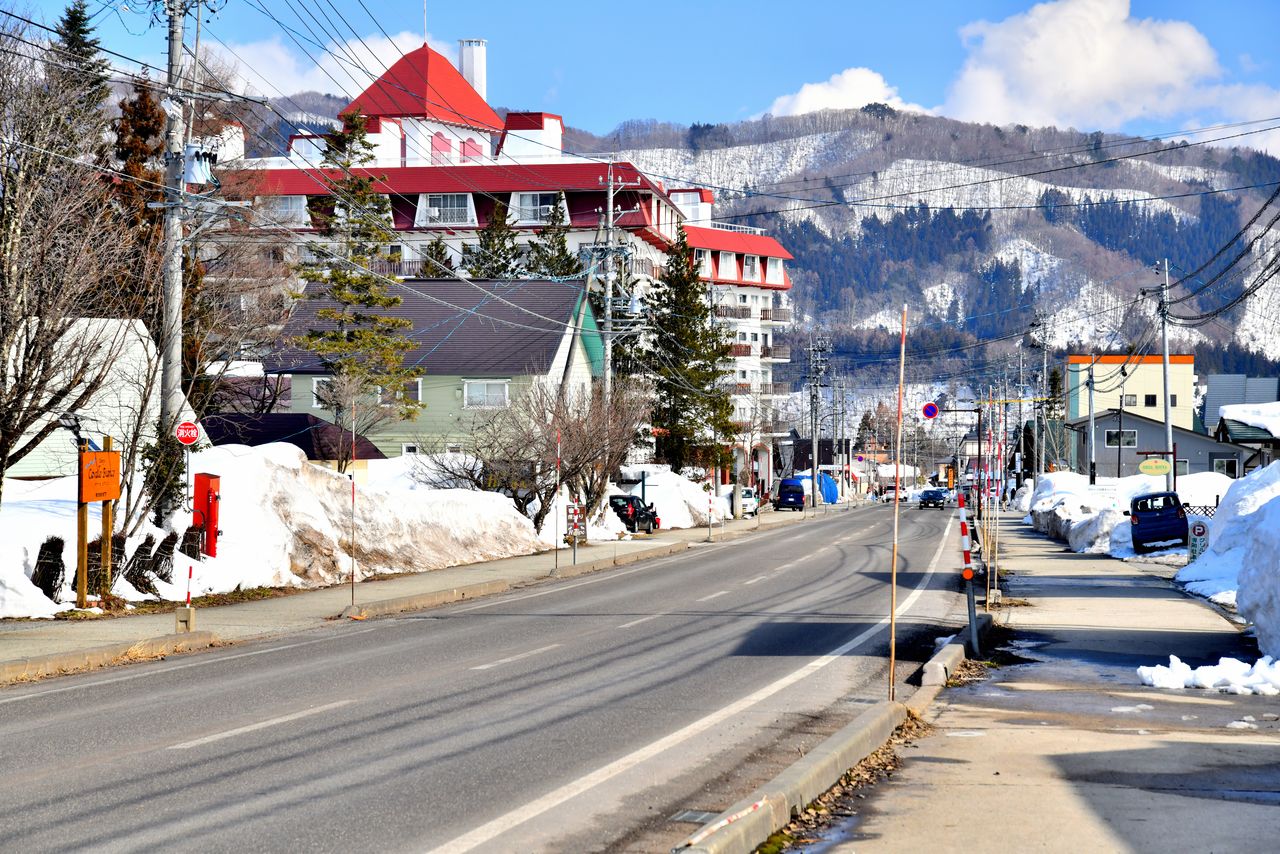
Hakuba is dotted by small-scale hotels and family-run lodgings. (© Pixta)
When foreign investors began to turn their eyes to Hakuba some five or six years back, it sparked a local movement, whose members advocated for a more community-led model for developing the tourism industry. Rather than landowners selling plots of land to outside developers to do with as they pleased, residents put their minds to hashing out a more sustainable development strategy that considers the types of facilities that would best take advantage of Hakuba’s strengths.
An example of this approach was the launch of Hakuba’s first luxury condominium project in 2017. The undertaking was realized through a partnership between an outside developer and Nagano-based Hachijūni Bank. “Hakuba welcomes foreign capital,” explains Hashimoto. “But local firms and other Japanese companies are the ones leading the development of the area.”
Take, for instance, a five-star hotel of the luxury resort brand Banyan Tree slated to open its doors in 2026. Financed by money from Singapore, it only moved forward after a decade spent winning over local landowners.
While Hakuba does not object to projects led by foreign investors, the town’s focus is on ensuring that the local community has a say in shaping the area’s future. “Hakuba certainly needs more high-end accommodations,” states Hashimoto. “At the same time, though, it needs to make certain that these benefit the local economy, such as reinvesting the profits of land sales in infrastructure projects.” One such initiative is the redevelopment of the area around Hakuba Station.”
Local Needs First
The impetus behind Hakuba’s development strategy has deep roots. During the halcyon days of Japan’s bubble economy in the 1980s and early 1990s, Hakuba’s tourism industry could survive on its earning from the 100-day span of the winter ski season. Things have changed, however. Japan’s population of skiers and snowboarders has shrunk to a quarter of what it was in the 1990s. Even with the recent surge of international tourists, the number of skiers hitting Hakuba’s slopes is only about 40% of what it was during the peak years.
Wada Yutaka, co-CEO of local land developer Zukutochie, declares that “the area is quiet most of the year,” noting that Japanese tourist numbers have continued to decline and that foreign visitors mainly come during specific periods. “If it stays this way, the local tourism industry will see its bottom line shrink, making it hard to attract investors or to secure workers.”
Another issue the town is facing is the aging of its tourism infrastructure. Many of Hakuba’s hotels and restaurants were built three or more decades ago and are in bad need of renovation. However, owners often lack the funds or know-how to carry out projects. If deep-pocketed outside investors are given free rein to develop new, high-end properties, locally owned tourism facilities will appear all the more dilapidated and unattractive by comparison.
Wada argues that the most pressing issue is not overtourism. “It’s that local businesses aren’t able to invest in a way that reflects the changing tourism landscape.” He stresses the need to build a sustainable model that enables the local tourism industry to develop and reinvest in itself. He suggests the four-point strategy of turning Hakuba into a year-round resort, investing in connecting multiple ski areas, doing away with competition over discounts and low prices, and moving from small, family-run businesses to a community-style shared management model that allows for large-scale investments.
The first of his suggestions, developing Hakuba into a year-round resort, offers a path toward gradually bolstering the tourism industry by improving the area’s appeal beyond just skiing. Toward this end, plans are already in progress to promote the area as a summer destination.
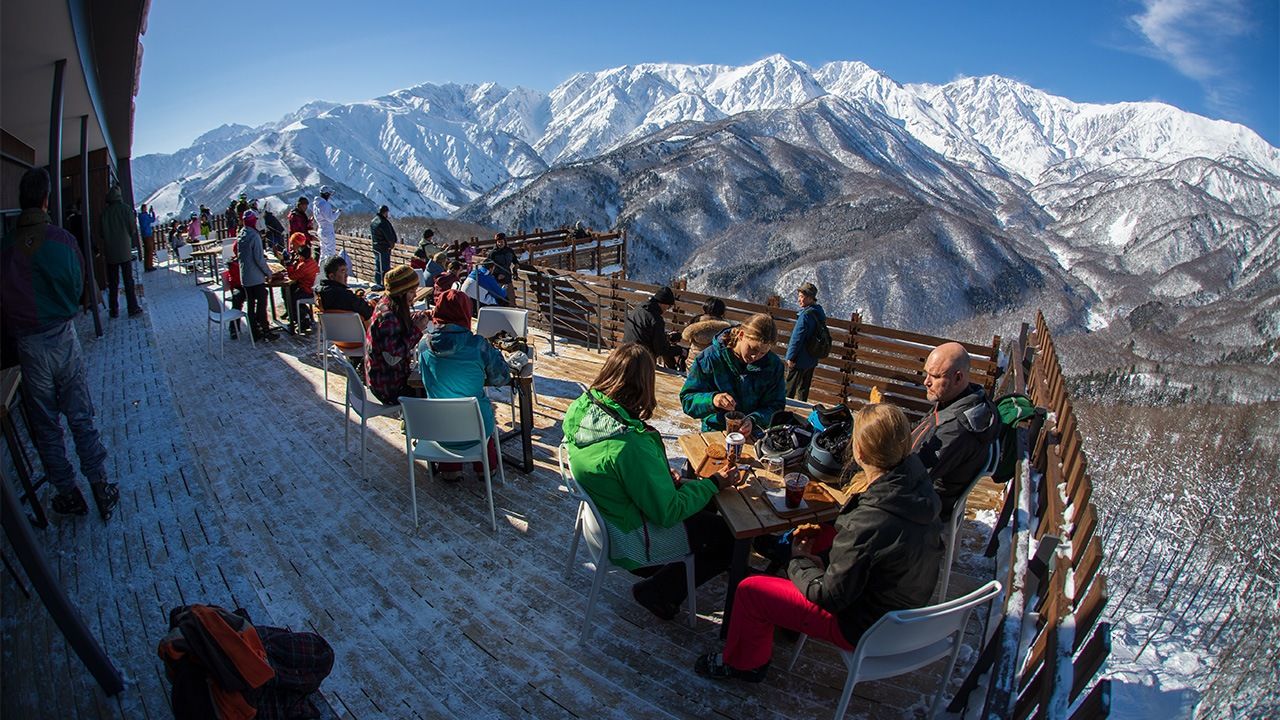
For instance, the Hakuba Iwatake Mountain Resort features a terrace set atop a 1,289-meter-high ski run. The facility, the Hakuba Mountain Harbor, houses well-known restaurant chains like Tokyo’s The City Bakery, offering visitors the unique experience of enjoying gourmet food while taking in the stunning mountain scenery. A giant swing built next to the terrace adds to the alpine enjoyment, with riders having the sense of flying through the scenery. There are also three-wheeled mountain carts, an outdoor activity that started in Germany, available at the summit. Videos and photos of the terrace and swing shared on social media, particularly among younger people, have helped boost the popularity of the area as a summer destination.
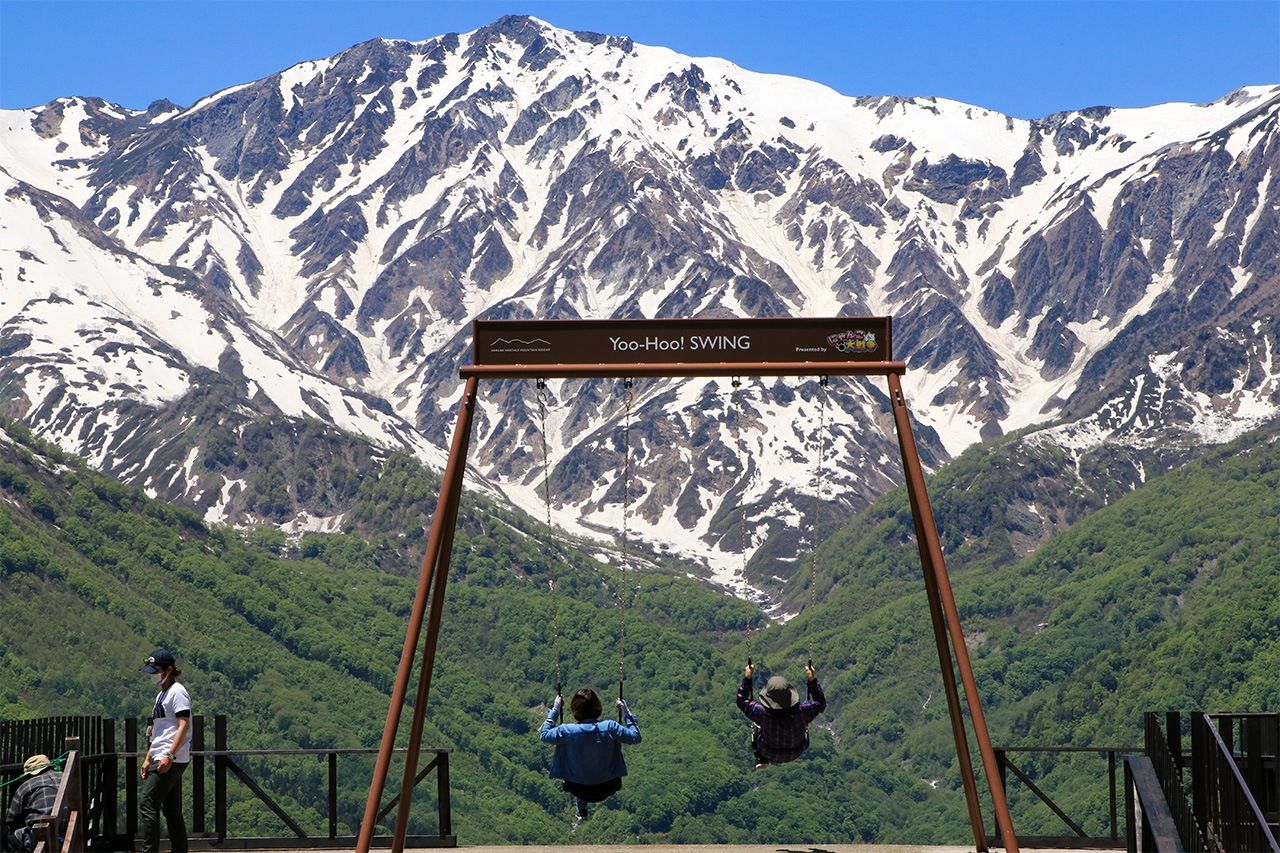
The giant swing at Hakuba Mountain Harbor. (Courtesy Iwatake Mountain Resort)
Another facility encouraging tourists to explore more of what the area has to offer is the Ao Lakeside Cafe, located on the shore of Lake Aoki in Ōmachi, just south of Hakuba. The lake is famed for the clarity of its water, and the café, a branch shop of a popular restaurant from Tennōzu in Tokyo, was designed with the idea of guests enjoying drinks, including a selection of craft beers, and light fare while taking in the beauty of the lake. There is also a sauna, and from summer to autumn, guests can cool off after a session in the steam bath by jumping directly into the lake.
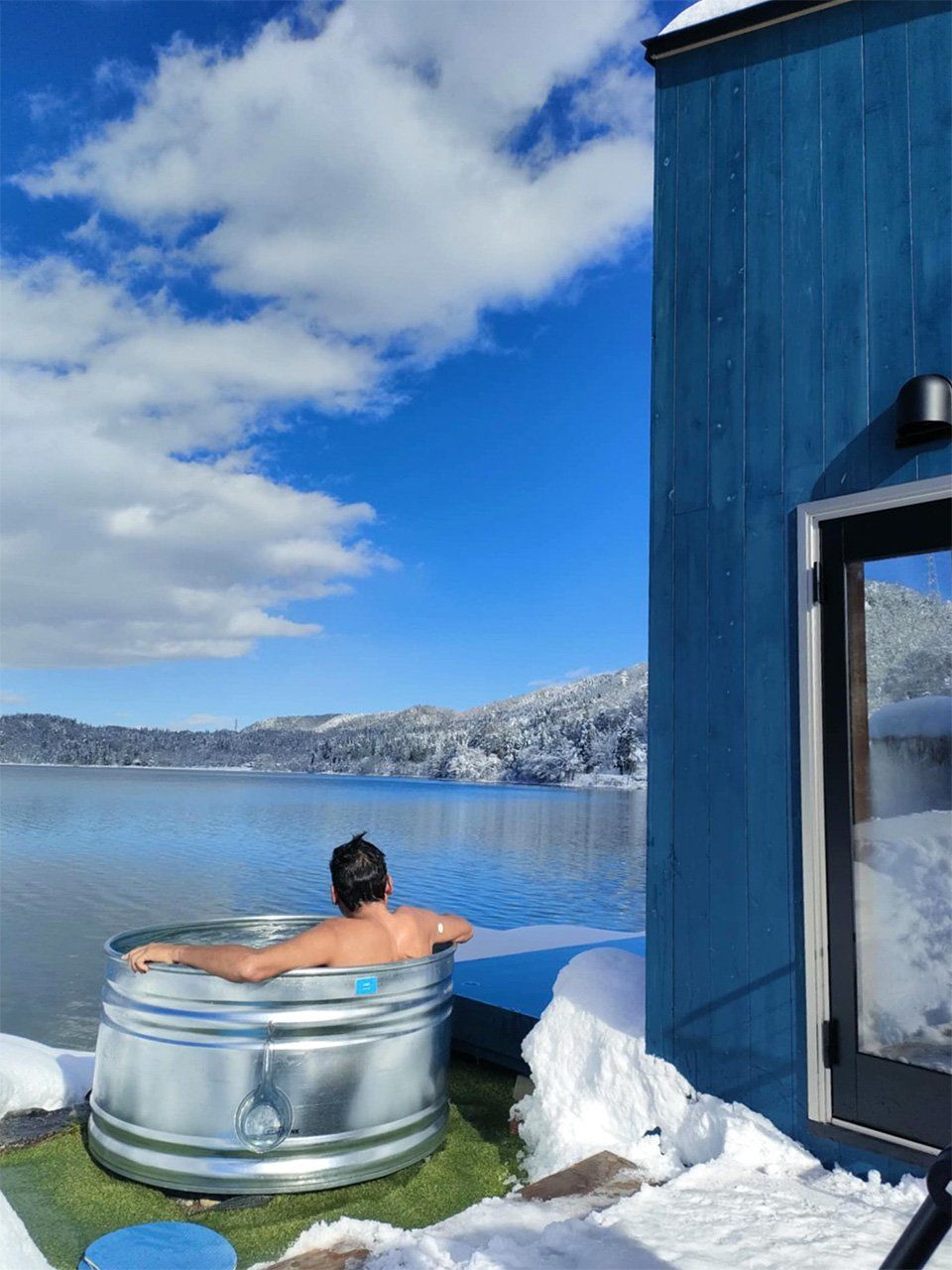
A guest takes in the view of Lake Aoki while cooling off after time in the sauna. (Courtesy Zukutochie)
More than Just a Ski Resort
In winter, several facilities in Hakuba launched new attractions with the goal of expanding the resort’s offerings for non-skiers and boosting traffic to local businesses: The Kitaone Highland area of Happō-One opened a Kotatsu Café on weekends, offering guests treats like oshiruko, a sweet and warming soup made with azuki (red beans), at traditional kotatsu heated tables; the Hakuba Alps Hotel at the Norikura Onsen Ski Resort set up an outdoor heated pool and sauna and hosted a music event with DJs that combined snow and hot spring bathing; and the Iwatake Mountain Resort set up heated tents with fire pits where guests could enjoy food and drinks, and a mountaintop dog run offered a snowy stroll for guests and their pets.
Maruyama Naoki, president of developer Happō-One Kaihatsu, says that the goal was to expand services for tourists from China and other parts of Asia who may not ski but still want to enjoy hot spring bathing and the alpine atmosphere.
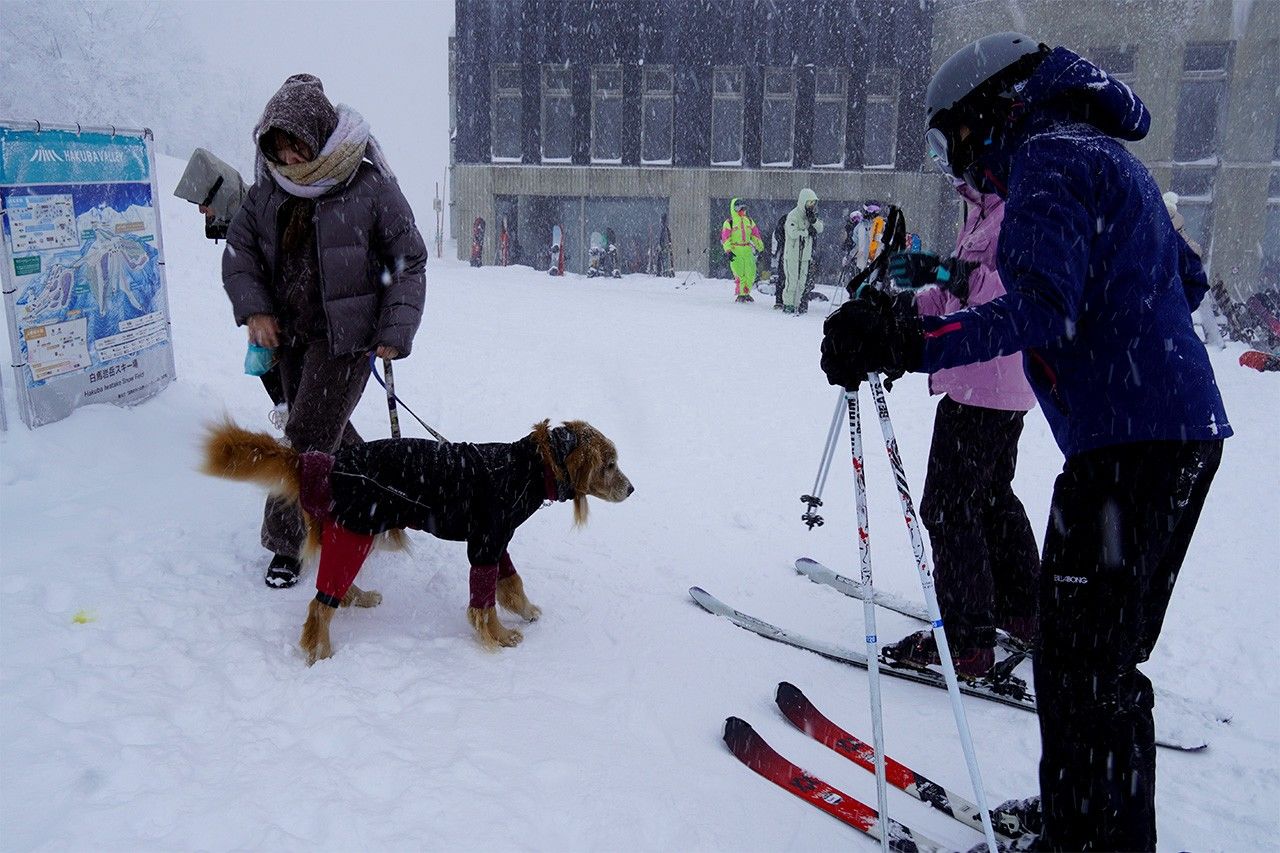
A guest at Iwatake Mountain Resort walks a dog past skiers at the top of the ski slope. (© Nakahara Mieko)
Zukutochie’s Wada stresses that while the increase in international tourists is something that Hakuba should embrace, he calls for a sustainable approach that benefits all parties, saying that “if outside investors are the only ones to profit, local industries will wither, taking with them everything that makes Hakuba unique. To avoid such a fate, it’s vital to craft an approach that ensures that residents remain central players going forward.”
Hakuba has committed to a vision of locally driven, sustainable tourism. Whether it can overcome the hurdles in achieving this goal remains to be seen.
(Originally published in Japanese. Banner photo: Guests enjoy the alpine scenery at the Hakuba Iwatake Mountain Resort. Courtesy of Hakuba Mountain Harbor.)