Is There a “Correct” Way to Pray at Temples and Shrines?
Culture History- English
- 日本語
- 简体字
- 繁體字
- Français
- Español
- العربية
- Русский
Worship at Shrines and Temples in Japan
When praying at a Shintō shrine, it is customary to bow twice, clap twice, and then bow once more at the conclusion of one’s invocation—nirei, nihakushu, ichirei in Japanese. By contrast, the accepted etiquette for Buddhist temples is to quietly join the hands together in the gasshō pose. Although I have never witnessed this, I have heard of people clapping when worshiping at temples. Such behavior has drawn comments of surprise and disapproval on social media, but is this really a faux pas? I argue that the situation is more complex than it appears.
Many people will be surprised to learn that the clap-and-bow practice common today at shrines is actually a fairly recent invention. It originated in the worship methods prescribed for Shintō priests during the Meiji era (1868–1912) and only spread to the wider populace after the Jinja Honchō, a postwar organization that oversees many shrines, began recommending it.
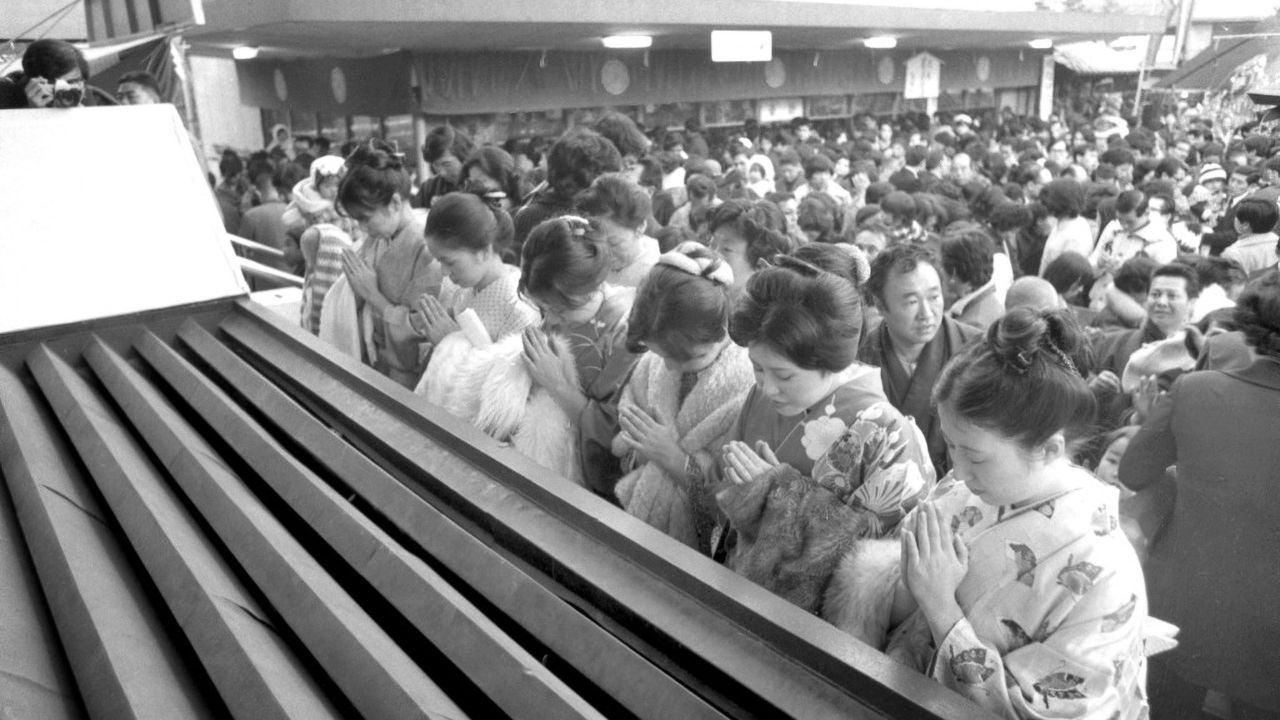
Nowadays, many shrines display signs instructing visitors on the clap-and-bow procedure, which is echoed in the mass media as the “correct” way to worship. However, a review of YouTube videos of hatsumōde, the first visit to a shrine in the New Year, from the early 1990s reveals a conspicuous absence of clap-and-bow, with most visitors simply joining their hands together in prayer.
Giving the issue closer thought, it strikes me as rather disrespectful for a human to stand and clap as if summoning the deities. In the past, worshippers did not clap, but sat on the ground and put their palms together when praying. During the Edo period (1603–1868), pilgrimages to Ise Grand Shrine were very popular, and guide books published at the time show the faithful sitting and prostrating themselves in front of Ise’s worship halls. Even today, Shintō priests commonly sit when conducting ceremonies at shrines.
An example from popular culture is director Kurosawa Akira’s 1943 martial art drama Sugata Sanshirō. The work includes a scene where the daughter of an opponent of the film’s protagonist Sanshirō prays at a shrine in the hope that her father will come out of the contest unscathed. The young woman, clad in a kimono, does not sit but squats down as she prays.
No Prescribed Format for Temples
As for Buddhist temples, there is no one prescribed way to worship. When praying to the principal image in the temple’s main hall, many people bring their palms together in the gasshō pose, but this is simply a natural gesture and not imposed by the temple.
Unlike Shintō, which has no codified doctrine or “schools” with differing interpretations of sacred texts, Buddhism encompasses a wide range of schools and sects with their own distinct teachings. Typically, worship takes the form of priests chanting sutras during ceremonies and at morning and evening prayer in a temple’s main hall. Ordinary adherents may also chant sutras, and temples belonging to esoteric schools may recite specific mantras or litanies. With such a wide range of practices, Buddhism never developed a universally prescribed method of worship.
Shrine and Temple Connections
Another factor complicating the situation is the historically close relationship temples and shrines held in Japan. Scholars hold that religion in Japan began to change starting in the twelfth century with the amalgamation of Shintō gods (kami) and Buddhist deities. Known as shinbutsu shūgō, it was a major characteristic of religion in Japan up to the modern era.
Buddhism, in contrast to native Shintō, was transmitted to Japan from the Asian continent around the middle of the sixth century. Initially, the two religions were seen as having contrasting beliefs, but as Buddhism became entrenched in Japanese society, the faiths gradually became functionally one and the same.
This was facilitated by the lack of a clear Shintō doctrine, in contrast to the established theology of Buddhism. Accordingly, there were no doctrinal conflicts between the two. The situation was a very different to the spread of Christianity in Europe, which led to the destruction of native folk religions. This synthesis allowed for the development of jingūji, sprawling complexes incorporating both Shintō shrines and Buddhist temples that were managed by Buddhist priests. It was ordinary practice for such priests to chant sutras in front of a shrine’s worship halls, in the belief that the kami were reincarnated as a result of their desire to be liberated by following Buddhist practice.
Take, for instance, Kamakura’s Tsurugaoka Hachimangū, a shrine popular with both domestic and foreign visitors. At its founding in the eleventh century, it was both a Buddhist temple and Shintō shrine. Numerous Buddhist structures stood on its grounds, including a pagoda containing relics of the Buddha. However, following the Meiji Restoration in 1868, the new modern government issued an order legally separating Buddhism and Shintō, and all traces of Buddhist worship were removed from the shrine.
In the centuries prior to this, though, Shintō and Buddhism were closely intertwined, with no distinctions made between shrines and temples. Tsurugaoka Hachimangū was both a shrine and a temple, and worshippers there prayed to both kami and Buddhist deities by simply joining their hands in the gasshō gesture. There was no particular Shintō or Buddhist worship method to follow.
Moving Beyond Formality
Even with the Meiji government’s separation of the religions, people continued to worship as before, often praying in the gasshō pose at both temples and shrines. Some people clapped when praying at shrines, but this was only in imitation of Shintō priests who were doing so.
Be it gasshō or bow-and-clap, neither practice is prescribed by kami or Buddha. Human beings decided which prayer method should be followed, and in that sense, there are no hard-and-fast rules. Japanese, however, are very etiquette conscious and tend to follow whatever method is deemed “proper.” Having emerged as the endorsed practice for worshipping at shrines, bow-and-clap has become widely accepted.
The influence of Japan’s past religious syncretism still lingers, though. People today visit both temples and shrines without much thought to the differences. Take hatsumōde at New Year as an illustration. In Tokyo, crowds throng Meiji Shrine, whereas in neighboring Kanagawa Prefecture, Kawasaki Daishi, a temple of the Shingon school of Buddhism, draws equally vast numbers. Many of these hatsumōde worshippers pay little mind to one being a shrine and the other a temple, with some people even clapping to worship at Kawasaki Daishi.
There is no need to get stirred up about supposed breaches of etiquette where worship is concerned. The point of devotion is to pray in a heartfelt way. I believe that placing one’s palms together in the gasshō pose lends itself well to this and I have adopted it as my preferred way to pray, be it at a shrine or a temple.
(Originally published in Japanese. Banner photo: Visitors offer New Year prayers with hands together in the gasshō pose at the temple Kongōji in Hino, Tokyo, on January 1, 1976. © Kyōdō.)