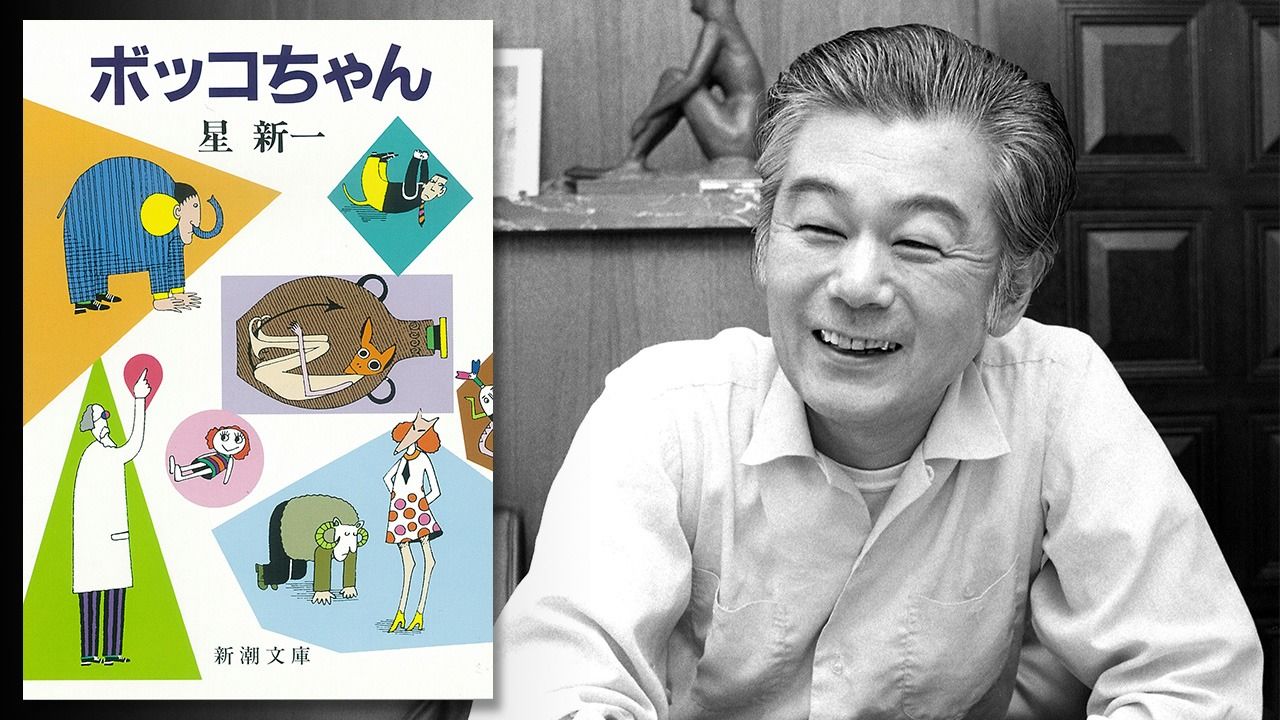
Hoshi Shin’ichi: Japan’s Timeless Master of the Short-Short Story
Books Culture History- English
- 日本語
- 简体字
- 繁體字
- Français
- Español
- العربية
- Русский
Seeing into the Future
The year 2026 is the centenary of Hoshi Shin’ichi’s birth. This milestone for the prolific writer has prompted media features and bookstores displays across Japan. Ever since his writing debut in 1957, Hoshi has consistently ranked among the Japanese reading public’s favorite authors over the past 50 years, evidence of his popularity among succeeding generations, as he has attracted new readers and ensured steady sales over the decades.
Hoshi is well known for his “short short” stories, which are accessible, imaginative, and fun. These flash fiction works contain no real-world proper names or references to contemporary trends, are free of graphic sex and violence, and are easy even for children to read.
Hoshi’s works often appear in school textbooks, and many Japanese are likely to have read “Bokko-chan” or “He-y, Come on Ou-t!” Some, such as the novel Voice Net or “Shoulder-Top Secretary,” are curiously prescient about the future, for example, bringing to mind the internet or communication via generative AI.
To understand why Hoshi wrote over 1,001 short shorts over his lifetime, it helps to know his background.
A Spirit of Adventure
Hoshi’s father Hajime, born in 1873, was the founder of Hoshi Pharmaceuticals and a member of the Japanese parliament. His maternal grandfather had been an anatomist and professor emeritus at Tokyo Imperial University (predecessor of the University of Tokyo); his grandmother was a sister of the novelist Mori Ōgai.
Hoshi lived with his maternal grandparents in Hongō, Tokyo, as his father was often absent due to his involvement in politics. Hoshi wrote two books about his father and one about his maternal grandfather, which must have reflected a strong desire to understand his family.
The leaps of imagination and surprising twists in Hoshi’s stories were influenced by his father’s spirit of adventure. Born in the late nineteenth century, when Japan was rapidly pursuing Westernization, Hajime had studied at Columbia University, and had extensive contacts with politicians, including Gotō Shinpei, the head of civilian affairs in Taiwan, a colony of Japan at the time. A gifted creative thinker, Hajime served as Gotō’s right-hand man and was a notable optimist: involved in a plane crash once, he was said to have remarked “I had decided it wasn’t my time to die.”
Hajime, in the United States after World War II to raise money for Hoshi Pharmaceuticals, died suddenly, leaving Hoshi to head the company. Although Hoshi’s relationship with his father had been complicated, he later wrote “I’m lucky that I inherited the essence of my ideas from my father. I sincerely believe that.”
Hoshi and War
One clue to Hoshi’s perspective is his birth year, 1926. In wartime Japan, many young men were conscripted, and some of Hoshi’s classmates were sent off to fight. But since Hoshi was studying agricultural chemistry, he was exempted from the draft and spent the war years as a laborer. During my research for a biography of Hoshi, the words of one of his elementary school friends stayed with me:
“There was always someone who knew what was happening. The adults were saying, ‘Japan is going to lose the war; we lost the Battle of Midway.’ I suppose Hoshi had heard a lot of the details from his father . . . So when the war ended, for us it was just over. That was a massive difference from those who fought. People who went to the front or out on a battleship and came back alive, they wanted to atone. There was a big gap between us and those who had been five years ahead at school. But when you’re young, you can adapt.”
Hoshi was 18 and a student at Tokyo Imperial University when the war ended. Hearing the emperor announce Japan’s surrender at the university’s Yasuda Auditorium, he hurried to the Imperial Palace in the center of Tokyo. He did not know that the message had been prerecorded and assumed that the emperor would be returning to the palace after giving the address in another location.
Hoshi later wrote of his puzzlement every time he saw photos or films of sobbing crowds prostrating themselves in front of the palace at the time of the surrender, as he had not seen that kind of scene when he was there. His curiosity at going to the palace to see what was happening and his cool analysis hint at the future tenor of his works, which observed society from an unusual perspective.
A Six-Year Blank
Around that time, Hoshi had begun acting as his father’s secretary, accompanying him for work; he was appointed sales manager at Hoshi Pharmaceuticals when he entered graduate school. However, he wrote nothing about the time between his father’s death in 1951 and the sale of the company six years later.
The turning point for Hoshi came when, busying himself settling the company’s affairs, he went to a meeting of the Japan Flying Saucer Research Association, whose members included Mishima Yukio and Ishihara Shintarō. Its members simply gathered to talk about flying saucers and did not pry into each other’s backgrounds.
Together with other readers of science fiction, he set up Uchū-jin (Cosmic Dust), a dōjinshi self-published fanzine. The story “Sextra,” which he published there, drew the attention of mystery and thriller writer Edogawa Ranpo and marked his debut as a writer.
Enter Bokko-chan
Two months later, Hoshi completed “Bokko-chan,” a sharp satire about a bartender who builds a beautiful, android hostess called Bokko to boost drink sales, with unexpected, deadly consequences. He later recalled, “When I finished writing it, I said to myself, ‘This is it!’ It was like I’d discovered my true self. I may be exaggerating, but I felt like my ability was a divine gift.”
Written on the back of two sheets of company letterhead paper, the work was originally titled “Oseji o iwanai Bokko-chan” (Bokko-chan Flatters No One). Hoshi came to write drafts of his short-short stories on the back of used manuscript paper, filling the pages with tiny writing that enabled him to see the arc of the story at a glance, although at that point he had not yet settled on that method.
But Hoshi had found his writing style, characterized by short, rhythmical sentences devoid of any references to period, place or characters’ names. The way that customers interacted with Bokko-chan and how she parroted back their words would henceforth be his signature style. Hoshi later wrote, “I liked this story myself, and it was the prototype for all the short shorts that came after. I had found the style that suited me and for me, ‘Bokko-chan’ was the starting point for everything that came later. It made me the writer I am today.”
To be unique, a writer must not do the same thing that others do. According to a friend who knew Hoshi when he was his father’s secretary, the author focused on developing his uniqueness, voraciously combing newspapers and American magazines obtained from the postwar Occupation forces for ideas. Some of his works, such as “The Last Earthling,” are Bible-themed; his diaries reveal that he attended church services at one time.
No Two Like Him
It is also clear that Hoshi read many foreign works. Esaka Yū, a student of his who received his vast library, noted that Hoshi had amassed nearly complete sets of three leading Japanese mystery magazines: Hitchcock Magazine, Manhunt, and the Japanese edition of Ellery Queen Mystery Magazine. Esaka said that Hoshi often encouraged him to read foreign short stories.
The writer Aramata Hiroshi, who has read Hoshi since his very first works, commented that “Everyone thinks that they can write in Hoshi’s style and they have a go, but they soon find that they can’t sustain it.” Hoshi’s writing is sometimes described as being overly influenced by the West, but he can be better understood if we see how he introduced, in Aramata’s words, “the friendliness and snobbery of American culture.”
Having discovered his distinctive voice with “Bokko-chan,” Hoshi pioneered the inimitable short-short genre and went on to become a favorite writer among a wide audience.
In October 1983, Hoshi wrote a story that brought his tally to a landmark 1,001. He intended to continue publishing if he was satisfied with his writing and began branching out into folk tales. At the same time, he continued updating the vocabulary in older works.
When going through Hoshi’s papers, I felt overwhelmed by the huge cache of drafts, story outlines, and untitled manuscripts. These written materials were, unlike generative AI which can produce a novel in an instant, testament to the difficult craft of writing. This year, the hundredth anniversary of Hoshi’s birth, his daughter Marina discovered an unpublished story of his titled “Sacred Land.” She observes of the tale in the centenary collection where it was published that, “Today, everyone talks about AI’s energy consumption. I suppose you could say that my father foresaw a world where electricity is essential for everything we do.”
Working to create a database of Hoshi’s oeuvre, I believe his papers may still contain many unpublished stories. It makes me smile to think that even now, Hoshi is up to his old tricks.
Information on Works Mentioned
- “Bokko-chan” is translated by Saitō Noriyoshi
- “Ō-i, dete kō-i“ is translated as “He-y, Come on Ou-t!” by Stanleigh Jones
- Koe no ami is translated as Voice Net, and “Saigo no chikyūjin” is translated as “The Last Earthling” by Hoshi Marina and Kim Hines
- “Kata no ue no hisho” is translated as “Shoulder-Top Secretary” by Jay Rubin
- “Sekisutora” (Sextra) and “Seichi”
(Originally published in Japanese. Banner photo: The collection Bokko-chan [left], which takes its title from one of Hoshi’s best-known works, published in 1958 [© Shinchōsha], and Hoshi Shin’ichi [right] in June 1977 [© Kyōdō].)