


Lead the Way Toward a New Regional Architecture
The framework we envision is not unlike the “regional architecture” that former Secretary of State Hillary Clinton described in a speech delivered at the East-West Center in Honolulu on January 12, 2010. In her remarks Clinton said, “The United States . . . plays a central role in helping to deal with the difficulties that individual states and this region confront. This new landscape requires us to build an institutional architecture that maximizes our prospects for effective cooperation, builds trust, and reduces the friction of competition.” The Trans-Pacific Partnership is perhaps the best-known example of the kind of regional framework the US administration has in mind.
Meanwhile, the shifting balance of power between the United States and China in the Asia-Pacific is bringing about major changes in the region’s political, economic, and security climate. To protect its own interest in the midst of this upheaval, Japan can no longer be content to ride on the coattails of another power. It must take the initiative and lead the way in setting a direction for the emerging regional community. Teaming up with other countries with whom we share interests and values to create our own regional architecture is an effective way to go about this, and it can also strengthen our security system by adding additional layers of cooperation.
To this point, the relationship between ODA and NGOs has been defined on a project-by-project basis, with the government providing financial support for specific programs planned and carried out by NGOs. This is a positive development as far as it goes, but it seems to me that investment in a new nongovernmental framework like APADM should also be a major ODA priority. This would be an efficient means of building the sort of international framework that could help preserve the independence of Japanese foreign policy. Such a framework would also maximize access to private-sector resources and contribute to the speed and flexibility of foreign aid through the involvement of people from the private and nonprofit sectors.
Another task of vital importance to the future of Japan’s international cooperation efforts is human resource development. I launched Peace Winds Japan in 1996, the year after the 1995 Kobe earthquake. It was a time of unprecedented volunteer activity among Japanese young adults, whom the media dubbed the “Kobe generation.” The Tōhoku earthquake and tsunami of 2011 triggered another surge in volunteerism and charitable donations. Interest in social enterprises, NGOs, and other philanthropic groups has soared to new highs. In short, the tragedy of the earthquake and tsunami has given birth to the “Tōhoku generation,” a pool of human resources with an unprecedented orientation toward public service. How well we tap into and train this generation will have a huge impact on the future of Japan’s performance in the field of international cooperation.
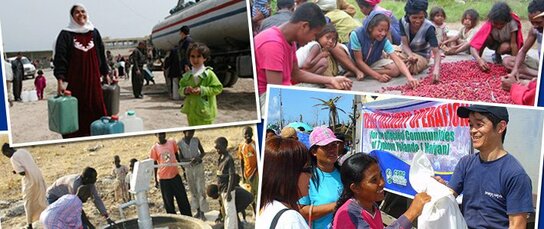
(Originally written in Japanese on July 18, 2014. Title photo: Peace Winds Japan at work. Photos courtesy of PWJ.)






 Read in other languages