


Creative Engagement
INTERVIEWER
Another recent development relating to corporate governance is the Japanese edition of the Stewardship Code, and I understand that you were actually involved in its drafting. Can you share some of your impressions from that experience?
ISHIDA
For one thing, there was quite a bit of discussion regarding the English word “engagement.” The Japanese word taiwa [dialogue] has taken hold as the standard translation for “engagement,” but I think taiwa is narrower in meaning, so you lose some of the dimensions implicit in the term “engagement.” In the United States, shareholder involvement takes a lot of different forms, including proxy voting, letter writing, face-to-face meetings, shareholder resolutions, and even proxy fights. If the company can convince a shareholder to withdraw a resolution, then that’s considered “successful engagement.” When you focus on dialogue per se, it becomes an end in itself. That ends up costing the company money without accomplishing much, so people give up on it. In the Japanese context, I think we’re going to see an extended period of trial and error before businesses figure out how to engage shareholders meaningfully.
Japan’s Capital Productivity Problem
INTERVIEWER
In October 2014, your company decided to recommend voting out the top executives of corporations that fail to maintain an average ROE of at least 5 percent over five years. Why did you adopt such a guideline? Also, the final report of the Itō Review of Competitiveness and Incentives for Sustainable Growth [April 2014], commissioned by the Ministry of Economy, Trade and Industry, calls for an ROE target of 8 percent. What’s your view on that recommendation?

ISHIDA
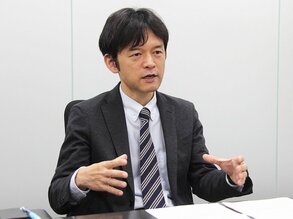
Our ROE policy isn’t targeted at governance reform per se so much as the basic profitability problem that’s afflicted Japanese business for some time. The purpose is to focus on the need to boost capital productivity. We welcomed the Itō Report. A key issue in this sort of reform is the receptivity of top management to the message. If an activist hedge fund lectures executives about the importance of ROE, they’re not apt to take it as constructive criticism. But a government report is a different matter entirely. It helps set the tone of discourse.
We selected 5 percent as a reasonable absolute minimum, without regard to sector. Stocks are more risky than bonds, so unless investors can anticipate a higher return, there’s no incentive to invest in stock. After soliciting a lot of feedback from Japanese investors, we settled on the 5 percent figure.
Separating Governance and Profitability
INTERVIEWER
It seems to me that in the past, discussion of corporate governance centered on oversight to ensure that management didn’t act against the interests of shareholders. But lately the focus has shifted to “proactive governance” geared to maximizing growth and shareholder profits. Do you agree with that approach?
ISHIDA
I think enthusiasm for the word “governance” may be getting a bit overheated. We need to take a step back. It’s a mistake to link governance and corporate profitability. Can you quantify the value of appointing one outside director in terms of corporate profits? No, that’s nonsense. If merely appointing an outside director could lead directly to improved business performance, that would be terrific, but it’s not that simple. Governance is all about systemic safeguards. Think of it as risk management.
I think it helps to go back to the basic idea of a joint-stock company. Shareholders can’t run the business themselves, so they appoint directors to work on their behalf, in the expectation that the directors will oversee the senior managers who actually run the business. But if the directors are themselves members of management, then that calls their oversight into question.
Let’s say you have a Scandinavian pension fund that invests its assets in stocks around the world on behalf of the nation’s elderly. Supposing it comes down to a choice between a Japanese business and a South Korean business. If the Korean business has outside directors, and the Japanese business has only insiders on its board of directors, which is going to look like a safer investment? If we want investors to choose the Japanese business, then we need a system that meets minimum international standards.
The incorporation of an outsider’s viewpoint on the board doesn’t lead directly to higher profits. But if the board of directors changes from a group of insiders who represent the interests of the company’s divisions to an organ that rises above internal politics and performs its oversight function in a rational manner, that could open the way for the company to close down unprofitable divisions that had previously been untouchable.
As I see it, investing in corporate governance is a bit like insurance. Buying insurance doesn’t guarantee you a happy and fulfilling life. It’s the basic price you pay for eliminating the need to worry about certain risks on a daily basis, so that you’re free to focus on what you should be doing.
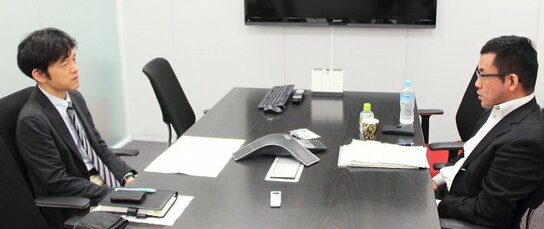
(Based on an interview conducted in Japanese by Takenaka Harukata on October 22, 2015. Banner photo: Interviewer Takenaka Harukata, left, with Ishida Takeyuki, executive director at Institutional Shareholder Services in Japan.)











 Read in other languages