


Evictions as Part of the Drive to Enhance Core Capital Functions
The campaign by the municipal government to evict internal migrants might look like a sudden move, but in fact it is in line with the ongoing policy of strengthening Beijing’s core functions as the nation’s capital. On the occasion of a 2014 inspection tour of Beijing, President Xi issued a directive to strengthen the core capital functions—national political affairs, culture, international concourse, and science/technology and innovation—and move other functions outside the capital. And at a meeting of the CPC’s Central Leading Group for Financial and Economic Affairs called by Xi on February 10, 2015, where responsible officials reported on the state of progress of policy implementation regarding such matters as the National New-Type Urbanization Plan, food security, water issues, energy issues, innovation strategy, the Asian Infrastructure Investment Bank, and the Silk Road Fund, there was also discussion of the plan for collaborative development of Beijing and neighboring Tianjin and Hebei. This plan aims to coordinate industrial, economic, and urbanization policies within the three areas and to address the issues of regional gaps and environmental degradation. It calls for the dispersal and adjustment of the capital’s non-core functions, and an urgent part of the agenda is improvement of conditions not appropriate to the capital city, such as the excessive concentration of population, deterioration of public security, and clustering of low-profit industries.
In 2017 the Beijing municipal government started implementing this plan with a firm hand, forcibly removing illegally constructed buildings and evicting residents. The authorities judged that they would not be able to meet their targets under the plan unless they stepped up the pace of their action. And according to a June 9 story in the People’s Daily, as of the end of April 2017 the city had implemented removals at 2,225 locations covering an area of 16.4 million square meters, 3.8 times the figure for January–April 2016, thereby reaching 76.1% of the target for the year.
Redevelopment of areas occupied by illegal residents has also gotten into full swing. The story in the People’s Daily reported that as of March 8 the authorities had conducted 9,960 legal consultation sessions with residents and had settled or made adjustments in 439 cases.
The coverage in the People’s Daily seems to indicate that the authorities have managed in short order to implement the long-pending agenda of removing illegal edifices and residents. But given the strict controls on media reporting, it would be dangerous to take this positive coverage at face value. The forcible campaign of demolishment and eviction conducted after the November 19 conflagration involved grave violations of human rights and violated China’s own Administrative Compulsion Law, which went into effect in 2012. Article 5 of this law declares, “If the purposes of administration may be achieved by non-compulsory means, no administrative compulsion shall be set or implemented,” and Article 43 stipulates, “Administrative organs shall not force the parties concerned to perform the relevant administrative decisions by such means as cutting off the supply of water, electricity, heating, or gas for the living of residents.”
Properly speaking, removals of this sort should be implemented only after the completion of various preliminary procedures, such as inspection by experts, multifaceted risk evaluation, confirmation of legal provisions, and the holding of hearings, followed by the finding of new homes for those to be displaced and the determination of the amounts of compensation they are to receive. But it seems that in their eagerness to carry out the transfer of non-core functions from the capital, the authorities are skipping such procedures and seeking to speed up the various steps required for implementation. Also, most of the compensation payments and assistance being provided for moving to new locations are going to the urban-registered residents holding rights to land and structures. Virtually none of the rural-registered people with leases to their residences in the urban villages are receiving such compensation.
Narrowing Disparities Is the Only Solution
The urban-registered residents of China’s cities need the help of the rural-registered inhabitants of the urban villages. Who else is going to provide care for the growing population of seniors? Who else is going to assume the duty of taking working parents’ children to and from school and making meals for them? Migrants are also the ones who operate the stands where people get their breakfast, and they do the heavy labor on construction sites and in factories. Even so, the Beijing municipal authorities are unlikely to actively assist them by, for example, building low-rent housing or putting up schools that the children of low-income families can attend.
As noted above, Chinese children are assigned to their parent’s hukou at birth, and their future lives are greatly affected by whether their place of registration is one with good conditions or not. The regional economic disparities within China are continuing to widen, and there is no indication when this situation might be ameliorated. Both farmers and rural-registered migrant workers in cities deserve more generous public support, but there is a firmly established setup of exploitation in place, a setup under which rural migrants are hired and fired at their employers’ convenience and sometimes forcibly evicted from their urban homes.
The reason China’s “villages in the city” have developed as places where the law is flouted is that, given the persistent disparities between regions, there is an endless stream of people who want to better their economic status even if they must break the law to do so. Until the disparities within Chinese society are greatly narrowed, even if the existing urban villages are cleared away, new ones will spring up elsewhere.
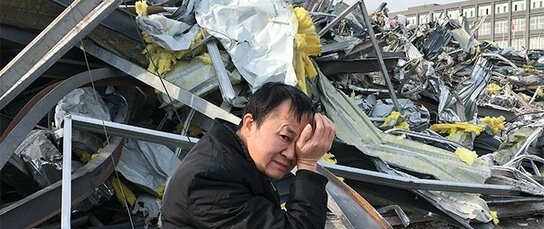
(Originally published in Japanese on July 3, 2018. Banner photo: A resident of a Beijing neighborhood largely inhabited by migrants from rural areas passes by the rubble of an illegal building torn down following a fatal conflagration in their slum-like “village in the city.” © Reuters/Aflo.)










 Read in other languages