


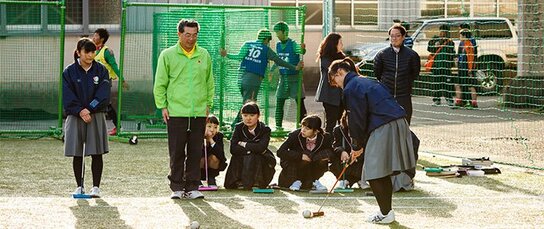
Gateball is a team sport, five players facing off against five. The point is for team members to strike the balls bearing their own numbers in consecutive order, collaborating to get as many of the team’s balls through the three gates on the court in the correct order and hitting them against the goalpost before the 30-minute time limit is up. It is an intensely competitive game, with victory decided by the combined points of all five members of each team.
“At first, it was fun enough just learning how to get my ball through the gates, and getting to the point where I could hit another player’s ball with my own,” says junior Munakata Yūki. “But what I really find interesting now is thinking strategically, like calculating where to leave my ball so the other team can’t knock it out of position. And then, since a single shot can change the course of the entire game, anyone can become the team’s key player from one match to the next. I find that really appealing.”
Indeed, this is one thing all the club members seem to agree on. The true allure of gateball, they say, lies in its unique combination of intricate strategic thinking rivaling shōgi and chess, and the social fun you can only get from team play. It is a sport, they all agree, that only gets deeper the better you become.
Certainly club captain Seitō Arisa, a junior this year, thinks so. “When I watch videos of matches between top-level teams on YouTube,” she says, “I’m constantly thinking to myself, ‘Wow, I never thought of that strategy before!’ I learn so much that that once I start watching, I can’t make myself stop.” Indeed, some club members say that after school, they do solo practice on the carpet at home in pursuit of the perfect winning strategy.
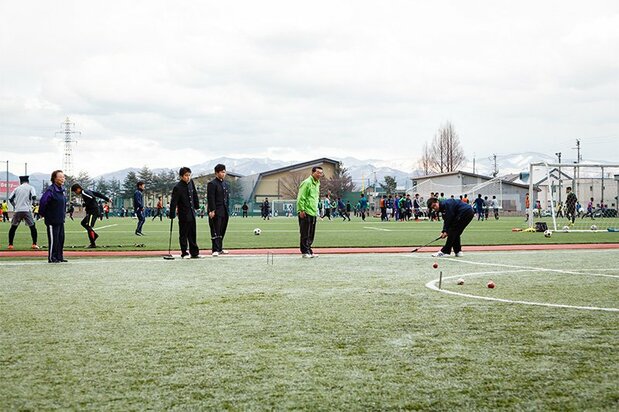
 Gateball requires thinking many moves ahead. Players position their own balls where teammates can easily deflect them through a gate.
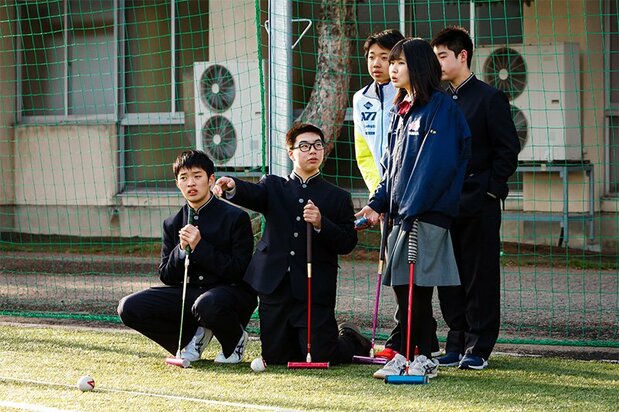 Debate arises frequently over the most advantageous spot to leave a ball.
Our Dream? To Be Aomori Yamada, the Gateball Champs!
Recently the club has been taking monthly road trips to open gateball competitions in other prefectures to compete against top-level teams and boost their game. Their ride for these excursions is club faculty advisor Norita Shūichi’s van, with Norita himself at the wheel, and the trips have taken them as far as Niigata and Nagano Prefectures, more than five hours away. Norita obtained a medium-sized motor vehicle license just for these sorties.
“The students are giving it their all, so what choice do I have?” laughs Norita. “What do you think? I must be the best club manager cum bus driver in Japan!”
 Aomori Yamada teacher Norita Shūichi puts long hours into advising the club, even getting a medium-sized motor vehicle license to take them to out-of-town matches.
The other thing Norita drives into his students is the need to keep their enthusiasm for gateball from interfering with their studies. No matter how late they get home from a road trip, he expects them all to be in class on time the next morning, and he demands that they score better than passing grades on all of their exams. This spring one club member qualified for the prestigious University of Tokyo, suggesting that gateball might just possibly be good for academics as well.
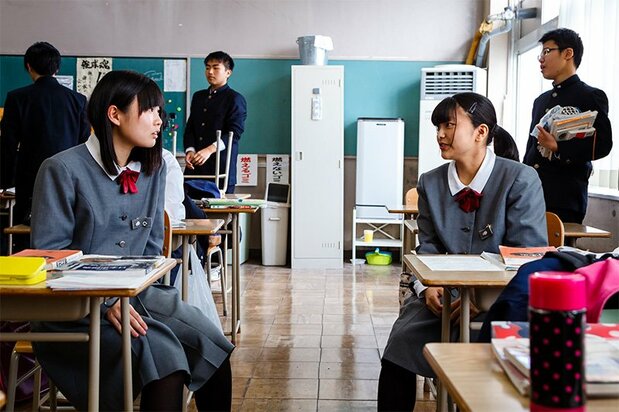 All gateball club members are in Aomori Yamada’s special academic track for students seeking to enter Japan’s top universities. Except for Mondays, when they have afternoon gateball practice, they are all in class until 6:00 every school day.
 Club members all say gateball is a welcome change of pace from their relentless studies.
The students’ greatest goal this year was to take first place in both the boys and girls categories in the twenty-second Japan Junior Gateball Championships, held in Saitama Prefecture in July. They sadly fell short of this goal, but put up solid performances in tournament play, with the girls’ squad taking second place and the boys’ team coming in third.
The club members continue to put their all into their practice sessions in the hope that gateball will spread among their contemporaries and become a major high school sport. When it does, they believe, Aomori Yamada High School will be the gateball powerhouse to beat. Their energy makes it clear that this game, once a dwindling pastime of the elderly, has a long future ahead of it in Japan.
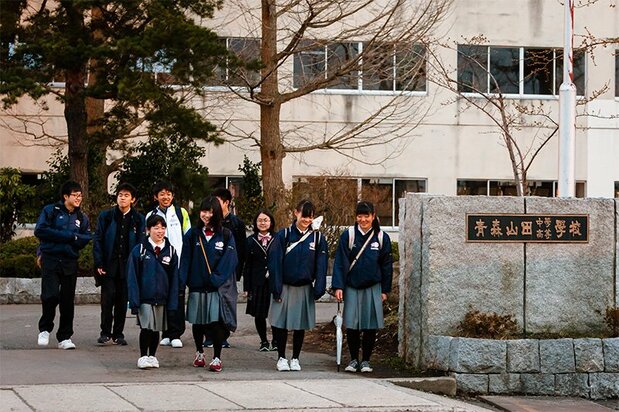 Club members head home after another day’s practice, some with mallet cases hand-stitched by their mothers slung across their backs.












 Read in other languages