


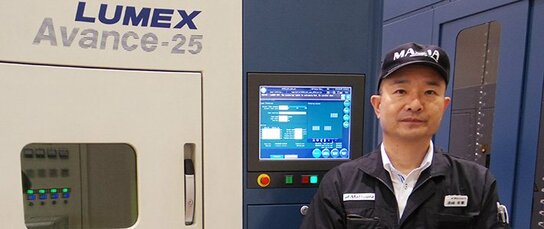
Lumex Solves the Problem of Wear
Over the years, the product lineup of Matsuura Machinery has evolved from lathes and milling machines to machining centers (numerically controlled machine tools with automatic tool changing functions)—and now Lumex. Today machining centers account for 95% of Matsuura Machinery’s sales, but Matsuura Katsutoshi thinks Lumex will change the situation. “Inquiries have been increasing recently, and it seems like the new product’s time has finally arrived. We anticipate that Lumex sales will be on the scale of around three billion yen by 2020.”
Lumex was not created in a vacuum. It is the result of efforts to raise the productivity of machining centers. In pursuit of high-speed, high-accuracy machining, the company always ran up against the problem of cutting tool wear at higher speeds, which reduced accuracy.
The question was how to overcome the problem of tool wear. The company’s solution, explains President Matsuura, lay in the possibility of using high-speed lasers to cut the material without contact. “I wondered for a long time whether lasers could be applied to metal machining as a way to avoid the problem of wear and degradation,” he recalls. Around that time the company was approached by the electronics giant Matsushita Electric, today’s Panasonic, about the possibility of jointly developing laser and cutting processes.
The Perfect Partner
For Matsushita, shorter product development times were a matter of vital importance. The company had been working on modeling technology using lasers since the early 1990s. Through trial and error it had developed the basic technology for performing the processes from laser sintering to finishing on a single machine, and had built machines for internal use. However, Matsushita had difficulty getting the machines to perform in the desired way. This led to the company’s decision to approach Matsuura as a potential partner, recognizing the excellence of Matsuura’s machining centers that Matsushita had used as a customer.
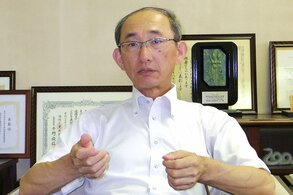
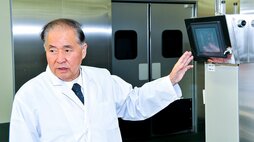
 Katsuki Kazuo, director of the Industrial Technology Center of Fukui Prefecture.
Around that same time the Industrial Technology Center of Fukui Prefecture also began using laser technology for locally produced products, such as textiles, eyeglass frames, and machines. Looking to innovate processing methods, the center applied for a joint project sponsored by the Ministry of Education, Culture, Sports, Science and Technology aimed at mobilizing regional assets. Development of a hybrid metal laser sintering and milling machine fell within that framework, and an industry-government-academia project that included the University of Fukui was launched in December 2000.
Katsuki Kazuo, director of the center and a project member, recalls that time. “It just so happened that our development project to use lasers corresponded perfectly with the timing of the joint initiative of Matsushita Electric and Matsuura Machinery. And the president of Matsuura Machinery at the time, Matsuura Masanori [currently the company’s chairman], was asked to direct our project. So we were fortunate that our group came together to work on laser development at the exact moment that a company based in Fukui was trying to advance the industrial applications of lasers. It may seem random, but I almost think it was fate.”









 Read in other languages