


The Return of Christianity
In 1873, the newly established Meiji government lifted the prohibition on Christianity. However, it was several decades before Catholic churches were again built on the rugged terrain of Hirado. The Jesuits did not return to Japan until the early twentieth century.
Today there are around 130 churches in Nagasaki Prefecture, many of them in Hirado. The best known of these is St. Francis Xavier Memorial Church, which was built in 1931 to replace an earlier structure established in 1913. To celebrate its fortieth anniversary in 1971, a statue of the Spanish missionary was put up nearby. While the church steeple can be seen from many of the streets of Hirado, the most famous vantage point offers a view of it rising up between the temples of Kōmyōji and Zuiunji.
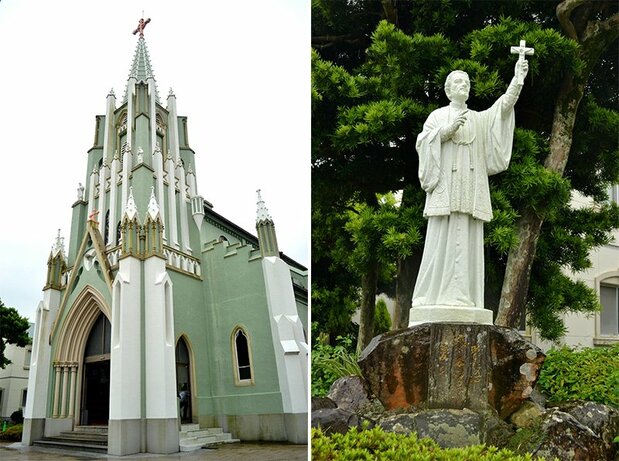
 External view of St. Francis Xavier Memorial Church in Hirado and a statue of the Spanish missionary.
The Churches of Hirado
The oldest church still standing on Hirado is Hōki Church, which was constructed in 1898. Believers originally built an altar near its present location in 1878. The church is notable for its brick façade and wooden side walls, which make it unique among Japanese churches. In 2003, it was designated as a tangible cultural property by the Nagasaki Prefectural Government. The church was a significant factor in the Hōki district’s selection by the national government as an important cultural landscape in 2010.
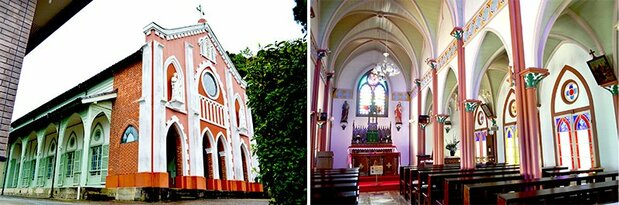 Hōki Church is notable for its brick façade and wooden side walls.
Another of the important churches in the area is Yamada Church on the island of Ikitsuki. Constructed in 1912, the church was designed by Tetsukawa Yosuke, who was much respected for his religious architecture. Ikitsuki’s remote location beyond Hirado made it one of the best-known places where hidden Christians (kakure Kirishitan) preserved their faith through the 250 years it was outlawed. The long isolation fostered a distinct form of Christianity, which some still practice today.
 Yamada Church, constructed by Tetsukawa Yosuke.
Himosashi Church, also designed by Tetsukawa, was built in 1929 in imitation of the European Romanesque style. For many years it was Japan’s largest church, until the reconstruction of Nagasaki’s Urakami Cathedral following its destruction in the 1945 atomic bombing. The white walls stand out against the blue of the sky, while interior floral elements attest to the Buddhist influence prevalent in Testukawa’s work.
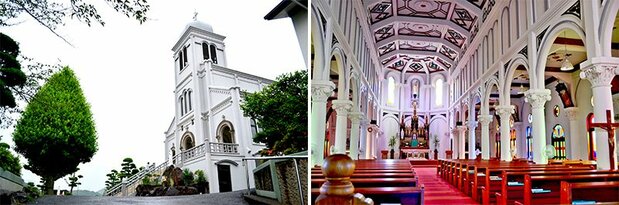 Himosashi Church is the largest church in Hirado.
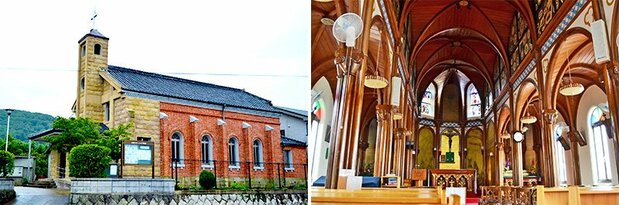
Kigatsu Church, converted from a wooden school gymnasium in 1962, is also fascinating, despite its unassuming outer appearance. Inside the building are 14 illustrations of the Stations of the Cross by Nagai Takashi, a survivor of the bombing of Nagasaki and a major figure in modern Japanese Christianity.
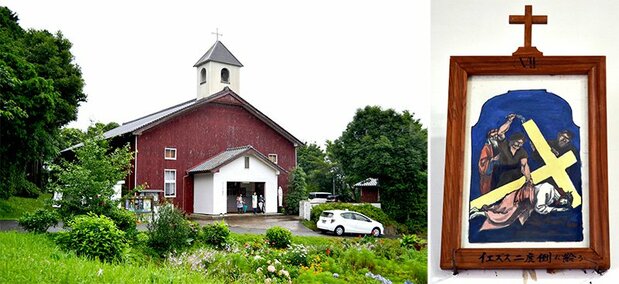 Kigatsu Church and an illustration by Nagai Takashi of one of the stages in the Stations of the Cross.
Hirado ranks alongside Nagasaki as one of the Japanese places most strongly influenced by Christianity. The Hirado churches are of particular historical significance and the focus of efforts to boost tourism among Catholics, as well as Christians in general, especially in this year that marks the 150th anniversary of the rediscovery of hidden Christians.
Major Historical Churches in Hirado
| Kamikōzaki Church | 1891 (Rebuilt in 2014) |
| Hōki Church | 1898 |
| Furue Church | 1899 |
| Ōsashi Church | 1911 (Rebuilt in 1944) |
| Yamada Church | 1912 |
| Tabira Cathedral | 1918 |
| Yamano Church | 1924 |
| Himosashi Church | 1929 |
| St. Francis Xavier Memorial Church | 1931 |
| Hiradoguchi Church | 1952 |
| Nakano Church | 1952 |
| Fukuzaki Church | 1954 |
| Kigatsu Church | 1962 |
| Ichibu Church | 1964 |



 Read in other languages