


Globalization Brings New Opportunities
Tea-related products account for around 70% of all sales at the centuries-old store, while Japanese paper represents the remaining 30%. Yearly sales are approximately ¥2 billion, which is a 20% decline compared to the level 10 years ago. However, much of the drop was caused by the slump that followed the March 2011 earthquake and tsunami in northeastern Japan, when the store had an annual turnover of only around ¥1.5 billion. Sales have been recovering over the past few years.
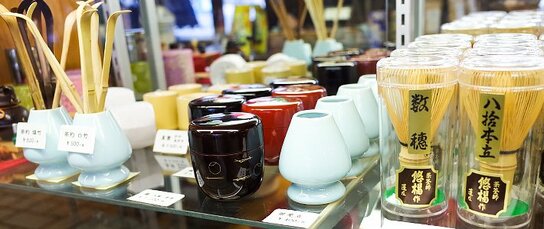
The store’s main tea-related products are the upscale green tea that is produced in the city of Kakegawa in Shizuoka Prefecture. Along with the store’s sales of sencha, hōjicha, genmaicha, and other types of Japanese tea packaged under the Ejima-en brand, the store sells various tea implements. Customers who visit the store can see porcelain urns or wooden boxes used to store tea, as well as old-fashioned scales to measure the tea. Ejima Ken also emphasizes that the store has been striving to come up with innovative sales ideas to counter the recent trend of consumers away from green tea.
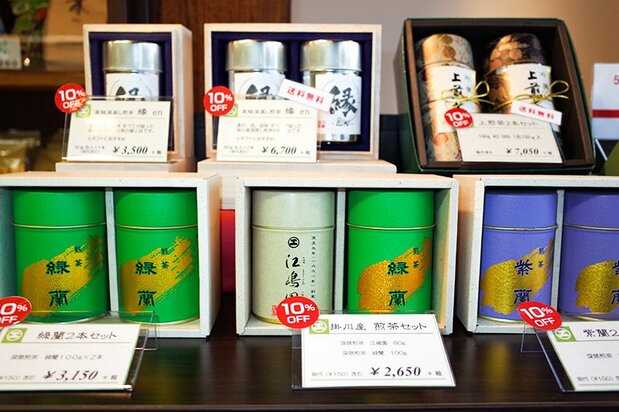
 Some of the main types of Japanese tea sold at Ejima. The Ejima-en brand brings together well-known local varieties.
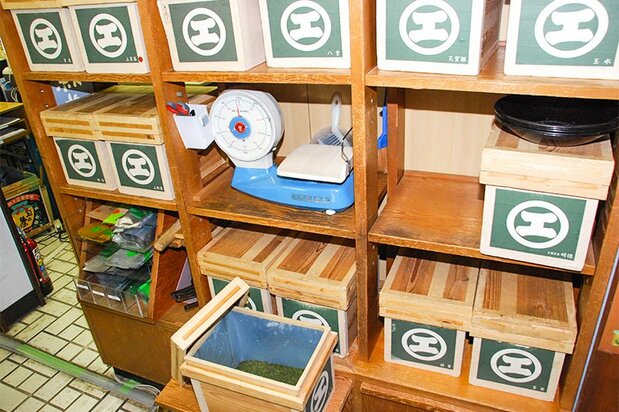 Near the scales used to weigh the tea that is sold, are wooden boxes for storing tea, featuring the katakana character エ, pronounced e, that has long served as the symbol mark for the store.
“In July of this year, we began sales of a new tea-bag product for green tea, much like those used for black tea,” Ejima Ken explained. “It was developed over the period of a year in collaboration with a manufacturer based in Shizuoka. So far the sales have been very good. The convenience appeals to younger people in particular, who do not tend to make tea using a teapot. This is one way that we are striving to keep up with the times.”
Ejima Ken’s 44-year-old wife, Sumiko is at the heart of the Japanese paper business, overlooking the sales of paper products obtained from manufacturers across Japan. The brightly colored luxury papers used for paper art and wrapping gifts, such as the Yuzen paper that originated in Kyoto, have been particularly popular in recent years.
 Ejima Sumiko, who is in charge of Japanese paper sales, says that the paper sold at Ejima is characterized by a light texture and use of color, and a handcrafted feel.”
Looking to the future, Ejima Ken sees the 2019 Rugby World Cup, which Odawara will be a training site for, and the 2020 Tokyo Olympics as offering exciting opportunities.
“These past few years we have had a noticeable influx of tourists from China, Europe, and North America. We plan to respond to this development by creating English and Chinese labels for our products, and we also plan to negotiate with the local tax authorities for our store to be granted duty-free status I am eager for people overseas to become more familiar with green tea, as an integral part of the healthy Japanese diet that promotes longevity, and for them to also learn more about the tradition of Japanese paper.
The business plans to draw on the Internet to strengthen mail-order sales, and to even open a shop in Hawaii to promote overseas sales of its popular “cold green tea.” At the same time, the company aims to open an Ejima shop in Tokyo, where it had a presence around three decades ago. These are some of the ways that the owner of Ejima is seeking to strengthen local brand value while also looking to new growth opportunities.
(Originally written in Japanese. Photos by Kikuchi Masanori.Banner photo: Some of the tea implements sold at the historic Ejima store in the castle town of Odawara.)












 Read in other languages