


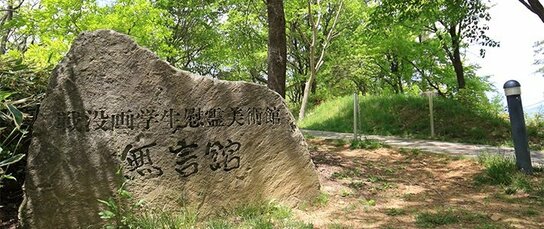
A Labor of Love
The name Mugonkan—literally, “speechless museum”—came to Kuboshima almost at the same instant he decided to build the museum. It seemed to sum up his feelings toward the artists and their families. Kuboshima, who was born just before the war broke out, is a self-made man who grew wealthy operating a small chain of restaurants in the Tokyo area during the rapid-growth years after the war. By his own account, he spent most of the postwar era thinking about how to make money. “What can I say to these people who look at me with tears in their eyes and say, ‘Take good care of my little brother’s painting’? There’s nothing I can say.”
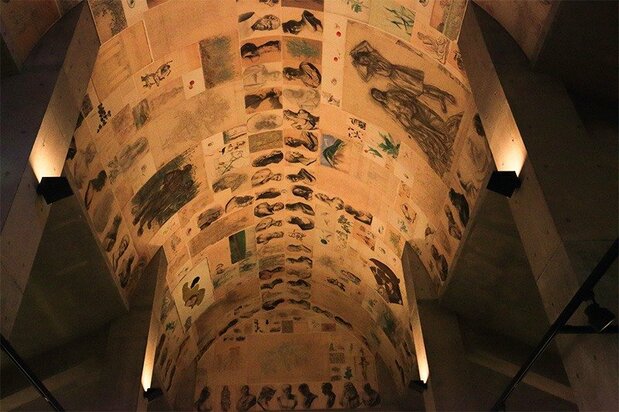
 Dome of Damaged Canvases in the new building.
Kuboshima ended up taking sole responsibility for the project, embracing Nomiyama’s dream as his own. He traveled the country from Hokkaidō in the north to Tanegashima in the south, visiting surviving relatives and explaining his plans for a museum devoted to the paintings and drawings of art students killed in the war.
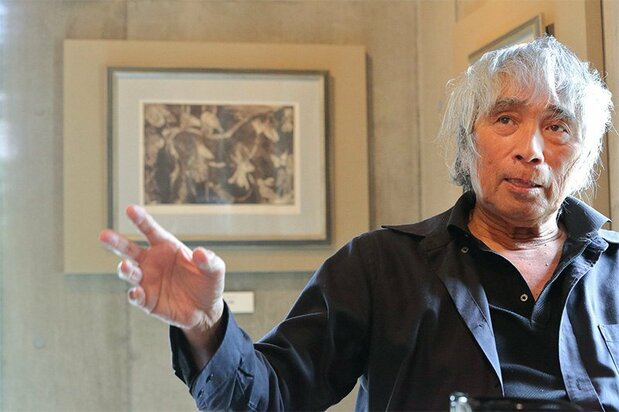 Mugonkan founder and director Kuboshima Seiichirō.
Kuboshima was surprised at how quickly most of the families agreed to donate their paintings. The parents of the artists had already passed, and the relatives who had come into possession of the artworks worried about their ability to store and preserve them. Indeed, some of the pictures had already suffered considerable damage. Though not everyone believed in Kuboshima’s good intentions (there were those who accused him of publicity mongering), most of the relatives took his offer to restore, preserve, and exhibit the works as a godsend.
Meanwhile, Kuboshima set about raising the funds needed to build a museum. He borrowed what he could and solicited donations for the rest. Finally, on May 1, 1997, the Mugonkan opened with a collection of 87 works by 37 artists.
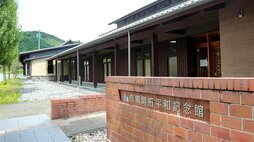
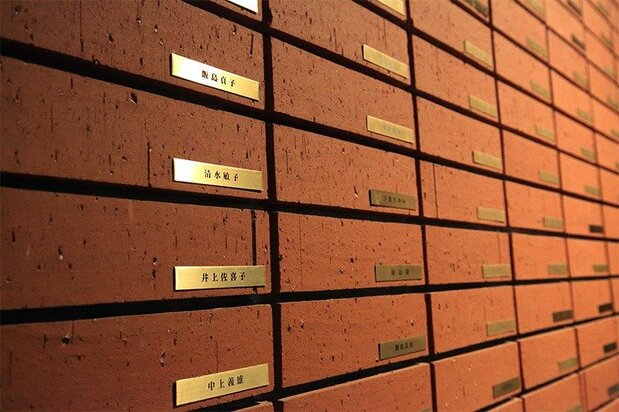 The names of the original donors who supported the museum’s construction adorn a brick wall in the main building.
As word of the Mugonkan spread, more people stepped up to donate the works of fallen relatives, and the collection grew. Eventually Kuboshima had a second building erected in September 2008 to accommodate that growth. Today the Mugonkan houses roughly 700 works by about 130 artists.
But even as the museum expanded, attendance fell off, dropping from an annual average of about 100,000 visitors during the first few years to less than 40,000 today. After covering maintenance costs and the salaries of his 10 employees (including the staff of the Shinano Drawing Museum), Kuboshima lacks the resources to finance the restoration of all the museum's paintings and drawings, many of which are deteriorating rapidly. Kuboshima himself is saddled with monthly payments of more than ¥600,000 (close to $6,000) on the building loan he took out more than two decades ago—payments that will continue until he is 82. Still, he is determined to preserve at least one work by each artist for posterity, whether by restoration or the creation of replicas.
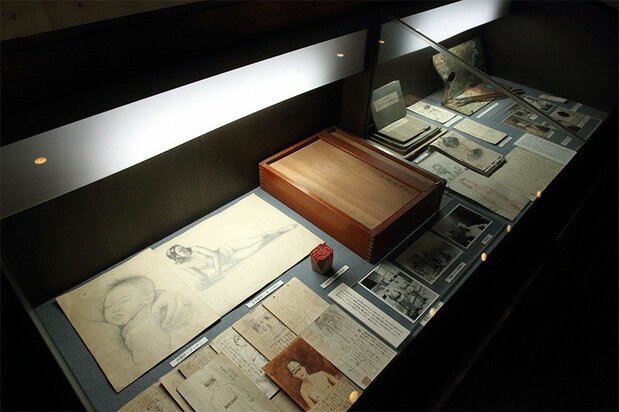 Art students’ personal effects on exhibit in the main building.
Seeing the Light in the Darkness
Kuboshima is sometimes assailed by doubts about the project he undertook. He fears that the purpose of the museum has been distorted. Each August, on the anniversary of Japan’s surrender, journalists trek up the hill to visit the museum and proceed to write anti-war articles focusing almost exclusively on the tragic loss of young lives. Kuboshima feels they are missing an important point.
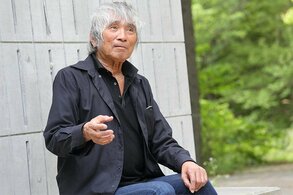
“Those students didn’t paint to make a statement about war or peace or Article 9 [of the Constitution],” he says. “They just painted the people they loved. What I see there is the sheer joy of painting.” Kuboshima would like to think that that expression of joy will live on through the museum’s collection. He wonders how the students would feel if they knew their paintings were being used first and foremost to remind people of the nightmare of war.
Still, there is one annual event at the Mugonkan that temporarily banishes all such misgivings from Kuboshima’s mind. That is the Coming of Age Ceremony for 20-year-olds held on April 29. Each year, Kuboshima invites a national celebrity, who personally hands out letters of congratulation to each of the participants.
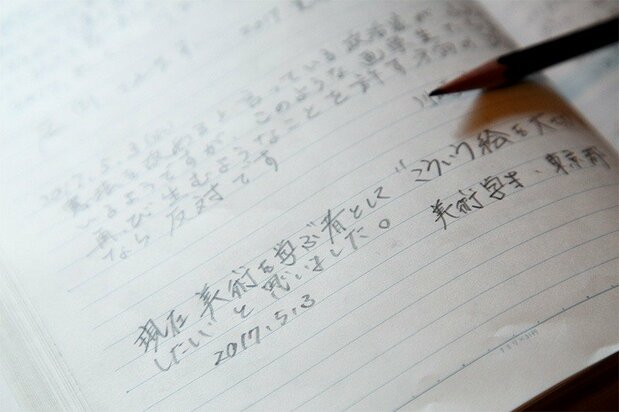
After spending the morning on a tour of the museum, the 20-year-old guests record their impressions in the visitors’ book. “I play the guitar,” writes one, “but after seeing these pictures, I’m not sure I’m worthy to call myself a musician.” Another writes, “It made me think about family for the first time in my life.”
Kuboshima rejoices in such comments. This, he believes, is what the artists truly wished to communicate through their paintings. From the viewpoint of his young visitors, the Mugonkan is not an anti-war museum but a museum of youthful dreams, where one can see how young adults of an earlier time devoted themselves to the art that they loved.
Of course, when it comes to interpreting an artwork, there is no one “right answer.” But Kuboshima feels that the Mugonkan as a whole represents “both the despair of war and the hopes of these young people who painted in the midst of that despair—the struggle between despair and hope.” He adds, “Only by fully conveying that struggle can the Mugonkan communicate what war is really about.” First-time visitors generally come away struck by the tragic waste of life and talent, says Kuboshima, but by their second or third visit, they begin to see the joy underlying these paintings.
Listen carefully, and you begin to hear the voices of these young, dedicated art students, saying, “I want to paint!” Look closely, and you begin to see how brightly their spirits burned during their all-too-brief lives. And with that realization comes a still deeper awareness of the darkness that extinguished it.
Mugonkan
3462 Koaso, Ueda, Nagano Prefecture
Phone: 0268-37-1650
Wednesday–Monday: 9:00-5:00
Closed Tuesdays, or the following day if a national holidays
High school and university students: ¥800
Elementary and junior high school students: ¥100






 Read in other languages