


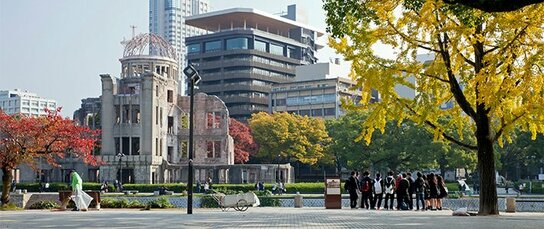
Worried About Waning Memories
More than seven decades after the bombing of Hiroshima, hibakusha are now in their autumn years. According to Japan’s Ministry of Labor, Health, and Welfare, the average age of atomic bomb survivors, as of March 2017, is 81.41 years old. And as the population dwindles, society is inching toward a time when there will be no witnesses alive to give first-hand testimony about the horrors of nuclear weapons.

 Hiroshima municipal employee Nakagawa Haruaki explains the background of the A-Bomb Legacy Successor program.
Nakagawa Haruaki, director of Hiroshima’s International Peace Promotion Department, says the loss is felt most keenly with hibakusha who regularly give public talks about their experiences. “We conducted a survey earlier this year and found there are 150 people in this group,” he explains. “They range in age from 71 to 95 years old and include survivors still in the womb when the atomic bomb fell. We had expected the figure to be around 200, so it was a really an eye opener to see just how many prominent hibakusha had passed away.”
Faced with the urgency of the situation, Hiroshima in 2012 initiated the A-bomb Legacy Successor program to keep the stories of the dwindling number of hibakusha alive. Under the initiative, participants known as A-bomb successors spend at least three years learning the stories of survivors in depth. As of October 2017, there are 243 trainees of varying ages, 89 active successors, and 15 mentor hibakusha who pass down their stories.
Nakagawa says the program is open to all, including people from outside Hiroshima. After completing training, participants are recognized as official A-bomb successors by the Hiroshima Peace Culture Foundation and can begin lecturing, mainly at the museum, which holds three presentation sessions a day, and at local schools. Presentations are generally in Japanese, but several participants have been trained to give lectures in English.
In 2016 A-bomb successors gave more than 1,000 presentations, speaking to over 16,000 people. The program is still in its infancy, though, and Nakagawa understands there is plenty room for improvement. “The response has been wonderful so far, but many people feel the presentations still need work,” he explains. “It will take time, and we are looking to smooth out the wrinkles over the long run.”
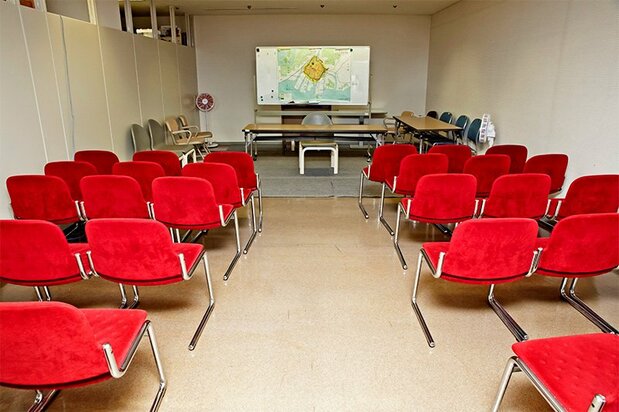 One of the rooms where successors are trained.
Becoming an A-bomb successor requires a deep level of commitment. During the first year of training, participants attend lectures by hibakusha and receive coaching in public speaking. In the second year they are tasked with learning the stories of mentor A-bomb survivors. This includes shadowing mentors at speaking events and working together to create scripts based on their experiences. The third and final year is spent gaining practical experience, refining presentations, and honing storytelling skills. At the end of the training period, participant must receive approval from the hibakusha they have studied under to be officially recognized as A-bomb successors.
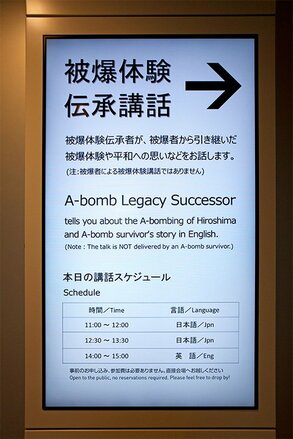 A panel gives the times for lectures by A-bomb successors.
The most formidable hurdle during the three-year training period is creating a script of a hibakusha’s experience. The unique and moving experiences of A-bomb survivors can be incredibly difficult for others to convey, and many participants find themselves overwhelmed by the challenge.
Those who become A-bomb successors, though, inherit the important duty of passing on testimonies of atomic bomb survivors. As might be expected, many people prefer to hear testimonies first hand from hibakusha, and for the time being the successors mainly serve a secondary role.
“Some people feel it’s still too early to have successors sharing the stories of hibakusha,” says Nakagawa. “But we can’t wait until the last atomic bomb survivor passes on. It’s crucial to start the process of training the successors while hibakusha are still physically and mentally able to directly hand down their experiences.”




 Read in other languages