


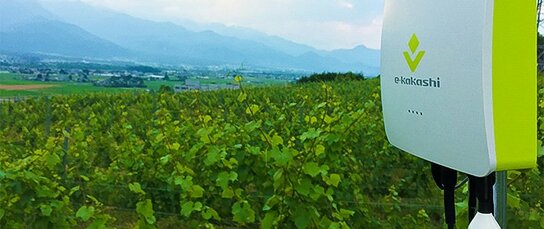
Tech-Managed Grape Growing in the Chikuma River Valley
Growers along the Chikuma River valley in eastern Nagano Prefecture have also begun using IT to manage their fields. Nagano’s Shinshū University is working together with the environmental measuring instrument maker Uizin and the region’s wine producers on a project backed by the Ministry of Internal Affairs and Communications that aims to put the internet of things to use in creating new services.
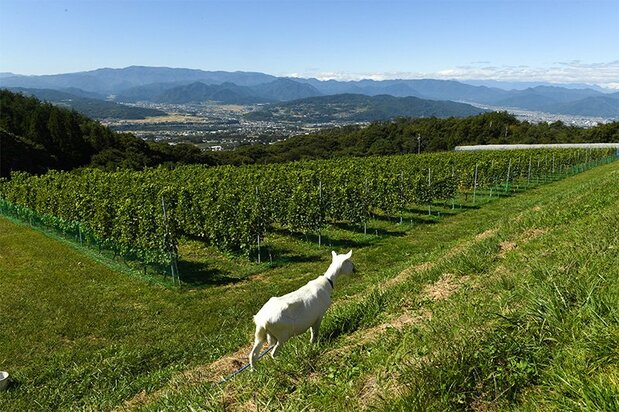
 The Chikuma Wine Valley’s Villa d’Est Gardenfarm and Winery is in Tōmi, Nagano. The fluvial terrace home to the vineyard gets plenty of sunshine and is ideal for grape-growing.
Analyzing Three Kinds of Data
Many new wineries and new wine grape growers have established themselves at the eastern end of the Chikuma Wine Valley. Sensors have been set up in 10 locations in Ueda, Tomi, and other parts of the district to measure temperature, humidity, sun exposure, and precipitation six times an hour. Growers input information such as the grapes’ growth stage and pest control records, and university researchers collect ripened grapes to analyze and record their composition. All of the data is analyzed to work out a formula for forecasting the optimum times for pest control and harvesting, helping the growers obtain best results.
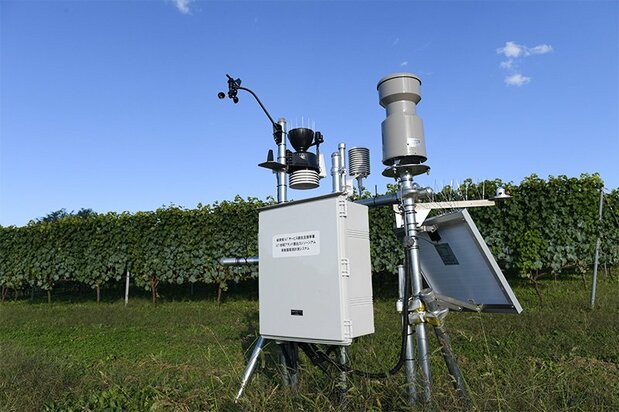 Sensing equipment in a field farmed by Izawa Takahisa, of Tateshina, Nagano, records data in the Chikuma Wine Valley. Izawa, a new grower in the area, moved to the area from Tokyo four years ago.
Kameyama Naoki, a researcher at the Chikuma Wine Valley Data Center, explains the project. “Discussion has begun on the regional appellation for wine produced in Shinshū, the traditional name for Nagano Prefecture, and our project’s mission is to collect data that will be used to establish quality standards. Regional characteristics will be extrapolated from the data collected to support Shinshū wine’s brand power.”
The regional appellation system protects the names of growing regions, for example “Bordeaux” or “Bourgogne,” as brands, but in order to do that for Shinshū, uniform quality standards are necessary. This requires identification of the special characteristics of Nagano wines; the project’s data collection is the first step toward that.
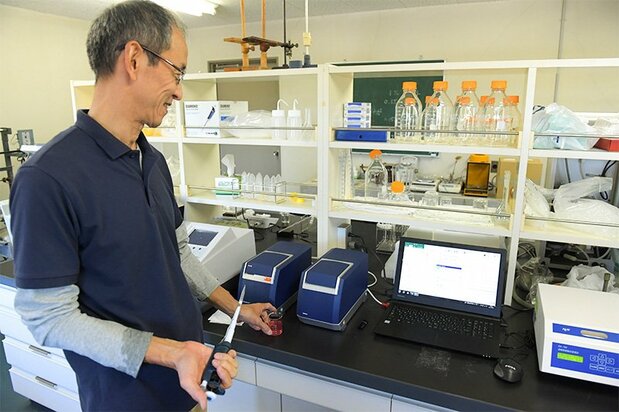 Researcher Kameyama Naoki analyzing and recording the composition of grapes taken from the fields every morning
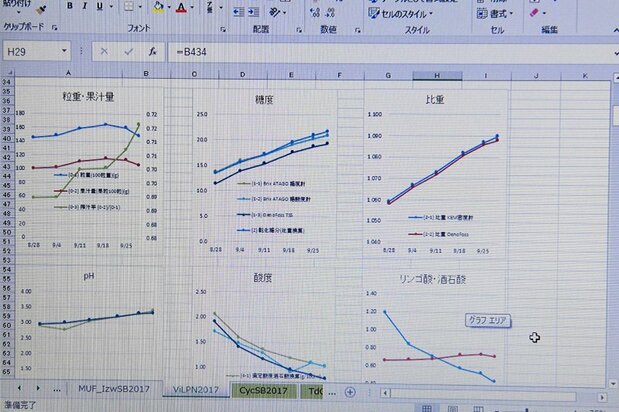 Charts showing changes in the grapes’ composition. This information is analyzed together with data on weather and soil.
Sharing Experiences with Collected Data
The instruments collect weather data automatically, but producers need to input growing records themselves. The system is in test mode right now and is being tweaked to make it easier to use.
Kameyama, who until two years ago was an engineer with an electrical product maker, says, “We’re asking growers to manually input information about their grapes at the various stages of growth—from germination to leafing, flowering, and so on—and about pest control. We are developing an interface like a smartphone’s that can be used with one hand while they are standing in their fields.
“The data collected will eventually be used as a teaching tool for others who want to get into grape-growing. Looking at data collected by others and sharing their experiences means that everyone will get something out of this, which will in turn contribute to the region’s growth and prosperity.”
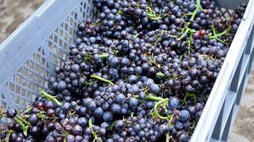
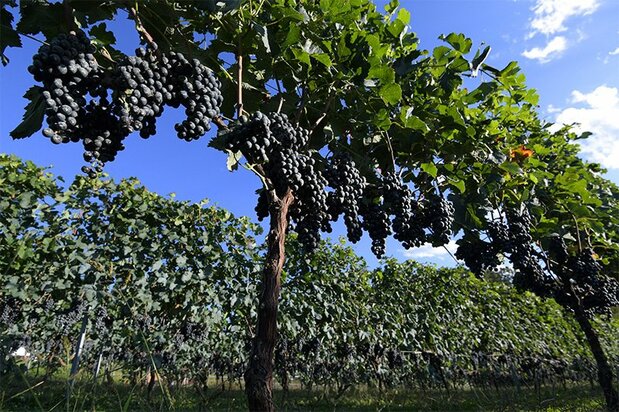 Fully ripened Merlot grapes awaiting harvesting (Tateshina, Nagano).








 Read in other languages