


Key Points in Alternate Sea Lane Routes
Fully 80% of the oil imported by Japan travels through the South China Sea on its way from the Middle East, via the Indian Ocean and the Strait of Malacca. If this route becomes no longer viable for some reason, Japan has two substitute routes in mind: one through Indonesia’s Lombok Strait, lying between Lombok and Bali, to the Makassar Strait and Celebes Sea and then to the East China Sea; and the other around the southern side of Australia and then past the eastern side of Guam, making for a much longer journey.
The southern Australia route would make the journey excessively long, thereby increasing importation costs. According to the Nippon Foundation’s calculations, Japan, which currently needs 4.12 million barrels of imported oil per day, would see its feasible imports drop to just 2.47 million barrels a day, causing industry to stagnate and pressing the country to think of alternate means for addressing its energy needs. The impact on the economy would be enormous.
With the route travelling through the Lombok Strait, however, there wouldn’t be a significant change in the distance travelled. While this would lead to price increases, the foundation believes that the country could continue to maintain its petroleum imports at current levels. Notably, this route would have tankers travelling near Palauan waters, and Japan is hoping to head off Chinese influence in their region with an eye on the potential for this sea route becoming necessary in the future.
A Joint Commitment to Maritime Safety
Palau is located in the southern part of what China calls the “Second Island Chain.” China’s current maritime military strategy is to exert influence in the region between the first and second island chains, the former accounting for the area stretching from the Ryūkyū Islands including Okinawa to Taiwan and the South China Sea, and the latter extending from the Ogasawara Islands to the Mariana Islands and southward to the waters around Guam and Palau in the Western Pacific.
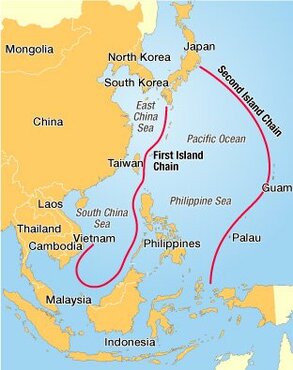

In recent years China has taken an increasingly aggressive stance on the Senkaku Islands, and its activities in the area around Okinawa, shows of force toward Taiwan, and advances into the South China Sea have also thrown the larger picture of its maritime military strategy into sharper focus.
With all of this in mind, global maritime security analysts are paying more and more attention to the important position that Palau occupies in the geopolitical scheme. Japan, for its part, needs to further its relationship with the small island nation that will play a vital role in an enhanced maritime security situation.
The Western Pacific Ocean was a key battlefield during the Pacific Theater of World War II. The Palauan island of Peleliu was the scene of a particularly fierce standoff where 10,000 Japanese and American soldiers lost their lives.
After the end of World War II, the United States entered into the Compact of Free Association with the three countries that comprise Micronesia. Through the COFA, America maintains military jurisdiction over a large area of the Western Pacific. Australia, meanwhile, exerts considerable influence in the Southern Pacific. Seeing as how Japan once fought with these two countries in the same area, there has traditionally been a general sentiment that Japan should be distrusted if it were to exert itself as a security force for the island nations in the region.
However, in the face of Chinese military expansionism and North Korea’s unpredictable posturing in recent years, Japan-US-Australian relations have grown deeper. Today we see a regional situation where the United States and Australia look to Japan as a partner that will help to maintain security in the Pacific Ocean.
In the wake of North Korea’s threats last August to target waters near Guam with its ballistic missile tests, the United States and Palau agreed to install high-performance US radar facilities in Palauan territory. In a joint declaration, the two countries announced that the radar sites would enhance the Palauan government’s law enforcement capabilities within its EEZ while helping the US government to defend against airborne threats in the region.
Palauan GDP is currently above $12,000, moving the nation nearly out of the range of developing countries that receive financial aid. While Palauans may no longer be eligible to receive large amounts of official development assistance from, Japan and other national donors, the Nippon Foundation has signaled its intent to continue offering support to the nation in a nongovernmental capacity, helping the people of Palau to keep their waters secure.
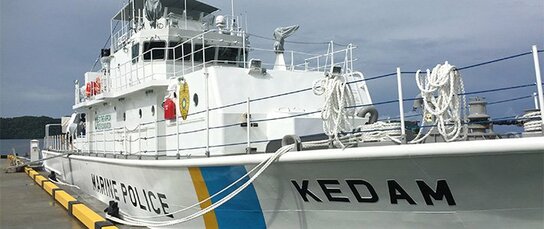
(Originally published in Japanese on February 16, 2018. Banner photo: The Kedam, presented to the Palau Division of Marina Law Enforcement by the Nippon Foundation. © Nojima Tsuyoshi.)








 Read in other languages