


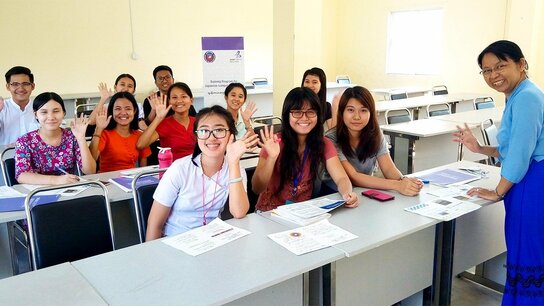
Japanese and Myanmar Affinity
Ikeya, resident in Myanmar for 50 years, has paid close attention to local attitudes towards Japan, and explains the mutual affection between the two countries thus.
“Most of Japan’s soldiers were from rural backgrounds, and it is likely that locals who had contact with them developed a good impression of the Japanese. Furthermore, they had been made to think that Asians were inferior by the British, thus the postwar development of Japan came as a surprise, leading to an even greater admiration for Japan.”
Nay Myo Chow (aged 41), my interpreter, who has worked in Japan for five years, praised the Japanese, saying that Myanmar people thought they were less forceful and therefore easier to get along with than Koreans or Chinese.
Maruyama Ichirō, the first Myanmar language expert to become Japan’s ambassador in Myanmar, describes the similarity in values of the two countries thus.
“The affinity between the countries is largely thanks to the shared common understanding of Japanese and Myanmar people. There is no definitive difference between the cultures of the two. Anade is a Burmese term referring to personal restraint that closely corresponds to the Japanese word enryō. I don’t believe that there are many other countries with a concept like enryō.”
Proliferation of Good Will and Gratitude
In addition, the clinching factor in Myanmar’s positive attitude towards Japan is the constructive nature of relations between the two countries.
The first country with which Japan reached agreement on reparations after World War II was the (then) Union of Burma, in 1954. This milestone probably enabled smoother reparation negotiations with the Philippines and other Asian nations.
Baluchaung Hydropower Plant, constructed as the first reparation project, was also a recipient of subsequent overseas development assistance from Japan, and still supports Myanmar’s electricity supply, standing as a symbol of goodwill between the two countries.
One reason behind the popularity of Japanese vehicles in Myanmar is said to be the supply, under reparations and assistance programs, of large numbers of Japanese pickup trucks, which made a deep impression for their sturdiness and sound performance.
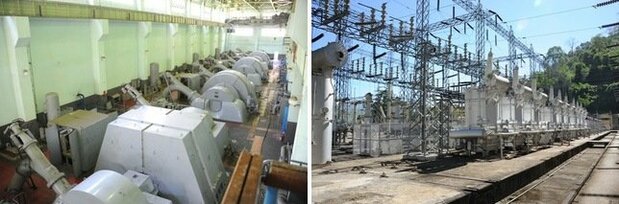
 Baluchaung Hydropower Plant. (Courtesy Embassy of Japan in Myanmar)
There was a precedent to the initial reparation. Shortly after World War II, when Japan was suffering food shortages, the Union of Burma, newly independent from Britain, supplied Japan with cheap rice imports. Some of Japan’s older generation remember having their hunger satisfied thanks to Burmese rice.
The assistance which Japan offered Burma in obtaining independence from Britain has also certainly left an impression. However, there is a dark side to the history between the countries. During World War II, Japan forcibly mobilized many Burmese into construction of the Thai-Burma Railway, the hardship of which is said to have resulted in “one death for every sleeper laid.”
However, there are also many stories of Burmese people providing food for Japanese forces escaping British troops after defeat in the Battle of Imphal.
Without a doubt, many Japanese have worked to express their gratitude for such kindness in the years following the war.
In addition, the Japanese government has adopted an attitude of engagement with the country throughout its postwar history, through independence, the military junta and the return to democracy, unlike Western countries that imposed sanctions. Through continued economic support, Japan has maintained a pipeline between the military government and democratic forces. This is another factor behind the constant presence of Japan in the minds of the Myanmar people.
In 2017, Japan’s Ministry of Foreign Affairs conducted an opinion poll of the 10 ASEAN nations, in which people in Myanmar responded that their most trusted country was Japan (34%), significantly ahead of the USA (18%) and China (13%).
Speaking at a Japan-Myanmar amity event in February, State Counsellor Aung San Suu Kyi spoke positively of the current relations between the two countries in her opening remarks, saying that the two countries have achieved mutual understanding in spite of difficulties, and have assisted each other with compassion and affection. As a result, they have continued to enjoy an extremely intimate relationship to this day.
Goodwill ties have fostered the current relationship between the countries and have undoubtedly helped to create positive sentiment towards Japan in Myanmar. Japan must continue to be closely engaged with Myanmar in the future.
(Originally published in Japanese on June 6, 2019. Banner photo: Myanmar youth studying to become Japanese language teachers. Photo courtesy Japan Foundation Myanmar Liaison Office, Yangon.)



 Read in other languages