


State Sector Reforms Losing Steam
When viewed in its totality, it is safe to say that the Chinese economy is approaching a historical turning point. China has become the second largest economy in the world through the massive input of resources and labor. This economic model relying on the input of factors of production can no longer be sustained. Moreover, an externally dependent development model that relies on exports is approaching its limits. China’s leaders have called for a transition to an economy driven by domestic demand for 20 years. While this is the proper policy view, such a structural transition has yet to be achieved.
Another bottleneck for the Chinese economy is the slow pace of reform in the state sector. Through its bloated size, the state sector has become an impediment to economic growth. Three problems deserve mentioning in relation to the state sector. First, state-owned companies monopolize major industries. They have little interest in innovation since they can capture monopoly profits. Second, state-owned companies impose inefficiencies at the macroeconomic level since they are only interested in becoming larger. Third, since state-owned banks supply state-owned companies with generous liquidity, a certain proportion of loans turn sour each year.
While the impediments of the state sector are plain to see, the Chinese government has not become serious about reforming state-owned banks and state-owned companies. For the Chinese government, the state sector functions as a second national treasury and is a convenient supplier of vast quantities of liquidity.
A Devaluation That Ignores the Market Mechanism
In the face of a slowing economy, the Chinese government has repeatedly turned to orthodox monetary measures (interest rate and reserve ratio interventions), but these measures have not had a noticeable effect on the economy. Here is another area where Abenomics has offered a hint to the Chinese government. Monetary easing under Abenomics corrected an overly strong yen and prompted the substantial depreciation of the Japanese currency. The devaluation of a currency will without question increase the price competitiveness of exports.
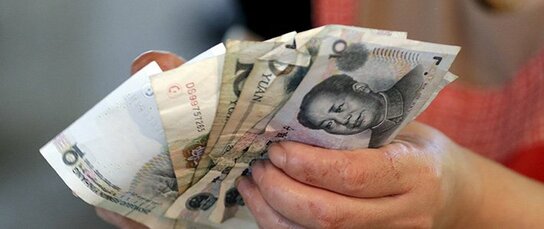
China began to revalue the yuan upward in July 2005, and the yuan has now risen 35% in value as of August 2015. During this same period, the minimum wage has increased 10% nearly every year in China’s major cities. There can be no doubt that these trends have reduced the price competitiveness of exports. Such is the backdrop to the Chinese government devaluing the yuan against the dollar on the pretext of reforming the exchange rate regime.
The exchange rate serves to establish the terms of international trade. Given the slowdown of China’s economy, the devaluation of the yuan can be viewed as unavoidable. What is problematic is not the devaluation itself but the government’s direct intervention. The exchange rate regimes of advanced economies rely on the market mechanism. Under such a regime, the government can intervene in the market as a market player when exchange rates fluctuate excessively, but it cannot directly determine the exchange rate as a market manager.
China’s exchange rate regime is one where the central bank fixes the intermediate rate or reference rate for the day with reference to the movement of prices in a basket of currencies on the previous day. This fixing of the reference rate tends to be arbitrary. Given the strong likelihood that it will diverge significantly from the equilibrium market rate, the reference rate has a strong impact on the market.
Concerns for a Hard Landing
Another issue should be spotlighted in relation to the devaluation of the yuan. In democratic nations, changes in economic policies are not implemented immediately. Rather, policy authorities engage in repeated dialog with the market, and policies are finally implemented in view of how the market and investors respond. A classic example is the way interest rates are raised in the United States. Repeated messages are being sent to the market by Federal Reserve Chair Janet Yellen to determine whether or not to raise interest rates in September.
The situation is different in countries where political leaders do not face elections. Press conferences make them uncomfortable, and they are inept at dialog with the market. Premier Li Keqiang has not held one press conference despite the sharp deceleration of the Chinese economy. Since authorities implement policies abruptly without dialog, such changes are experienced as an enormous shock by the market.
In terms of economic fundamentals, it is natural to think that the Chinese economy will slow at a gradual pace. Policies being implemented in a clumsy manner, however, have magnified economic fluctuations—that is to say, volatility. An important sentence was included in the various texts adopted by the Eighteenth National Congress of the Communist Party of China. This sentence states that a market environment will be developed to enable the normal functioning of the market mechanism. While this shows proper awareness of the issues at hand, what we find on examining the actual implementation of policy is a government that is still trying to outdo the market.
Plunging share prices should be viewed as the sounding of a warning bell. The yuan does need devaluation, but making that happen is not the role of the government. The government is a supervisor that monitors whether market transactions are fair. It should never be the manager of the market. Finally, now that China’s asset bubble has burst, what will determine whether a hard landing awaits the economy are the policies to be instituted by the Chinese government.
(Originally published in Japanese on August 21, 2015. Banner photo © Reuters / Aflo.)





 Read in other languages