


Dwindling Prospects for Further Development
While the fortunes of professional baseball have undoubtedly changed for the better since 2004, it is unclear if reforms have placed the sport on the road to growth and development. While many question where the sport is heading, it is unclear if anyone in the top echelons can provide an answer.
When I began covering baseball in 1974 the Major Leagues had 24 teams, with regional pennant races unfolding among 6 clubs in each of the Eastern and Western Divisions of the National and American Leagues and culminating in the World Series. Since that time, the MLB has grown to 30 teams and added a third Central Division to each league.

On the other hand, NPB has held fast to the same dual-league, 12-team system for nearly 60 years. The MLB over the same period went from two leagues with 16 teams to its present make up, adding organizations in Canada, expanding its minor league system to include Central and South America, and filling its rosters with players from every corner of the world.
If the changes to baseball in the United States can be considered an expansion of the sport, then the situation in Japan has to be called stagnant. Attendance has without a doubt increased, nearly tripling (some would argue quadrupling as early numbers were often padded) from 9 million to 23 million since the inception of the current league system in 1958. But there is little reason to believe figures will increase beyond the current level, having remained flat over the last decade.
Company Property
Boosting attendance is important, but it pales in comparison to the greater issue of whether the NPB commissioner or team owners are willing to take a page from the MLB’s strategy book and try to develop the league.
The MLB has taken a business approach to spreading its brand of baseball around the world, with an eye to reaping profits as the popularity of the sport grows. Professional teams in Japan, however, are property of their parent company and are used by and large for promotional purposes, to bolster the company’s image, and to boost sales of company products. The sole focus is on the domestic market and at present there is no thought of expanding the Japanese baseball brand to the baseball-friendly markets of South Korea, Taiwan, China, and Australia. In fact, the NPB is so thoroughly dominated by the massive Yomiuri media group, whose business interests fall firmly within the Japanese-speaking realm, that it does not even acknowledge the value of developing the domestic brand beyond Japan’s borders.
The strangle hold by media groups extends beyond Yomiuri, though, and includes the Asahi Shimbun, sponsor of the hallowed national high school baseball championship held each August, and the Mainichi Shimbun, backer of the country’s main amateur league. The result has been an overemphasis on maximizing profits, and, in the absence of the type of sports journalism that might take up the question of the future of baseball, a steady exploitation from the professional to high school levels by parent companies as well as schools.
As a result, many of Japan’s top players are looking across the Pacific and are being snapped up by Major League teams. Some may cite the Pacific League setting a new attendance record in 2015 and the Central League posting the largest figures since numbers began being announced in 2005 as evidence that alarm is out of place. But conspicuously absent from this stance is any hint of how to steer the resounding success of the domestic league toward new fields of expansion. In the end, one is left to wonder what all the fuss over reforming the sport in 2004 was about in the first place.
Weighing the measures and reforms needed to ensure the future of Japanese baseball is the province of journalism. However, media companies must first relinquish their influence from the business side of the sport. Only then will we start to see the path ahead.
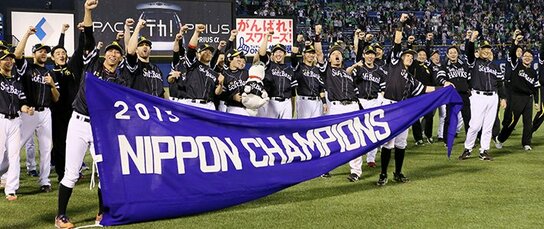
(Originally written in Japanese and published on November 20, 2015. Banner photo:The Fukuoka Softbank Hawks celebrate with fans at the Meiji Jingū Stadium after winning the Japan Series on October 29, 2015. © Jiji)






 Read in other languages