



The Toilet Threat: Unsanitary Conditions
The flush toilets that we use today provide us with a lifeline through a system that combines water supply and electrical power with all of the various processing functions. But in the event of a powerful earthquake or other natural disaster that would cut off the supply of water and electricity, flush toilets would become inoperable. This is what occurred in the case of the 1995 Great Hanshin-Awaji Earthquake, the 2004 Niigata-Chūetsu Earthquake, and the 2011 Great East Japan Earthquake—causing severe difficulties for toilet usage. When toilets become clogged with waste, this not only creates foul odor but also results in terribly unsanitary conditions.
As toilet conditions deteriorate, disaster victims often attempt to reduce the number of times they go to the bathroom by consuming less food and liquids. This in turn reduces their strength and immune powers, which can lead to deteriorating physical condition, chronic illnesses, or even death. The most common form of death among victims of the Great East Japan Earthquake was related to the physical and mental exhaustion of those living in evacuation shelters.
Past disasters have taught us the importance of implementing measures at the time of a disaster to ensure proper sanitation. If Japan can establish such sanitation measures for times of disaster, it will be possible to provide support not only within the country but overseas as well.
Since 2012, Japan Toilet Labo has been holding a Disaster-related Sanitation Management Workshop, with the aim of training people how to create a safe and reliable toilet area following a disaster.

 Participants in the Disaster-related Sanitation Workshop held at Japanese Red Cross College of Nursing on October 11, 2014.
New Mindset Needed for Toilet Diversity
In November 2014, as part of the lead-up to the 2020 Tokyo Olympics and Paralympics, Japan Toilet Labo launched a project to put in place an environment where toilet usage is available to everyone, free of concern and regardless of gender, cultural background, or disability. As the first stage of this Global Toilet Hospitality Project 2020, an effort began last year to solicit opinions from people regarding how to improve public restrooms. Around 2,000 pieces of feedback have been gathered as of November 2015.
For example, those who use wheelchairs or guide dogs, pointed out the importance of keeping floors clean and dry. Wheelchair users noted how water and dirt can cling to a wheelchair, while those accompanied by guide dogs did not want to make their trusted partners have to lie down on such a floor. Another sort of comment received from foreigners and the visually impaired was that toilets had too many buttons, making it hard to know which button was used for a particular function. In addition, there was feedback about how dividing restrooms into those intended for men or women can create difficulties in the case of transgendered individuals or care-givers and receivers of different genders.
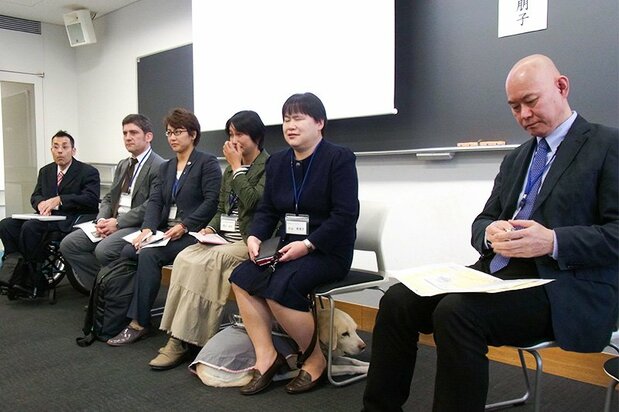 Scene from the panel discussion at a forum held at Taishō University on November 14, 2014, as part of the Global Toilet Hospitality Project 2020; discussion centered on how to make restrooms more accessible to users with special needs.
Plans call for the project members to present results compiled from the gathering of feedback in December 2015, and then begin efforts the following year to address the difficulties identified. In addition to improving facilities, it will likely be necessary to engage in the development of materials and to rethink the framework for providing information to the public.
Learning about the toilet-related difficulties that various people face also teaches us more about the nature of their disability or situation. Quite a few problems can be solved once we are aware of the nature of the difficulty. I would like to continue striving to expand my awareness of other people through my work with toilets.
Improving Toilets to Improve People’s Lives
Finally, I would like to touch on the issue of the sanitary conditions of toilets in developing countries. Some 2.5 billion people around the globe do not have access to sanitary toilets, and roughly 1 billion people are forced to defecate in the open. According to UNICEF, of the estimated 6.6 million children who died in 2012 before reaching the age of five, diarrhea was the cause of death in 9% of the cases, accounting for around 580,000 lives lost. Up to now this issue of fatalities related to toilet sanitation was treated as a separate subject from toilet-related issues in Japan, but moving forward I think that they should be considered together.
We need to create a world in which everyone, day or night, has access to safe and reliable toilets. This is not such a difficult task. New technologies and know-how are already transforming our lives at a remarkably rapid rate. As long as we take fundamental steps to improve awareness of the need to improve toilet facilities, success is likely.
Even more foreign visitors will be flocking to Japan with its hosting of the 2019 Rugby World Cup as well as the 2020 Tokyo Olympics and Paralympics. This will be an opportunity for Japan to showcase an array of new technologies and features for toilets, including energy- and water-conservation systems, sanitation and toilet-cleaning technologies, new sewage treatment methods, resource uses of human waste, universal design innovations, improved information provision, volunteer-based support, and prototype toilet designs. Japan will thus have a chance to show the world what it is capable of doing. I hope to contribute to the effort, so Japan can build on this experience to move on to an even higher stage of sanitation evolution.
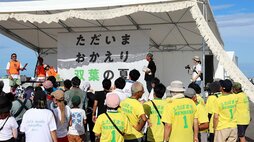
(Originally written in Japanese and published on November 17, 2015. Banner photo: Participants in an event organized by Japan Toilet Labo.)





 Read in other languages