



Channeling Public Anger into Greater Interest in Local Government
In November, shortly after the municipal by-elections, the publishers of Kitanippon Shimbun held an open symposium titled “Can the Municipal Assembly Change?” Over 800 citizens attended. And in January 2017 the paper started a major series of articles about the assembly, presenting revelations on topics including the sloppy handling of political activity reimbursements and the lack of checks on the payments, the dominance of a particular clique within the assembly’s LDP faction, and the secret set of rules that assembly members themselves had created for the padding of expense claims.
The series, which ran to 57 installments in five sections, also introduced advanced initiatives from places outside the prefecture that have reformed their assemblies, along with content encouraging citizens to audit assembly sessions by giving them pointers on how to follow the proceedings. As Katagiri explains, the earlier drive to uncover malfeasance had led to a series of resignations by assembly members, but it was not enough just to crow about having taken these members down. “We wanted to channel citizens’ anger and indignation toward active interest in the assembly and local government.
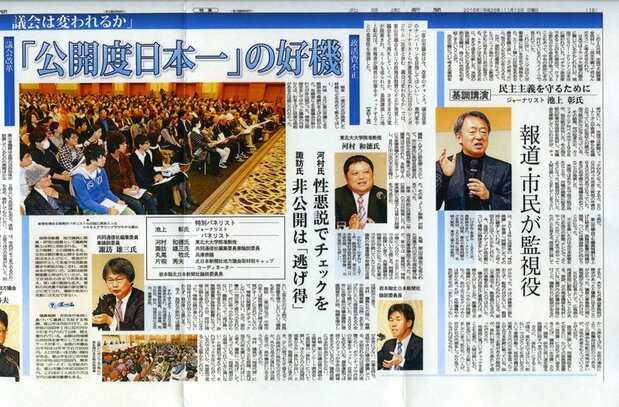
 Coverage of the open seminar in the Kitanippon Shimbun on November 13, 2016.
The municipal government of Toyama has traditionally been extremely closed. Of Japan’s 47 core cities, Toyama is the only one that does not yet provide live coverage of its municipal assembly sessions via cable television or the Internet. And the periodic Shigikai-dayori (News from the Municipal Assembly) that it publishes does not even record individual members’ votes on bills. But during the course of 2017, in response to the string of improprieties, the assembly made substantial progress toward greater openness. Political activity expense claims are now checked by an outside organ, and the receipts submitted can be viewed on the municipal website.
The public response so far, however, has been tepid. Only 26.9% of voters went to the polls for the November 2016 assembly by-elections, and the turnout for the combined mayoral and assembly elections in April 2017 was a disappointing 47.8%.
As Katagiri sees it, “This means that we can’t yet end our campaign. The issue now is how to turn voters’ anger into positive action and end their ‘we’ll leave it up to you’ attitude toward local democracy.” Miyagi at Tulip TV expresses a similar sentiment: “The purpose of the coverage wasn’t just to reveal malfeasance and get assembly members to resign. My idea was that local government should do more to address citizens’ real-life problems.”
(Originally written in Japanese by Nippon.com editor Ishii Masato and published on December 28, 2017. Banner photo: Sheaves of documents obtained by local journalists from the municipal government recording reimbursements for assembly members’ political activities. Photo courtesy of Tulip Television.)








 Read in other languages