


Thwarting a Peaceful Rise
Hu Jintao began efforts, both at home and abroad, to revamp China’s international relations soon after taking over the helm in 2004. The ideologues in his administration repeatedly expressed China’s intentions to pursue a peaceful rise. This was influenced by Washington’s strong desire that the Hu regime adopt a reformist—that is, internationally cooperative—stance.
US leaders invited one such ideologue to Washington based on the recognition that he was one of Hu’s most important backers. While the invitation was made by a private think tank, rather than the White House, he nonetheless met one key official after another while in town. On the way home, he stopped over in Tokyo, where I had an opportunity to speak with him at a private function. He seemed visibly elated in telling me that his US visit was highly successful. “The Americans were all eager to tell me that China would be afforded a respectable position in the international community,” he told me. “They said, ‘Historically speaking, international relations have become unstable whenever a country that had limited influence emerges as a rising power. This was the case with Germany and Japan, which were not given commensurate positions in the international community, a factor behind the outbreak of World War II. We’re not going to repeat that mistake. Giving China its proper place in the global order would be a natural endeavor, but this will require that China seriously pursue a course of international cooperation.’”
Quite naturally, upon his return to Beijing, this ideologue began asserting China’s intentions to rise peacefully, undoubtedly with the endorsement of the leadership of the Hu Jintao regime.
The “peaceful rise” scenario envisioned that China would attain a position of international prominence, not through violence or military conflict but on the strength of its growing economic clout. The scenario did not survive long as national policy, owing to pressure from the PLA.
The army was concerned about the implications of a peaceful rise for cross-strait relations. If Taiwan declared independence, for instance, the “peaceful rise” policy could prevent Beijing from intervening militarily. One could easily imagine that the PLA grilled the party over the issue. In fact, I have been privy to insider information on such moves. The phrase subsequently disappeared from the lexicon of the Hu administration, which also gradually did away with a reformist course.
Changes in US Attitudes
Soon after Xi Jinping took office, many commentators began voicing the idea of a Group of Two, under which the United States and China would divide the main responsibilities for maintaining the global order. China overtook Japan as the world’s second largest economy in 2011, but can the international community really be led under a G2 framework?
As questions of trust began to emerge in the context of its future relations with Beijing, Washington has focused on two key issues, primarily from a military perspective. One is cyber espionage. A 2013 report by Mandiant, an American information security firm, claimed that PLA hackers had not only stolen the blueprints of a stealth bomber from a US firm but had acquired huge volumes of data from various private organizations, including those regarding their decision-making processes. Such extremely important management information was passed on to Chinese businesses, implying that the PLA must have been handsomely rewarded for its cyber theft.
This revelation had a decisive impact on American opinion. While US businesses continue to be attracted to the lucrative Chinese market, they now have second thoughts about working with partners who may not be playing by established economic rules. Skepticism toward China has not been limited to the defense sector but has taken root in all segments of American society, and such concerns have even been on the rise.
Not Interested in Being Good Neighbors
The second security concern for Washington is China’s relations with its neighbors, particularly in view of the growing rift between the CPC and the PLA, as evidenced by the process by which China recently established new air-defense identification zones that overlap areas claimed by other countries. Questions remain as to whether the ADIZ decision was spearheaded by the party or the army and whether China is sincerely interested in building relationships of trust with its neighbors.
The close unity between the CPC and PLA, seen in the wake of China’s victory in the “War of Resistance” against Japan, has apparently undergone a dramatic change . The Tiananmen crackdown a quarter century ago triggered a sweeping transformation of Chinese society and system of rule. And it is necessary to continue closely monitoring which direction China is heading.
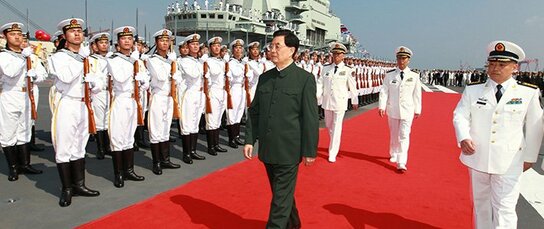
(Banner photo: Then President Hu Jintao inspects the Liaoning during a handover ceremony in September 2012. © Photo shot/Jiji Press Photo.)





 Read in other languages