


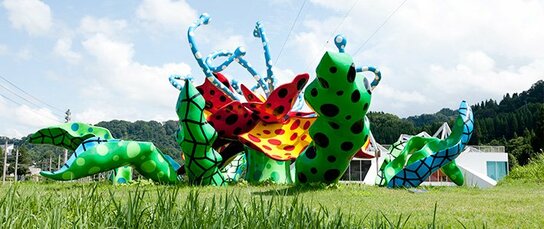
Cosmopolitan Offerings
Among the numerous works that incorporated natural scenery was Cakra Kul-Kul at Tsumari by Indonesia’s Dadang Christanto. The work comprised an array of bamboo whirligigs atop poles erected along a lane in the village of Seidayama.
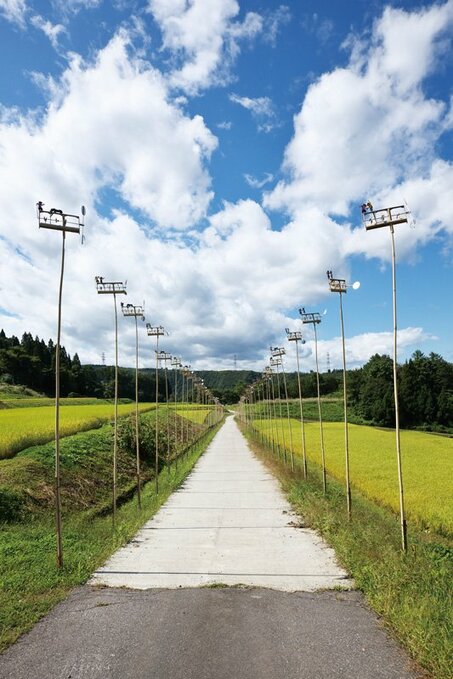
 Cakra Kul-Kul at Tsumari by Dadang Christanto.
Theatrical performances were also an important part of the festival. Students from Tokyo University of the Arts and France’s École des Beaux-Arts staged the wordless Nature and Me—Eleven Dreams in Tōkamachi on the night of August 6. The work, performed in a beech forest, employed a diversity of sound effects and lighting to evoke a series of children’s fantasies.
Organizers built a platform near Matsudai Station for the mid-August bon-odori. Obon is the season when Japanese welcome back ancestral spirits and folk dancing known as bon-odori forms a staple of festivities.
Mixed Feelings
Another feature of the triennale was a workshop in which young visitors from abroad gained hands-on experience in traditional Japanese agriculture. Among the participants was a group of youths from Hong Kong.
Young volunteers from Hong Kong have come to Japan to help with the preparations for each triennale since 2006. The youths have welcomed the opportunities that arise during their stays to take part in agricultural work alongside the local farmers. Hong Kong produces only about 7% of the food that its residents consume, so the very notion of cultivating edible produce has been original and stimulating for the visitors. Some of them have even found work in agricultural production on returning to Hong Kong.
Meanwhile, the local residents continue to welcome the festival, albeit with concerns about the fiscal burden that it entails. “This is a pretty quiet place most of the time,” mused a local farmer who was offering free tea and pickled vegetables to tourists near Tōkamachi Station. “So I like the way the triennale livens things up every three years. But I worry about the money that our town budgets for the event.”
The tourism bureau at Tōkamachi reports that the total budget for this year’s event was ¥600 million, with a subsidy from the national government covering ¥230 million of that amount and local tax payers footing ¥100 million. Those figures compare with a total budget of ¥490 million, a government subsidy of ¥100 million, and a local tax bill of ¥100 million for the 2012 event, according to the tourism bureau. The 500,000-plus visitors and the goodwill generated suggest that the Echigo-Tsumari Art Triennale expenditures have been money well spent.
(Originally written in Japanese by Murakami Naohisa of Nippon.com and published on September 23, 2015. Banner photo: Kusama Yayoi’s Tsumari in Bloom. Photos courtesy of the Echigo-Tsumari Art Triennale Executive Committee)








 Read in other languages