


The Loophole in the Public Finance Act
Over the long course of history, people have come up with various devices aimed at avoiding this “democracy trap.” Simply put, these have been tools for making commitments—deliberately setting limits on the discretionary scope of democratic governments.
One example of such a commitment tool is a currency system based on the gold standard or a fixed exchange rate. Under the gold standard, the value of a currency and the amount of it in circulation are linked to the country’s reserves of gold, and this link acts as a brake on government spending and fiscal deficits that may result in international payments deficits (outflows of gold). A commitment to maintaining a fixed exchange rate has the same sort of effect.
Another sort of commitment tool is the adoption of constitutional or legal constraints. In the case of postwar Japan, for example, the Public Finance Act of 1947 sets the basic rules for government finances, including the following provision in Article 4: “The expenditure of the state shall have its financial sources in revenue other than public loans or borrowing.” But the law continues as follows: “It is provided, however, that as concerns the financial source of public work expenditures, investment and advances, it is authorized to issue public loans or to make borrowings, within the limits of the amounts sanctioned, as the result of a decision by the Diet.”(*1) This has provided a critical loophole. Ever since fiscal 1966, for almost 50 years, so-called construction bonds have been issued under this exemption.
On a more basic level, the effectiveness of this sort of law as a government commitment tool is limited inasmuch as the law itself can be amended by a group with a majority in the legislature. This limitation is particularly clear in the case of a parliamentary democracy like Japan’s, where the party or parties with a legislative majority get to rule the government. In Japan’s case, aside from the construction bonds issued under the exemption noted above, large amounts of deficit-financing bonds have been issued by having the Diet pass enabling legislation providing for exceptions to the Public Finance Act every year.
The Role Played by the Prewar Genrō
A third type of tool for committing the government to fiscal probity is the yielding of authority over public finances to a neutral body that has at least a relative degree of independence from democratic controls. One example of such an arrangement that seems to have been effective is the informal system of oversight by the senior statesmen known as genrō in prewar Japan. The 1889 Meiji Constitution (Constitution of the Empire of Japan) did not provide for genrō, but the term came to be applied to a group of leaders who had wielded great political influence since the Meiji Restoration of 1868 and whom the emperor consulted particularly when naming a prime minister. The veteran leaders in question were Itō Hirobumi, Yamagata Aritomo, Kuroda Kiyotaka, Inoue Kaoru, Saigō Tsugumichi, Ōyama Iwao, and Matsukata Masayoshi.
In the early twentieth century, as Japan’s political parties gained strength and the characteristic democratic pressure for the swelling of the budget increased, the genrō served as a bulwark against this pressure. The Russo-Japanese War of 1904–5 was a major conflict involving military expenditures equivalent to 68% of Japan’s 1903 GNP, and though Japan was victorious, it did not win reparations under the peace settlement (as it had after the Sino-Japanese War of 1894–95), and so the government was left with a huge debt to service.
Despite this financial tightness, the government came under pressure from three directions for increased spending: from the army and navy, whose victory in the war had boosted their say, from the Home Ministry and Ministry of Railways, which sought money to improve the nation’s industrial infrastructure, such as railways, ports, and telegraph lines, and from the Rikken Seiyūkai (Friends of Constitutional Government), the most powerful political party, which was seeking to provide patronage benefits for local constituencies.
In the end, though, government spending after the war was held in check, the primary balance was kept in the black, and the government debt that had swollen during the war was reduced. This was made possible by the backing the Ministry of Finance received from the genrō in its fight against spending hikes. For example, in 1911 Inoue Kaoru and Shibusawa Eiichi, an influential business leader, submitted an opinion paper to Prime Minister Saionji Kinmochi calling for fiscal management based on (1) no foreign borrowing, (2) redemption of outstanding government bonds, and (3) streamlining of government organs. And the Ministry of Finance, with Inoue’s support, succeeded in cutting the public works spending demanded by the Home Ministry and Seiyūkai.
The genrō displayed several key characteristics in their role as an unofficial organ of the state. First, they were isolated from democratic control, since their positions did not depend on elections. Second, their status was effectively for life. And third, they were able to exercise influence on both the government and the military, which were separate loci of power under the Meiji Constitution. Thanks to these characteristics, they were unaffected by the democratic pressure for spending growth, and they were able to offer opinions on fiscal affairs from a long-range perspective, with their eyes on the national interest rather than the interests of particular groups. It was after the death of Saionji Kinmochi, who joined the ranks of the genrō during the Taishō era (1912–26) and was the last of them to survive, passing away in 1940, that Japan rushed down the road to financial ruin; this may be seen as symbolic of the role that the genrō had played.
Leadership by Elected Politicians Is Not the Answer
In today’s Japan, as noted above, public finances are already in a grave state in quantitative terms. On top of that, the commitment apparatus for restraint on government spending and fiscal deficits is not operating properly, and political forces are working to make it even weaker. Needless to say, Japan is not operating under the gold standard or a fixed exchange rate, and these are not appropriate options.
Under these circumstances, domestic legal and institutional commitments have a major role to play. Over the past half century, however, the Public Finance Act has almost completely failed to function as a commitment tool. Furthermore, the current administration is carrying on with the “politician-led government” espoused by the Democratic Party of Japan when it was in power (2009–12), moving away from the idea of entrusting particular areas of decision making to neutral organs independent of political control.
The simplistic notion that Japan will benefit by having elected politicians call the shots seems to have won broad support not just in the government and the ruling and opposition parties but also among political commentators. As this indicates, the crisis in Japan’s public finances is a far-reaching problem.
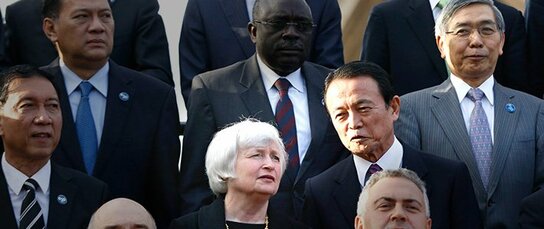
[Originally written in Japanese on March 20, 2014. Title photo: Japan’s Deputy Prime Minister and Minister of Finance Asō Tarō and US Federal Reserve Board Chair Janet Yellen (center), along with Bank of Japan Governor Kuroda Haruhiko (right), at a meeting of the Group of 20 finance ministers and central bank governors in Sydney, Australia, on February 22, 2014. Photo by Reuters/Aflo.]
(*1) ^ English translation from http://www.mof.go.jp/english/pri/publication/pp_review/ppr015/ppr015b.pdf.







 Read in other languages