



Doorway to Darker Crimes
Cyberspace later became the vehicle for increasingly serious crimes, which can be viewed as a precursor to the Zama killings. There was now a proliferation of “suicide by murder” sites pretending to show concern for troubled individuals, who would be lured to their deaths by thrill killers.
In February 2005, the body of a 25-year old woman was found near a soil erosion control barrier in the city of Kawachinagano, Osaka Prefecture. A male contract worker, arrested for her murder six months later and subsequently executed, had befriended the woman online and met with her, saying they would commit suicide together.
The killing had been particularly gruesome. After meeting the woman, the man bound her hands and feet with zip ties, covered her mouth with tape, and pinched her nose until she lost consciousness. He then slapped her cheeks to revive her, repeating the process for 30 minutes until he finally choked her to death. His motive: experiencing thrills by watching her repeatedly faint in agony. By the time the woman’s body was found, the man had killed two other people, a junior high school boy and a male university student, using the same method.
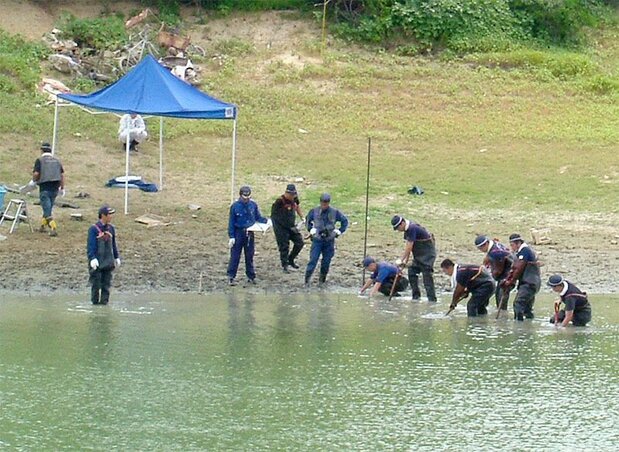
 August 12, 2005: Osaka Prefectural Police search a pond for a victim’s belongings disposed of by the serial killer. (© Jiji)
It was also around this time that news reports of “dark” online sites specifically for criminal activity began to appear. With names like “Alternative Job Center” and the like, these sites were used to exchange information about antisocial behavior such as buying and selling drugs, recruiting people to commit crimes, and so forth.
One of the most sensational cases involving a dark site was the murder of a 31-year-old female office worker in Nagoya in August 2007. Three men who met on a dark site got together to commit robberies but bungled the jobs. Frustrated at their lack of results, they hatched a plan to abduct a woman and force her to hand over her savings.
“So, who do we abduct?” went their conversation. “If we’re going to do it, let’s get a young woman. That’ll get us all hyped up.” Without any more justification, they dragged the victim, who just happened to be walking by, into a car and killed her with hammer blows to the head. Subsequently arrested and tried, of the three perpetrators one was executed and the remaining two were sentenced to indefinite detention equivalent to life sentences.
Slang, Vague Language to Attract Perpetrators
As online crime became more vicious, police authorities stepped up cyber patrols, focusing on explicit postings either announcing murders in advance or soliciting killers. At the Internet Hotline Center set up in 2006, operators contracted by the National Police Agency are tasked with detecting unlawful or pernicious postings related to suicide or criminal behavior, and can alert police and request that Internet providers delete the postings. The Act on Development of an Environment that Provides Safe and Secure Internet Use for Young People, enacted in 2008, made using a website filtering service mandatory for mobile phones.
Providers subsequently shut down numerous dark sites and the number of postings openly encouraging criminality has dropped. But even so, there are still dark sites using slang or ambiguous wording that continue to attract people up to no good.
Just recently, in June 2018, a crime reminiscent of the worst of the dark site incidents occurred in Hamamatsu, when a 29 year-old nurse on her way to her car after a gym workout was snatched in the parking lot and killed. This time, the three killers, men previously unknown to each other, had been brought together through a popular local online bulletin board, not a dark site.
The posting that was the catalyst for the crime read “Seeking two or three people to work as a team. We operate all over the country, so if you’re unattached, any age or sex welcome. Meet-up possible on the day itself. Anyway, drop us an email.” It was titled “Hey, want to make a pile of money?” and was posted by the likely instigator, a 39-year-old man, two days before the crime. Two men took the bait, met in Hamamatsu, and carried out the kidnapping and murder. After the crime came to light, the instigator was found dead in a hotel room in Niigata City, a likely suicide.
On the positive side, the spread of the Internet has enabled users to make personal and business connections in ways that were not possible before. But the Internet has also revealed the seamy underside of society. The perpetrators of the crimes described here did not share traits in common that led them to crime via the Internet. Rather, their behavior reflects the problems—insecure employment, lack of jobs, despair over the future—that afflict Japanese society today.
(Originally published in Japanese on December 6, 2018. Reporting and text by Shibui Tetsuya; editing by Power News. Banner photo: A police vehicle carrying suspect Shiraishi Takahiro leaves the Tokyo Metropolitan Police’s Takao police station on November 1, 2017. © Jiji.)












 Read in other languages