


While the West Withdraws, Japan Stays Put
The Myanmar government both welcomes and fears China’s encroachment. Shunned by the countries of the West, the military regime looked to China for support. It appeared that Western societies might take interest in Myanmar again with the emergence of Aung San Suu Kyi’s government, but they quickly retreated before the news of the persecution of the Rohingya people. So far, the only “Western” nation that has retained a presence in Myanmar is Japan.
The Japanese government appears to place great importance on Myanmar. Annual Japanese official development assistance yen loans to Myanmar have gone up from ¥220 billion to ¥230 billion and grant aid currently ranges between ¥15 billion and ¥20 billion. The support for Myanmar stands out at a time when Japanese ODA overall is being scaled back.
Part of this is due to the long tradition of friendship between Japan and Myanmar, but it is also intended to counter China’s efforts to chip away at the strong diplomatic ties Japan has forged over the years.
Currently, the Japanese embassy in Yangon is headed by Maruyama Ichirō, who has a close personal friendship with Aung San Suu Kyi, and staffed by diplomats fluent in the Myanmar language. Under the military regime English language instruction in the universities was allowed to deteriorate and few of Myanmar’s top government officials are able to speak the language. Other diplomatic corps have much praise for Japan for staffing its embassy with people who can negotiate in the local language.
A Clashing of Wills in the State of Rakhine
The clash between Japan and China’s diplomatic maneuvers is most evident in the state of Rakhine in the west, land of the persecuted Rohingya ethnic minority, and stems from China’s desperate efforts to solve its “Malacca dilemma.” China depends on passage through the Strait of Malacca for its energy imports. So does Japan, but the risk of its access being blocked is greater for China because the United States has control over the seas in the region. Desperate to secure an alternate route, China has been actively developing harbors, such as the Gwadar Port in Pakistan and the Port of Hambantota in Sri Lanka and is now targeting the small port of Kyaukpyu in the state of Rakhine.
Through large-scale investment, China appears to be seeking to build a pipeline extending from the Bay of Bengal into the Chinese mainland. Roiled by the Rohingya crisis, the state of Rakhine has been strongly criticized by the West and has little expectations of attracting investors. Xi Jinping’s government, however, sees this as an opportunity to incorporate Myanmar into its ambitious One Belt, One Road initiative through its offers to build ports.
Alarmed that China might get a monopoly grip on Rakhine, the Japanese government has been continuing its involvement in the region. In late February, Ambassador Maruyama made sure to attend the Rakhine investment fair sponsored by the Myanmar government. This, and other Japanese behavior in the region, seems to run counter to the strict condemnation of the Rohingya crisis by the Western countries, but Japan remains firmly committed.
China has shown signs it is sensitive to Japan’s push-back. When the Japanese government appointed Sasakawa Yōhei, head of the Nippon Foundation, as special envoy for national reconciliation in Myanmar, China countered by appointing Sun Guoxing as its special envoy for Asian affairs. As China’s de facto envoy to Myanmar, Sun has visited the country numerous times, including several excursions to Rakhine, and has been working to speed up the port construction projects that are so critical to China’s national interests.
Myanmar is an important geopolitical focal point in Asia. The outcome of the duel between China and Japan, the former working to extend its power and the latter equally determined to protect its long-standing position, is as yet unknown.
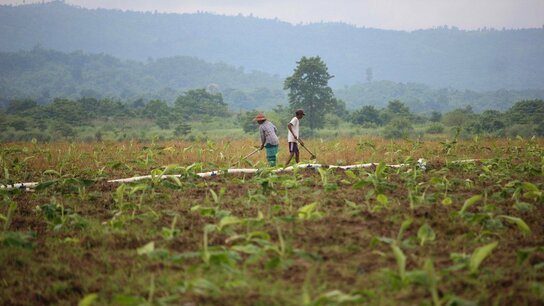
(Originally published in Japanese on June 17, 2019. Banner photo: Kachin farmers cultivate a banana field. Courtesy Myitkyina News Journal.)











 Read in other languages