


Building Policy Momentum
Turning an eye to the LDP leadership, we see that Abe has again looked to someone like-minded in replacing LDP Policy Research Council Chair Takaichi Sanae, who became the internal affairs minister, with Inada Tomomi. This, however, is not the case with his selections of Nikai as General Council chairman and Tanigaki as secretary general, both of whom toe a different political line from Abe. Ishiba, although out of a leadership role, remains a top challenger for the party presidency in next year’s elections. Noda Seiko, Nikai’s predecessor as General Council chair, is not considered a rival, but her stance on family and social issues runs contrary to that of the prime minister.
The LDP leadership strikes a balance with the appointments of Tanigaki and Nikai, two leaders hailing from leading factions and having differing political philosophies from Abe. By placing influential members of the LDPs foremost factions in executive posts—a practice known as “mainstreaming”—the administration preserves a structure conducive to promoting core cabinet policies.
By year’s end the cabinet must decide if it will move ahead and increase the sales tax to 10% in October 2015—a fiscally necessary move, but one that will certainly trigger an economic slowdown. It must also prepare for nationwide local elections next spring, the party election in the fall, and the looming possibility of the lower house being dissolved. Going forward, the administration is left with few other options for maintaining popular support than to remain focused on keeping the country’s economic recovery on track.
Abe’s appointment of faction heavyweights Mochizuki Yoshio, Takeshita Wataru, Nishikawa Kōya, and Eto Akinori to ministerial posts can be seen as an attempt to balance power among the different LDP groups. This is not the case, though. Attempts by earlier administrations to strike a balance in such appointments have relied on recommendations from the different factions and have been decided according to the size of each group (with the exception of those going against the party mainstream in the policy field). In the current reshuffle, however, factions have had a diminished say in deciding cabinet positions, with the faction of former Environment Minister Ishihara Nobuteru being excluded all together.
Attention Turns to Suga
Even as Abe has maintained the overall framework of the cabinet, the dynamics of the administration are bound to change as Suga, who retains his position as key handler in the overall running of the administration, continues to take a more central role in the cabinet.
The secretary general of the party and chief cabinet secretary are core positions for the administration, but the relationship between the two posts is dependent on the appointees’ status in the party. For Suga, his relationship with Ishiba was influenced by the latter’s position as a rival to the prime minister, but this is not likely to be the case with Tanigaki, who has focused on maintaining party harmony. This, along with Abe’s removal of Ishiba from the LDP’s number-two position, will likely give Suga greater influence in the administration.
The choices of Nikai and Motegi Toshimitsu, who was tapped as head of the LDP election strategy headquarters, also bear watching. Nikai has close connections with the upper echelons of Sōka Gakkai, the lay Buddhist and parent organization of the LDP’s largest coalition partner, New Kōmeitō. This is certain to draw the two parties closer together. Motegi may have been tapped for a top position in part for his affiliation with a major party faction, but Abe's recognition of his abilities as a capable administrator had as much to do with the selection as factional politics. Suga enjoys a good working relationship with both Nikai and Motegi, and the three can be expected to come together to in ensuring Kōmeitō support for cabinet proposals as well as in crafting election strategies.
Weakened Opposition
The reshuffle has allowed Abe to carve out an advantage for himself within the LDP. But this may prove to be detrimental by driving out critical voices and throwing the party out of balance.
The Democratic Party of Japan, the main opposition party in the Diet, has yet to recover as a viable rallying force against the administration. The DPJ remains fragmented and incapable of building lasting coalitions with other parties, with its attempts to oppose Abe’s policies petering out before even getting out of the gate.
The end of 2014 marks the halfway point until the next required election in the House of Representatives. As the dissolution of the lower house and the next general election become increasingly popular topics of discussion, we are likely to see further moves toward unity among the opposition parties. Disapproval of the state secrets law and push for collective self-defense, which have the potential to impact on the lives of the general public, remains strong; it is testament to the fundamental weakness of the opposition that this disapproval has not boiled over in a more public manner. Indeed, Prime Minister Abe’s seeming strength may be little more than the absence of effective opposition on the Japanese political stage—a fact that may signal future problems for his LDP.
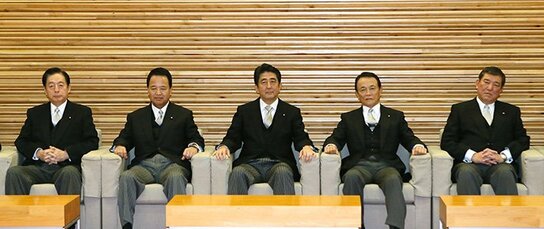
(Title Photo: Abe holds his first cabinet meeting on September 3, 2014, after reshuffling his administration. Ishiba, minister in charge of reviving local communities and Abe’s largest rival in the LDP, sits on the far right. © Jiji )

 Read in other languages