


The Mergers’ Dubious Constitutionality
I believe that the recent merger of upper house electoral districts is actually unconstitutional. This is related to the ad hoc nature of the revision that was enacted. Article 95 of the Constitution stipulates, “A special law, applicable only to one local public entity, cannot be enacted by the Diet without the consent of the majority of the voters of the local public entity concerned, obtained in accordance with law.” Here “one local public entity” means “a particular local public entity” (such as a prefecture or municipality), and the provision applies even if there are plural entities involved. The intent of this article is to prevent a Diet majority from enacting laws that impose unequal or disadvantageous treatment only on some particular local public entity or entities.
The revised Public Offices Election Law treats the 43 prefectures other than Shimane-Tottori and Kōchi-Tokushima as single districts for the upper house; these four prefectures alone have been merged into two-prefecture districts. So the upper house will no longer have members elected separately from each of these four prefectures. This can certainly be labeled unequal and disadvantageous treatment of particular local public entities. So the revision needed to be approved by referendum in each of the affected prefectures before its enactment by the Diet. But this was not done. And that is why I consider the measure unconstitutional.
It would have been a different story if the revision had stipulated a clear set of rules for the merger of upper house districts, rules that would automatically merge two electoral districts whenever some prefecture’s population fell below a set level. Under that sort of legislation, any prefecture would become the target of a district merger if at some point its population fell below the legally set standard, and so it could not be said that the four prefectures whose districts were merged this time had been singled out for unequal or disadvantageous treatment.
But as we have seen above, the sloppy, hastily enacted revision contains no such set of rules. Instead, the law treats the four affected prefectures as special cases. It is as if they had been singled out for unfavorable treatment. I might also point out that an annex to the revised law calls for ongoing consideration of a comprehensive revision of the electoral system in advance of the 2019 House of Councillors election. With this, the Diet has effectively admitted that the recent revision is not based on rules and principles.
The revision may avert lawsuits challenging the constitutionality of next summer’s upper house election on the grounds of excessive disparities in the value of votes. But we could see constitutionality suits based on new grounds. The Diet’s sloppy handling of this extremely important piece of legislation is liable to have serious consequences.
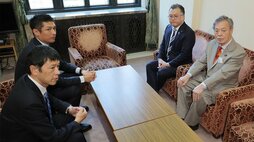
(Originally written in Japanese and published on October 2, 2015. Banner photo: LDP upper house leader Mizote Kensei [third from left] and Japan Innovation Party upper house leader Katayama Toranosuku [third from right], hand their parties’ joint proposal for revision of the Public Offices Election Law to House of Councillors Secretary General Nakamura Takeshi [center] on July 23, 2015. © Jiji.)





 Read in other languages