


Little Chance of a Female Prime Minister
Most of the women Diet members I have talked about thus far all share the skill of self-promotion. Perhaps because many of them have media backgrounds, they are highly adept at presenting themselves in a way that is based on a careful analysis of their own strengths and distinguishing characteristics. This careful attention to their image manifests itself even in the how they dress and the way they talk. In my opinion, Koike has proven herself the most accomplished in this art.
By contrast, Inada and Yamao have cast themselves in a different mold. It is intriguing that these two women are from the legal profession. Although they lack flair when presenting themselves to the public, they have earned reputations for their skill in deftly handling different situations. Inada and Yamao undoubtedly have natural political talent. However, neither rose to their posts through the kind of all-out battles their male counterparts in the Diet engage in. And to that extent, I do not think either will become anything more than political “billboards” for their parties.
As things stand, I do not believe any of the women I have talked about here are seriously considering taking a run at becoming Japan’s first female prime minister. However, even if I’m wrong, I think it still all but impossible for a woman in Japan to rise to the post. This is because a person’s political bloodline still counts for so much, particularly in male-dominated rural society, which becomes more conservative the deeper in the countryside you go. There is still a chance, however, if the environment is right and the candidate possesses all the skills and abilities that I will talk about below.
Policy-Centered Thinking
First, a candidate must possess the charisma, measure, and experience needed to win people over to her way of thinking. Take for instance the transformative income-doubling plan of Prime Minister Ikeda Hayato and the plan of Prime Minister Tanaka Kakuei for remodeling the Japanese archipelago. These massive initiatives were forged by brain trusts that devised suitable policy frameworks, refined those frameworks, and then rolled them out under the banner of the prime minister. Once in place, Ikeda and Tanaka then had the task of shaping the core policies of the plans and explaining them to the nation. In building brain trusts, there is no denying that politicians, male and female alike, from political families enjoy a distinct advantage.
Take for instance Abe, who was able to announce a wide range of policies beginning with his trademark Abenomics in rapid succession by relying on his personal brain trust. It goes without saying, though, that these policies had to tack closely with the prime minister’s own thoughts and beliefs—or, as some view it, the legacy of his grandfather, Prime Minister Kishi Nobusuke.
Brain trusts are made from bureaucrats, business leaders, and academics that see in the belief system of a given politician an avenue for realizing policies they themselves have aspired to implement. These people come to the task fully aware that laying the groundwork for their candidate’s rise to the top office will be a long, arduous, and mostly thankless job. But they are highly motivated as success will mean their long-held ideas will finally see the light of day. This is how it works across politics.
Supporting Women Leaders from Within
Japan’s old political factions have weakened considerably and are being replaced by new groups led by politicians with their own brain trusts. To form a group, though, a politician must be able to raise the funds necessary to secure posts for their supporters. The rules are no different for female legislators.
For women to head their own factions, however, there first needs to be an environment where more strong female legislators can win single-seat districts and hone their skills by battling it out together over policy on the Diet floor. It is also essential that there be more women in top positions in business, the central bureaucracy, and academe who can support the rise of women politicians. Only in such an environment will it be possible for leading women legislators to be measured by their deftness in reading situations and depths of their political decision making. The final decider will be their ability to hold their own in a world currently dominated by men.
Clinton formed her brain trust amid a much different political environment, structure, and background in the United States back when she was first lady. It is easy to imagine how it has served her in the exceedingly fierce struggle for power she has faced within the Democratic Party leading up to her nomination and throughout her presidential campaign.
Japan has only a handful of women in political, business, and bureaucratic leadership positions largely due to the fact that securing important posts requires obtaining the backing of a power broker. This situation is gradually changing, however, and more than ever women are breaking through the glass ceiling armed with their own networks and acumen. When Japan finally gains a diversity of women in the Diet who can go toe-to-toe and emerge victorious from long, hard political battles will be the day the nation sees its first female prime minister.
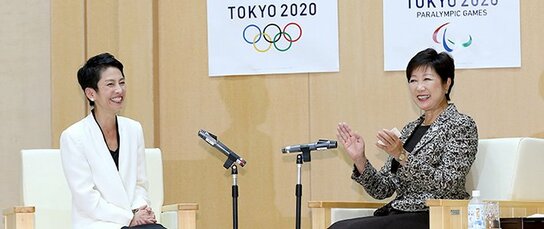
(Originally published in Japanese on October 25, 2016. Banner photo: Democratic Party head Renhō meets with Tokyo governor Koike Yuriko, right, at Tokyo City Hall following her election as party president on September 9, 2016. ©Jiji.)




 Read in other languages