


Unskilled Labor in “Invisible” Workplaces
Once they get to Japan, these sham students become a key source of labor. Japan has a serious shortage of manual workers. But the Japanese government does not allow the entry of foreigners for the purpose of “unskilled labor.” The authorities have established a Technical Intern Training Program through which about 210,000 foreigners are performing unskilled labor, but the employment of these “technical interns” is limited to 74 specific job categories. These include work at small-to-midsize factories in such fields as textiles/apparel and machinery/metal processing, along with jobs at construction sites and in the processing of agricultural and fisheries products. There are labor shortages in many other fields, however, and international students are valuable as workers to fill the gaps.
People tend to associate foreign students with part-time jobs at convenience stores and restaurant chains, but the workplaces where they play the biggest roles are ones that are ordinarily out of our sight. They take jobs making ingredients for the box meals sold at supermarkets and convenience stores, sorting parcels for home delivery services, cleaning hotel rooms, and delivering newspapers, for example. These all involve nighttime manual labor, which Japanese workers dislike, and the pay is at minimum levels. Even if students take on multiple jobs, working in excess of the 28-hour weekly maximum, it is very hard for them to make the ¥200,000–¥300,000 a month that they had been led to expect. And by the time they realize the broker deceived them, they are already stuck. If they return home without having paid back their loans, their families are liable to face financial ruin. These sham students, then, have no choice but to continue working in Japan.
International students’ enrollment in Japanese language schools is limited to two years. After that, the educational institutions that await them are universities and vocational schools that depend on such students for their survival. Because of the decline in the number of children, nearly half of Japan’s private universities are unable to recruit their full complement of students. The situation is even worse for vocational schools, and there are plenty of institutions that will admit international students regardless of their Japanese language ability; all they require is that the students pay their admission fees and tuition. In exchange for these payments, sham students are able to get their visas renewed and keep working in Japan.
Japanese Language Schools Spread to Depopulated Regions
Japanese language schools used to be located mainly in urban areas where part-time jobs are easy to find. Recently, though, they have also been springing up in parts of the country that are suffering from depopulation. In 2015, for example, a new Japanese language school was built in Amami Ōshima, an island in Kagoshima Prefecture; the following year one was completed on Sado Island in Niigata Prefecture. This autumn a new one is scheduled to open in Okutama, a town at the far western end of Tokyo, using the facilities of a former junior high school. And plans are in progress to open a new vocational school targeting international students in Setouchi, a city in Okayama Prefecture. In this case, a shuttered elementary school is to be used for the institution, which is aiming to open its doors next year.
The population of Setouchi, my hometown, has been aging and shrinking steadily, and now stands at about 38,000. The city’s main industry is oyster culture, but there is a shortage of workers on the front lines. So the city hopes to tap international students as a source of labor. And it has a growing number of empty homes, some of which it hopes to put to use at student lodgings. In order to implement this local revitalization project, the city is offering to provide a low-rent school building for the new institution.
Projects of this sort are sure to become more common in municipalities around Japan. But will they work out as hoped?
With Debts Remaining, More Are Overstaying Their Visas
As of January 1 this year, 65,270 foreigners in Japan were illegally overstaying their visas. This figure has risen in each of the past three years. The increase is especially pronounced among Vietnamese, among whom there are 5,137 of the illegal residents, up 35% from last year. Former international students account for 3,807 of the total, up 11%. In other words, the growth in the number of students from Vietnam has been accompanied by a rise in the number of Vietnamese staying on illegally.
Quite a few of these are people who are continuing to work illegally in Japan because they have unpaid debts at home. And it is hardly surprising that some of them turn to crimes like robbery and shoplifting in order to get the money they need quickly, before they are caught and deported. As of 2015, Vietnamese accounted for the largest share by nationality of foreigners apprehended for crimes in Japan—surpassing the figure for Chinese nationals, of whom there are four times as many living here.
A Straightforward Approach to Admitting Foreign Labor
The status quo regarding sham students from abroad is bad both for the students and for the Japanese people. International students borrow large amounts of money in order to come to Japan, and once they are here, they face the burden of paying tuition and making loan repayments. And the crimes they commit inevitably affect Japanese people.
The first step that should be taken is to halt the inflow of sham students. All this would require is for the authorities to scrutinize the documentation submitted by applicants for student visas and to reject those suspected of falsifying their ability to defray their expenses. Unfortunately, though, the situation is moving in the opposite direction.
This May the Liberal Democratic Party, which leads the ruling coalition, came out with a call for further action to promote the plan to raise the number of international students to 300,000. The party’s Headquarters for Promoting Dynamic Engagement of All Citizens issued a set of recommendations that included a reference to actively tapping these students as workers to offset Japan’s shortage of labor. And it is likely that the current 28-hour limit on their weekly working hours will be raised.
If Japan is short of workers and wants to rely on foreign labor, it should adopt a system for this purpose based on straightforward deliberation of the issue. What we are doing instead is relying on foreigners who have borrowed large sums to come to Japan under student visas, employing them to do jobs that Japanese people shun, and drawing on their earnings as tuition. It is only natural that this produces growing numbers of foreigners who are disappointed in Japan and come to dislike our country.
The admission of students from abroad has been adopted as a policy aimed at increasing the numbers of foreigners who contribute to Japan by learning the Japanese language and becoming familiar with our culture and customs. But the current system is working in the opposite direction. The national effort to expand the ranks of international students to 300,000 should be halted forthwith.
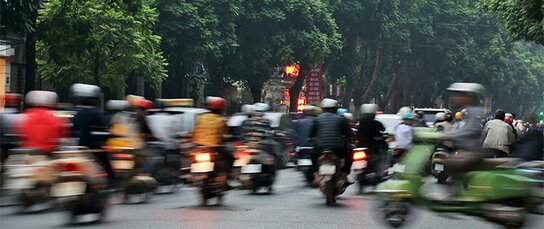
(Originally published in Japanese on July 13, 2017. Banner photo: Rush-hour traffic in Hanoi, Vietnam, a country now experiencing a “study in Japan” boom. Photo via Pixta.)







 Read in other languages