


International Certification for Japan’s Food Products
There is a possibility that Japanese agricultural products will not be used in the meals prepared for participants before and during the Olympics. Producers of food for the Olympics must be certified as meeting international or equivalent standards, but the share of Japanese producers with such certification is extremely low. Also, an international nongovernment organization is closely monitoring the sources of agricultural and other products, including timber, for sustainability and for human rights problems, such as child labor and bad working conditions. Japanese corporations supplying products for the Olympics will be held to account and required to make improvements if their products are not in compliance with international standards as part of global supply chains. Instead of taking a negative view of these potential barriers, domestic suppliers should see the Olympics as offering a good chance to meet all the relevant international standards in a single sweep, thereby opening the way to doing business globally after the games.
Another potential benefit that we should seek from the Olympics and Paralympics is the achievement of a more inclusive society. The games will bring to Japan people of various nationalities and races, and also people with a range of disabilities. Thanks in part to interest in the upcoming Paralympics, efforts are now underway to create both physical structures and intangible arrangements so as to enhance the welcome for those with disabilities. And we can hope that this event will also lead to better public understanding for such people. If acceptance of differences becomes widespread in Japanese society, it will make life more comfortable for Japanese people themselves, and diversity will become a source of social vigor and of new value.
In addition, we should take full advantage of the games’ deadline power—the concentration of attention and energy resulting from the need to complete the work as scheduled. We are already seeing this power operating in the form of efforts to achieve technological advances and social reforms by 2020 in a variety of fields, such as self-driving cars, hydrogen power, minpaku (home rentals for short-term lodgers), multilingual services, automatic translation and interpretation, recycling of “urban minerals” (such as metals from electronic devices), barrier-free design, and the development of sporting industries.
The Greatest Legacy: Human Resources for the Future
A multitude of projects are in the works across the country as part of the preparations for the 2020 games. Pre-games training camps are being arranged in hundreds of locations; Cultural Olympiad Tokyo 2020 is aiming to draw 50 million people to 200,000 cultural happenings; the organizers will stage official gatherings, while local bodies, schools, and others will also put on events, and some 80,000 people are expected to serve as volunteers. If young people and other residents participate, not only by volunteering to help out during the events but also by joining the planning and implementation teams and taking part in the decision-making processes, their experiences can help them become social and community leaders after the games are over. In other words, the games can serve as a valuable opportunity for the development of Japan’s human resources.
Our organization, Mitsubishi Research Institute, and Shibuya’s municipal government, in cooperation with business corporations, are organizing a project bringing together young people to come up with ideas for the area’s future in connection with the upcoming Olympics and Paralympics. Consisting of some 100 people aged 18–29 with connections to or special interest in Shibuya, this group will devise plans and proposals for the area, and the ones deemed worthy will be adopted as official initiatives to be implemented with support from businesses. In the course of their activities, the participants will have to cope with various pains, difficulties, and setbacks—travails not experienced by those who merely offer their ideas and proposals from the sidelines. But it is precisely this sort of experience that will imbue them with the toughness required of social and organizational leaders.
If initiatives like this bloom across Japan, attracting numerous young people and other local residents to take part in social endeavors, our country will gain a new store of human resources, which will be the Olympics’ biggest legacy. Also, if these are not just passing efforts but turn into platforms for tackling local problems on an ongoing basis, the initiatives themselves will be a valuable part of the games’ legacy.
I understand that the organizers of the 2024 Paris Olympics are planning to create a legacy whose biggest element will be the creation of social businesses aimed at achieving zero poverty, zero unemployment, and zero emissions of carbon dioxide. Some will probably ask what such goals have to do with sports. And it is true that it is important for the Olympics and Paralympics to generate interest and enthusiasm as sporting events. But in today’s world, the Olympics cannot be socially relevant unless their impact extends beyond the time frame of the event program and the physical confines of the host city.
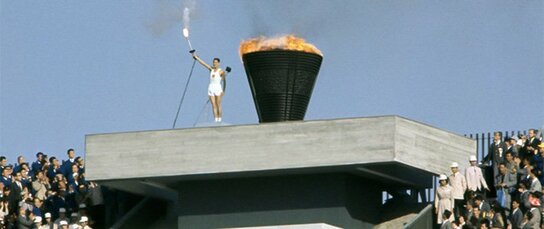
In retrospect, the 1964 Tokyo Olympics marked a turning point for Japan, showing it to the world as a country that had recovered from the devastation of World War II and had regained full membership in the international community—and giving a boost to the growth that would turn it into an economic superpower. It is our job to make the 2020 Tokyo Olympics another turning point, one to which future generations will look back as marking Japan’s transformation into a fully mature society.
(Originally published in Japanese on October 27, 2017. Banner photo: The final runner in the torch relay lights the Olympic flame at the October 10 opening ceremony for the 1964 Tokyo Olympics. © Mainichi Shimbun/Aflo.)





 Read in other languages