


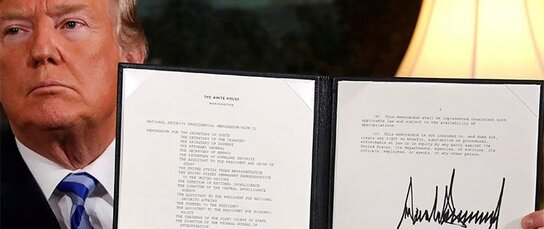
The Impact of Leaving
The decision to quit the deal is likely to have a multitude of repercussions. First, it has further deepened the political divide in American society. As I have already noted, opinion on the Iran agreement is split into two fundamentally opposed camps. While some American Jews and pro-Israeli evangelicals have applauded the decision, most Middle East experts and specialists in US-Europe relations have been strongly critical of the decision. Their concern is that America’s unilateral withdrawal from the agreement despite Iran keeping its end of the deal signals a wider American disengagement from the international community.
Of course, this is not the first time that the Trump administration has stirred up controversy that has divided society. But unlike the previous decisions to withdraw from the Paris Climate Agreement and the Trans-Pacific Partnership, which had yet to meet expectations, Trump’s recent decision showed the president pulling the plug on an agreement even though it was proven and functioning well to prevent Iran’s action.
Second, the gulf in US-Europe relations has now become unbridgeable. Just before President Trump announced his decision to withdraw from the deal, French President Emmanuel Macron, German Chancellor Angela Merkel, and British Foreign Secretary Boris Johnson all visited Washington in short succession, with Macron going so far as to include harsh criticisms of Trump’s proposed withdrawal in his address to Congress. But the president brushed aside these attempts to change his mind.
Also, the decision to re-impose sanctions is widely expected to mean secondary sanctions on European firms that have close economic ties with Iran, something that is likely to result in serious economic pain for these companies. The EU has reinstated its 1996 “blocking statute” stating that US and other foreign laws have no jurisdiction in the commonwealth and plans to take measures to compensate European companies that are adversely affected. But this is unlikely to be enough to counter the impact of secondary sanctions altogether.
It is unlikely, though, that the move to leave the nuclear deal will have a significant impact on conditions in the Middle East right away. Iran will no doubt suffer an economic shock as a result of the unilateral American decision, but it is important to remember that President Trump’s announcement does not mean the end of the deal altogether—merely that the United States has decided to leave it. The nuclear agreement and the United Nations Security Council Resolution 2231 that approved it will remain in force, at least in form.
If Iran is found to have infringed the terms of the agreement, though, it will still be forced to take responsibility for its actions. And the steps that Iran can take to protest the decision are relatively weak. Although it may restart uranium enrichment above the prescribed limits and reestablish centrifuges, it will not be able to quickly develop a nuclear weapon. Another factor is that any sudden progress toward developing nuclear weapons would increase tensions with Saudi Arabia and other neighboring countries, seriously destabilizing the region. In the worst-case scenario, it might lead to a “domino” effect with other nations racing to develop nuclear arms. Iran is therefore likely to respond in a relatively restrained manner.
There is also concern about the possible impact on the issue of North Korea’s nuclear program. Trump’s decision has created a precedent for the United States to leave a previously agreed on deal for its own reasons at any time, even if the conditions of the agreement are being met by other parties. In such circumstances it would be natural for the North Koreans to suspect that even if the US-North Korean summit on June 12 were to produce a deal, there is no guarantee that the agreement would be maintained on an ongoing basis.
On May 16, Kim Kye-gwan, First Vice Minister at the North Korean Foreign Ministry, described American unilateral demands as the “Libya model,” and hinted that he might not attend the summit as a result. Even if Iran was not mentioned by name, there can be little doubt that distrust and suspicion remain. Depending on how things develop, the results could well have a massive impact on Japan. In this sense, it is no exaggeration to say that the American decision to quit the Iran deal has caused serious instability in the international order.
A Limited Impact on Japan?
Finally, is it true to say that Trump’s decision is likely to have only a limited impact on Japan? Unlike European countries, South Korea, and India, Japanese companies have generally taken a cautious approach to investment and trading in Iran on the grounds that there is a real risk that the nuclear deal was not sustainable. Although there is likely to be some impact on petroleum imports and exports of automobile components, it is likely that Japan’s economic losses will be relatively mild compared to other countries.
There are also concerns about a possible pinch in the global oil supply if exports of crude oil from Iran come to a halt, but with Saudi Arabia and other producers expected to increase production, there have not so far been any major fluctuations in crude oil prices. Japanese companies tend to be sensitive to risk, and this often leads to a somewhat reactive “wait-and-see” policy. But on this occasion, companies’ cautiousness about plunging into the Iranian market may prove to have been sound business.
(Originally published in Japanese on May 25, 2018. Banner photo: Donald Trump in the White House on May 8, 2018, showing off the presidential order committing the United States to withdrawal from the Iran nuclear deal. © Reuters/Aflo)




 Read in other languages