


Harmony with Nature as a New National Brand
INTERVIEWER After a disaster like this, it is perhaps more important than ever to look to the future.
KOBAYASHI One of the major changes since the disaster is the question of how to brand Japan internationally. Until recently, Japan sold itself as a country with high standards of safety, but now even Japanese industrial products are being subjected to radiation checks. So what will our new selling point be? My proposal is for Japan to put the concept of harmony with nature at the heart of its international marketing and branding efforts. As a first step, we should announce to the world that we will offer products and services that allow modern societies to prosper in harmony with nature, based on what we have learned from this recent disaster. Without a major effort like this, there’s a danger that Japan could become a country the rest of the world feels it can do without. Japan needs to take the initiative and launch a major branding effort based on the idea of harmonious symbiosis with nature. A commitment to ecology goes beyond simple economic effects and the impact on the environment. It’s also vital in terms of ensuring Japan’s continuing viability as a leading member of the international community.
INTERVIEWER Ecologists overseas have shown considerable interest in the sustainable lifestyles and ecosystems that were present in Japan during the Edo period [1603–1868]. But Japan today is a long way from the model that prevailed in those days.
KOBAYASHI A concept with deep roots in Japanese culture is the idea of mottainai—a sense of regret when the intrinsic value of something is allowed to go to waste. Ultimately, this stems from an animistic view of the world that perceives a spiritual presence in all natural phenomena, including mountains and trees. Germany has made a name for itself as a leader on environmental issues by emphasizing environmental performance. But Japan can become a leader with a slightly different approach. We can position ours as a country that considers matters from a perspective separate from energy issues and performance and emphasizes harmony with nature. I think many aspects of this would attract international interest, including the reuse of old houses and old housing materials. So far, unfortunately, the traditional Japanese affinity for nature has not been communicated to people overseas very effectively.
Japan has already played a leading role in created important international rules designed to make it possible for human beings to live in harmony with nature. The Kyoto Protocol(*1) of 1997, for example, was an extremely significant commitment by the international community to the idea that human societies exist at the heart of nature. The Nagoya Protocol(*2) signed in 2010, which fixed the rules for sharing the benefits of the international use of genetic resources, was also highly significant. I think we should be more proactive about publicizing the fact that Japan has been publishing environmental white papers longer than any other country, for example.
INTERVIEWER You suggest a new national brand for Japan based on the idea of harmony with nature. In concrete terms, what kind of ideas would you like to see incorporated into urban design and planning in the regions of Tōhoku affected by the March 11 disaster?
KOBAYASHI Compared with Western countries, Japan is good at making efficient use of confined spaces, but perhaps not so good at building wide-open exterior spaces. We can no longer keep thinking in terms of twentieth-century ideas of urban design—long lines of high-rise buildings, a few bits of greenery down on the level areas, and a big road running through the middle. My personal idea for a new kind of twenty-first-century city would be something that from the outside looks like a lot of green hills linked together. The slopes would be totally given over to plants and greenery. If there are problems with space, build underground. I think that’s the kind of radical change we need if the “harmony with nature” brand is really going to take off. I really hope a town or city in Tōhoku will give something like this a try.
INTERVIEWER Your own “eco-house” is a good example of an attempt to live in harmony with nature in the big city.
KOBAYASHI I’ve always liked butterflies, and the open spaces around my house are planted with all kinds of trees and flowers to attract butterflies to the garden. You can find 30 different species of butterfly in Setagaya-ku alone. I use double-glazed windows to improve insulation in the house.And thanks to the double glazing, there’s no condensation on the windows even when it snows. So while I thoroughly recommend double glazing as a highly effective way of saving energy, it also has the added benefit of allowing you to enjoy snow viewing with a drink from the comfort of your own home! I think it’s important to create small spaces like this within your urban life from which to enjoy nature.
Kobayashi Hikaru’s Eco-house
In addition to his public role as a formulator of Japan’s environmental policy, Kobayashi is a private individual with an eco-house of his own. His home in Tokyo’s Setagaya-ku incorporates more than 30 different environmental features, from solar power to water recycling. As a result of these efforts, in 2008, nine years after renovating his house, he achieved a 50% cut in carbon dioxide emissions. He says between 20 and 30 different species of butterfly visit his garden. Kobayashi’s efforts show that it is possible to live in balance with nature even in the heart of a major modern city.
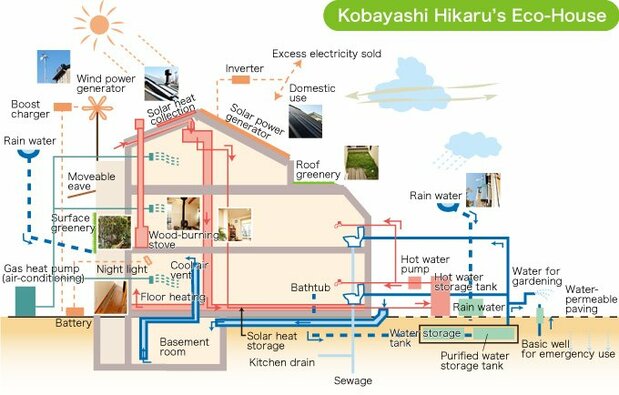 Click the thumbnails to view larger images.
- Wind power generator
- Rain water
- Surface greenery
- Solar heat collection
- Solar power generator
- Wood-burning stove
- Floor heating
- ダクト
- Roof greenery
(Translated from an interview in Japanese by Hayashi Aiko, science writer. Portrait photographs by Kawamoto Seiya; eco-house photography and diagrams provided by Kobayashi Hikaru.)







 Read in other languages