


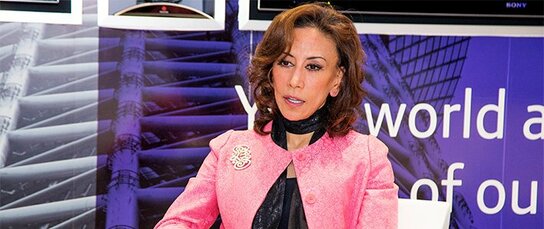
Technology and the Work-Life Balance
Yoshida says the reforms of working styles that Japan is trying to introduce now would have been impossible when she was bringing up her daughter 20 or 30 years ago. “Recent technological revolutions make it possible to balance home and work life without reducing productivity. Long working hours are not realistic. The lack of proper work-life balance causes problems for everyone—men and women, all over the world. And although we cannot change the basic fact that there are only 24 hours in the day, the digital age allows us to maximize the amount of meaningful activity we can squeeze into one day.
“The postwar technological revolution in the home liberated women from housework so they could join the workforce. Now we need to promote a similar technological revolution in our offices. Today, it’s possible to do your work anytime, anywhere—your office can be any place you happen to be with your computer switched on. Ideally we want to see systems introduced that will allow people to take part in meetings wherever they happen to be. BT has jointly developed a high quality audio speech meeting service together with the US audio company Dolby that facilitates virtual meetings. This makes it possible to take part in a meeting wherever you might be—not only from home but also on the move. All you have to do is click on the smartphone app. This helps to boost productivity. The adoption of this kind of teleworking tool will be a vital part of making a better work-life balance a reality and increasing women’s participation.
Plenty of Room for Economic Growth
Japan still lags some distance behind most other rich countries in terms of introducing technological innovations to the workplace. “And of course we are still several decades behind in terms of encouraging women’s full participation. I am the first female president of BT Japan. And I think for the management in London it was quite a daring decision to choose me for the position—and this is in the context of a head office that is quite proactive about improving employment diversity by providing better opportunities for women, sexual minorities, people with disabilities, and immigrants. So I think that’s one thing we need more of in Japan: people who are prepared to make bold decisions.”
Yoshida says that the outstanding skills of Japanese women are already widely acknowledged internationally. “According to surveys carried out by the OECD, Japanese women’s literacy and numeracy levels are among the highest in the world.” Despite this, the World Economic Forum ranked Japan 111th out of 144 countries in its 2016 Gender Gap Index—its lowest ever position.
“But it’s no use simply getting pessimistic. The fact that Japan lags so far behind means our economy still has that much room to grow. Let’s assume that half our population of 130 million people is female—these numbers should be a huge global asset for us. The question is: How can we tap this potential and make the best of it? We all need to think of solutions and put those ideas into practice. Change and reform bring some degree of pain. But we mustn’t hesitate for that reason—this pain is the pain of growth.”
Yoshida says she feels a genuine sense of the dynamism and drive that women are increasingly bringing to the workplace. But she also feels a keen sense of dismay about the growing numbers of families with single mothers and the worsening problem of child poverty. According to a survey carried out by the Ministry of Health, Welfare, and Labor in 2012, around one in every six children below the age of 18 lives in poverty—and over 50% of single-parent households. “Children have huge untapped potential. They are vital for the future of this country. It would be a tremendous loss for Japan if we failed to give these children the proper education opportunities they need to bring out and develop those talents. The government and business sector must take all the necessary measures to address the problems that our children face.” Yoshida insists that the key is to find a way to convert the battling determination and hard work of single mothers into positive economic energy.

 Yoshida says that Japan has some of the most talented women in the world, and needs to do more to make better use of these assets.
Living Your Life to the Fullest
Yoshida accepts that the government will have to play a leading role in the ongoing technological revolution and that close collaborations between government and the private sector will be an essential part of tackling issues and making the reforms a success. But she stresses that technological breakthroughs on their own will not be enough. Individuals have a huge part to play too: personal motivation and a strong desire to make the most of one’s abilities are just as important as drivers of social change.
“To achieve sustainable ongoing reform, we need mechanisms that will foster motivation, and we need to scrap the regulations that prevent women from fulfilling themselves in their careers. This will involve reforming our social security and taxation systems, introducing performance-related pay, and ensuring that we have the right leaders who can steer the whole enterprise and inspire motivation. These three elements are vital.”
But Yoshida says that the government drive to promote female participation in the workforce does not mean that everyone has to be a leader. Rather, women should be able to use the latest technology to help them pursue their goals whatever their chosen sphere, while also raising their children and providing care for other family members who may need it. The aim is to make it possible for women to follow their own wishes and expand their potential to the widest extent. “And for that, you need to be constantly pushing yourself to refine your abilities—what can you do to maximize your individual strengths?” A society built more around individuals will bring new challenges of its own in some respects. “But I know from my own experience that it is in moments of crisis that you can find new sources of strength and seize new opportunities.”
Today it has become common for people to live to 80 or 90. In thinking about the question of work-life balance, Yoshida says, it is important not to think in units of single days or months but in terms of our entire lifespan. “I’m sure my daughter felt lonely sometimes when she was in her teens because I was so busy. So now it’s makeup time. I want to do everything I can to support my daughter who has left university and is now embarked on her own career. At some stage in the future I hope I’ll be able to look after my grandchildren too. I look forward to taking the grandkids to the park when I’m 70. It’s possible to keep a balance between these different things we want to do in life.”
(Originally published in Japanese on March 14, 2017. Text by Itakura Kimie of Nippon.com. Photographs by Ōtani Kiyohide.)




 Read in other languages