


Bringing Soba to Tainan
Daidō Atsushi was the first Japanese I met who had moved to Tainan. I recall him being very untypical, wearing a short-sleeved aloha shirt even in midwinter and riding around on a scooter carrying a sanshin (an Okinawan musical instrument similar to the samisen). He also had a fascinating background. As a schoolboy he liked reading books so much that he began skipping classes, and in his late teens he was drawn into the world of pachinko gambling. He then began to make his living as a “professional pachinko player.”
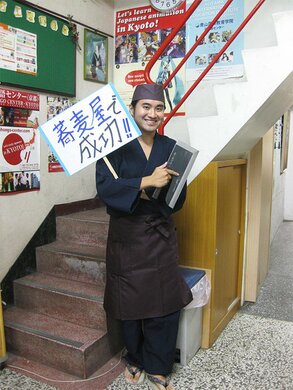
 Daidō Atsushi
Later Daidō returned to the world of books. While he was taking a postgraduate course at Meiji University, he chanced to visit Taiwan. “I was captivated by the sweltering, southern island atmosphere, and I knew this was the place for me.” He chose to live in Tainan because he felt it was just the right size and was near to the sea. “I’m thinking of opening a soba restaurant next year,” he told me.
He was born in the city of Chōfu in Tokyo, which is famous for its Jindaiji soba, named after a local temple. Thinking that it would be fun to popularize soba in Tainan as a form of cultural exchange, he immediately procured a kitchen knife, a wooden bowl, and other necessary tools in Japan, along with a samue uniform. “I like Japan, but I was also eager to immerse myself in a completely new culture,” he said. Daidō is a free spirit, and he feels perfectly at home in Tainan—a city that fully embraces his freedom.
History and Family Ties
 Kuroha Natsuhiko
“I wanted to learn about Taiwanese history, and that’s why I chose to come to Tainan, which is distinctly Taiwanese in character.” It may have been destiny that sparked Kuroha Natsuhiko’s interest in the country’s history and brought him to study in Tainan. His grandfather was born in Japan, but was assigned to a teaching post in Taiwan. His grandmother was born in Tamsui in northern Taiwan and later moved to Japan. She was one of the Wansei, Japanese people who were brought up and lived in Taiwan before 1945, when it was still a colony of Japan. Thus, Kuroha’s connection to Taiwan goes back to his grandparents’ generation.
He heard a lot about Taiwan from his grandmother before she passed away in 2014, and this made him eager to learn more. “You have to actually live in a place to understand its atmosphere,” he said. This was why he quit his job at a publishing company and came to study in Tainan.


 Read in other languages